
Kunpeng
鲲鹏
The colossal fish-bird that transforms and transcends all boundaries.
Origin Story
What Is Kunpeng?
Kunpeng is a creature from the Daoist text Zhuangzi, written by the philosopher Zhuang Zhou in the 4th century BCE. It is not a creature of flesh and blood but a philosophical metaphor given mythological form — and its scale defies imagination.
In the Northern Darkness, there lives a fish called Kun. Nobody knows how vast it is — some say it is thousands of li long. When it transforms, it becomes a bird called [Peng](/creatures/peng), whose back is so broad it blocks the sky. When Peng beats its wings, the winds rise and it soars ninety thousand li into the sky.
The Kunpeng — the largest creature in Chinese mythology, bridging sea and sky
Kunpeng is a being of impossible scale from Chinese mythology — a fish so vast it becomes a bird so vast it blots out the sky. Its story, told by the philosopher Zhuangzi, is a meditation on transformation, perspective, and transcending limits.
Powers & Symbols
Attributes & Artefacts
Click each card to reveal the details behind Kunpeng's divine attributes.
Historical & Cultural Meaning
Beyond the Myth
The Philosophy of Kunpeng
[Zhuangzi](/myths/zhuangzi) uses Kunpeng to make a profound philosophical point about perspective. A cicada and a young dove laugh at the giant bird, saying, 'We fly up into the air, but we never get very far. Why should this creature want to fly ninety thousand li?'
The small creatures cannot comprehend the vast because their experience is limited. Just as the cicada cannot understand the seasonal year (it dies before autumn), small minds cannot understand great ambition. This is [Zhuangzi](/myths/zhuangzi)'s central theme: what seems impossible or absurd from one perspective may be natural from another.
Kunpeng thus represents the Daoist ideal of transcending conventional limits — not through force, but through transformation. The fish doesn't fight to fly; it becomes a bird. The [change](/zodiac/change) is not struggle but nature.
Kunpeng in Chinese Culture
Kunpeng has become a powerful metaphor in Chinese culture for ambition and transformation. The phrase 'Kunpeng zhi zhi' (鲲鹏之志) means 'the ambition of Kunpeng' — describing someone with grand aspirations who refuses to be limited by conventional boundaries.
The creature's influence extends to modern naming: China's heavy-lift rocket, the Kuaizhou-21, and several Chinese tech companies reference [Kunpeng](/creatures/kunpeng), including Huawei's [Kun](/creatures/kun)peng processor line — all invoking the image of transcendent scale and transformation.
Sources & References
Primary classical texts: Shanhaijing (山海经, Classic of Mountains and Seas, c. 4th-2nd century BCE) · Fengshen Yanyi (封神演义, Investiture of the Gods, c. 16th century) · Journey to the West (西游记, Xiyouji, c. 16th century) · Records of the Grand Historian (史记, Shiji, by Sima Qian, c. 91 BCE) · Classic of Mountains and Seas commentary (郭璞注 Shanhaijing, c. 4th century) · Bamboo Annals (竹书纪年, c. 4th century BCE onwards)
Classical translations: Legge, James (trans.). The Sacred Books of the East (1879-1910, 50 volumes covering Chinese classics) · Girardot, Norman J. Myth and Meaning in Early Taoism (University of California Press, 1983) · Werner, E.T.C. A Dictionary of Chinese Mythology (Shanghai: Kelly & Walsh, 1932)
Modern academic references: Birrell, Anne. Chinese Mythology: An Introduction (Baltimore: Johns Hopkins University Press, 1993) · Yang, Lihui, and Deming An. Handbook of Chinese Mythology (New York: Oxford University Press, 2005) · Strassberg, Richard E. A Chinese Bestiary: Strange Creatures from the Guideways Through Mountains and Seas (Berkeley: University of California Press, 2002)
Digital encyclopedias and online resources: Wikipedia — Chinese mythology portal (continuously updated, citations to primary sources) · Encyclopedia Britannica — Mythology and Religion section
Mythology Network
Connections & Relationships
Kunpeng is woven into a larger web of gods, creatures, and legends. Explore the connections below.
Kunpeng
鲲鹏



📱 Wallpaper · $2.99
Take 鲲鹏 with you
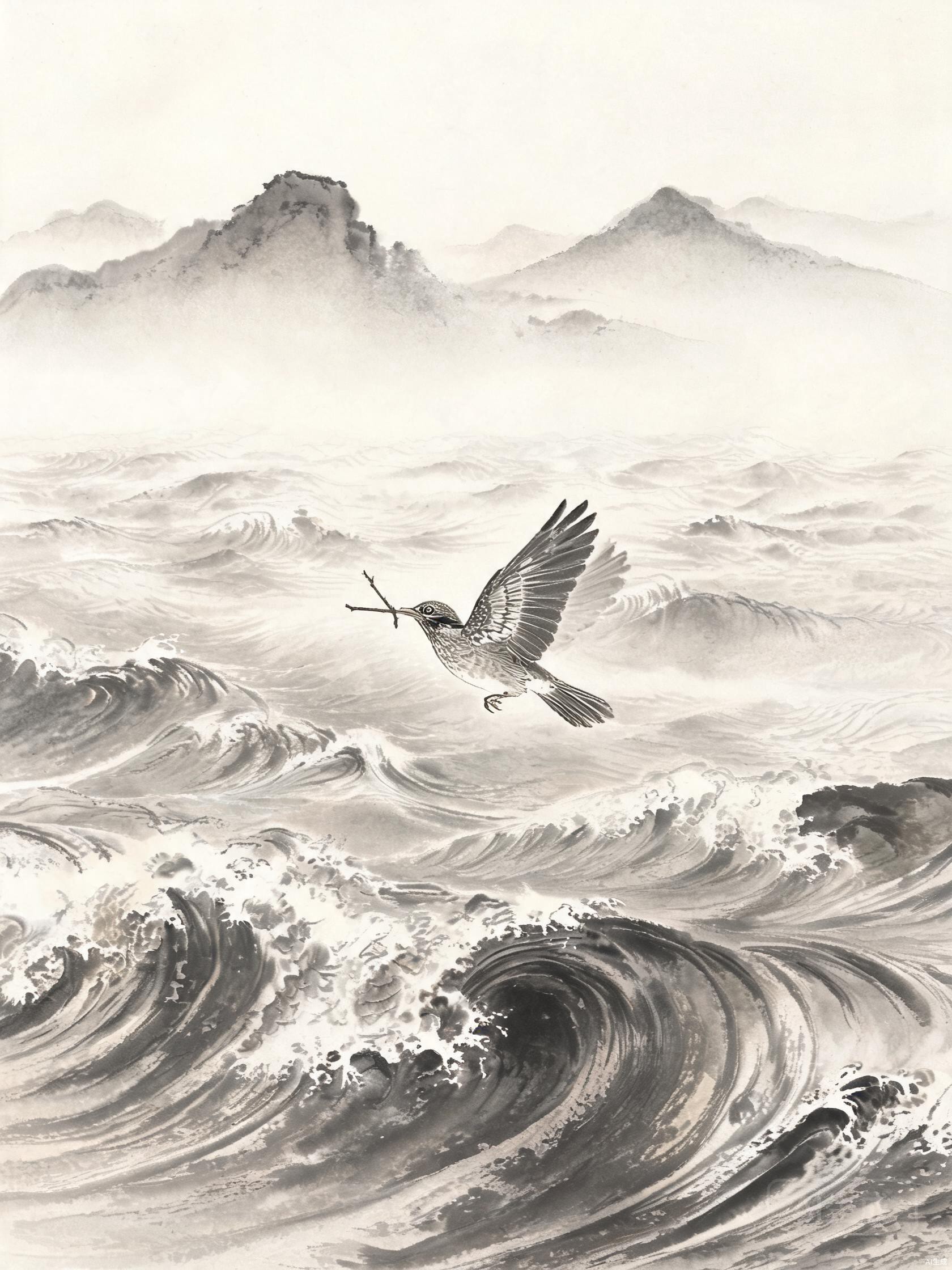
High-resolution phone wallpaper of Kunpeng the Giant Bird (鲲鹏) — iconography drawn from classical Chinese sources, painted in traditional style.
📜 Iconography sources
《庄子·逍遥游》 gives the Kunpeng its single, unsurpassable passage: '北冥有鱼,其名为鲲。鲲之大,不知其几千里也;化而为鸟,其名为鹏' — the fish Kun of the northern darkness, become the bird Peng whose wings are like clouds across the sky, rising ninety thousand li on the whirlwind. Every later image of the giant bird-fish descends from Zhuangzi's paragraph.
Buy & download
Explore the Topic
Kunpeng in the Mythology Network
Go deeper — read the topic guides that gather every creature like Kunpeng.