Topic · Mythological Text
The Shanhaijing (Classic of Mountains and Seas)
山海經 — China's Oldest Mythology Text
A 2,400-year-old atlas of gods, monsters, and strange lands — the Shanhaijing is the foundational text of Chinese mythology, describing more than 200 bizarre beings and a mythological geography that shaped Chinese cosmology for millennia.
Quick Facts
What Is the Shanhaijing?
The Shanhaijing (山海經), or 'Classic of Mountains and Seas,' is the oldest and most important source text of Chinese mythology. Compiled between the 4th and 1st centuries BCE from much older shamanic and oral traditions, it describes the geography, creatures, gods, and myths of ancient China in a style that blurs the line between the real and the fantastic.
The text reads like a mythological atlas. It catalogues mountains, rivers, seas, and wilderness regions — and for each location, it describes the creatures that live there, the minerals and plants that can be found, and the gods or spirits that reside there. Many entries also include practical information: what happens if you eat a particular creature, what disasters its appearance foretells, and what talismans or medicines can be made from its parts.
For most of its history, the Shanhaijing was treated as a geography or natural history text. Modern scholars recognize it as a rich mythological and ethnographic source that preserves beliefs from China's pre-imperial past — a window into a world before Taoism, Buddhism, or Confucianism standardized Chinese spiritual life.
The Shanhaijing is not a single narrative like the Iliad or the Epic of Gilgamesh. It has no protagonist, no unified plot, and no consistent theology. Instead, it is a stratified compilation of older traditions — some entries date to the Shang Dynasty, others to the Warring States period, others to the early Han. This patchwork character is exactly what makes it invaluable: it preserves fragments of a far more ancient worldview than any other Chinese text.
The Structure: 18 Chapters in Four Sections
The Shanhaijing consists of 18 chapters divided into four main sections. The first two sections (the 'Mountain' and 'Sea' sections) are more geographically grounded; the last two (the 'Great Wilderness' sections) are more mythological and cosmographic.
Understanding this structure is essential for reading the text. The Mountain Chapters (山經) describe the mountains of central China in systematic detail, organized by cardinal direction — South, Central, North, East, and West. Each mountain entry follows a rigid formula: location, distance from the previous mountain, notable minerals and plants, the creatures that live there, and the local deity.
The Sea and Great Wilderness Chapters (海經 and 大荒經) shift focus outward — beyond the borders of the known Chinese world, into increasingly fantastical regions. Here we encounter lands where everyone has one eye, where people fly without wings, where rivers of milk flow, and where cosmic beings like the Torch Dragon) and the Queen Mother of the West hold court.
This geographic progression — from the known to the unknown, from mountains to seas to cosmic wilderness — mirrors the ancient Chinese cosmological sense that the world was organized in concentric rings, with civilization at the center and wild, supernatural forces at the edges.
Sacred Geography: Mount Kunlun and the Cosmic Tree

Mount Kunlun — the cosmic axis and home of the Queen Mother of the West
The Shanhaijing's most enduring contribution to Chinese cosmology is its description of the sacred geography — the cosmic structure of the world. At the center of this geography stands Mount Kunlun (昆崙山), the cosmic axis.
Mount Kunlun is described in the Shanhaijing as a mountain of staggering proportions, located in the western reaches of the world. Its base is surrounded by a weak water (弱水) — a river so light that even a feather sinks into it. The mountain has nine gates guarded by fierce beasts called Kai Ming (開明獸), each with a human face and tiger's body. At its summit stands the palace of the Queen Mother of the West.
Another key feature of the cosmic geography is the Jianmu (建木) — a tree that grows at the world's center and connects heaven and earth. Gods and spirits climb the Jianmu to travel between realms. This image of the world-axis as a tree is found in many mythologies worldwide, from Yggdrasil in Norse myth to the world-tree of Mesoamerican civilizations.
The Four Pillars of the Sky (四極) — described in the Great Wilderness chapters — are the four corners of the earth that hold up the heavens. After Gong Gong's destruction of Mount Buzhou, Nuwa cut the legs of a giant cosmic turtle to restore these pillars. The Shanhaijing preserves both versions of this cosmic architecture.
Iconic Creatures of the Shanhaijing
The Shanhaijing describes more than 200 mythical creatures, many of which have no equivalent in any other mythology. These beings often combine body parts from multiple animals and possess bizarre abilities. Some are auspicious omens; others are omens of disaster.
What makes the Shanhaijing creatures distinctive is their hybrid nature — a single being might have a snake's body, a bird's wings, a tiger's paws, and a human face. This composite design was not whimsical: in ancient Chinese thought, mixing animal essences combined their powers. A tiger-snake hybrid would be both fierce and cunning.
Many Shanhaijing creatures are also omens. Their appearance foretells droughts, floods, war, or prosperity. The Hundun, for instance, is said to bring chaos wherever it appears. The Qingniao (青鳥), on the other hand, brings messages of peace and serves the Queen Mother of the West.
Below are some of the most famous creatures preserved in the text. Each has inspired art, literature, and ritual for over two millennia.
Cosmic Beings and Gods of the Wilderness
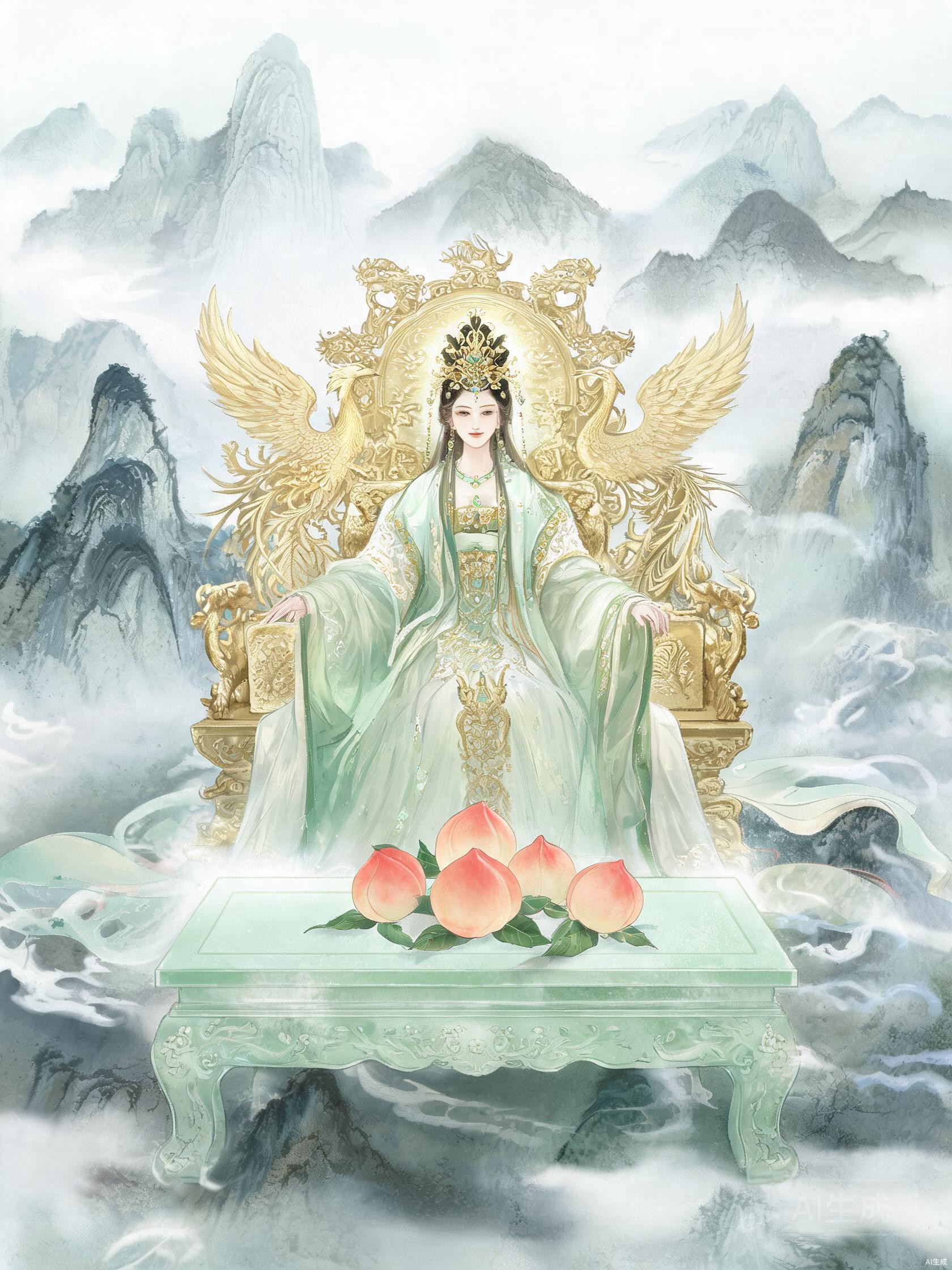
Xi Wangmu — depicted in her fearsome original form, very different from her later, more refined Taoist image
Beyond its catalog of creatures, the Shanhaijing preserves some of the oldest descriptions of Chinese gods. Several deities appear here in forms dramatically different from their later, more familiar versions.
Xi Wangmu (西王母) — the Queen Mother of the West — appears in the Shanhaijing as a fearsome creature with tiger's teeth, a leopard's tail, and a headdress, dwelling in a cave atop Mount Kunlun. She rules over pestilence and the spirits of the dead. This is very different from the elegant, immortal goddess she later became in Taoist tradition — a transformation that took roughly a thousand years.
The Torch Dragon) (燭龍, Zhulong) is one of the most cosmic beings in the text — a giant with a human face and a serpent's body, whose open eyes create day, closed eyes create night, and breath creates the wind. He lives far to the north, illuminating the darkness with his gaze. This is one of the oldest dragon-deities in Chinese mythology, predating the imperial dragon of later ages.
Other important deities include the Four Directional Guardians (the Azure [Dragon)](/creatures/azure-dragon) of the East, Vermilion Bird of the South, White [Tiger](/creatures/white-tiger) of the West, and Black Tortoise of the North) — the foundation of feng shui and the Four Symbols — and various lesser mountain and river gods.
Strange Peoples and Foreign Lands
One of the most fascinating sections of the Shanhaijing describes strange peoples and foreign lands — perhaps real ethnic groups, perhaps pure imagination, perhaps a mixture of both.
In these descriptions, we encounter peoples with one eye in the middle of their face, peoples with three heads, peoples with wings, peoples with bodies covered in hair, peoples whose feet face backwards, and peoples who walk on their hands. Some are peaceful; some are monstrous. Each lives in a precisely located region beyond the borders of known China.
Modern scholars debate what these accounts represent. Some are likely ethnographic observations of non-Chinese peoples, embellished and misunderstood through Chinese cultural lenses. Others may reflect real physical differences — facial features, body modifications, or clothing — interpreted as monstrous by Chinese observers. Still others appear to be pure mythological invention.
Whatever their origin, these passages have had enormous cultural influence. They inspired the 'wonder tales' (zhi guai) of later Chinese literature, and they shaped Chinese conceptions of the wider world for centuries. Many similar motifs — dog-headed people, one-eyed giants — appear in Greek, Indian, and Persian mythology, suggesting either shared cognitive archetypes or genuine ancient cultural exchange along trade routes.
The Four Perils (四凶)
The Shanhaijing also describes the Four Perils — four destructive beings whose nature is to oppose civilization, order, and the moral cosmos. Together, they represent the forces of chaos that humanity must continually resist.
The Four Perils are: Hundun (混沌, Chaos) — the faceless primordial mass; Taowu (檮杌, Stubbornness) — the wild, untamable beast; Qiongqi (窮奇, Injustice) — the winged tiger that rewards evil; and Taotie (饕餮, Gluttony) — the faceless devourer. Each represents a different kind of destructive force: chaos vs. order, rebellion vs. authority, injustice vs. fairness, excess vs. restraint.
In some traditions, the Four Perils are associated with the four failed emperors of antiquity — failed rulers who embodied chaos and were overthrown. The lesson is political: a ruler who becomes chaotic, unjust, or tyrannical forfeits the Mandate of Heaven.
Beyond their political symbolism, the Four Perils represent the perpetual challenge of civilization. Even today, the imagery of these four monsters is used to describe moral failures: chaotic policy, stubbornness, injustice, and greed.
Origin Mythology Preserved in the Shanhaijing
Although the Shanhaijing is not primarily a narrative text, it preserves fragments of several origin stories. These include some of the oldest versions of myths that later became central to Chinese culture.
The Pangu Creation Myth appears in the Great Wilderness chapters in a much older form than the version made famous by Xu Zheng's later commentary. Pangu is described as a cosmic being whose body becomes the world after his death — the very framework that supports all later Chinese mythology.
The Sun Myth is also preserved in striking form. In the eastern wilderness, there grows a tree called Fusang (扶桑) — a giant mulberry tree with ten suns resting in its branches in the form of birds. Each day, one sun rises and travels across the sky; ten suns, taking turns, make up the ten days of the ancient Chinese week.
Other origin myths include the first humans being born from a cloth after heaven and earth separated (one version of the Nuwa creation story), the cosmic turtle whose legs hold up the sky, and various birth-from-egg myths that predate later, more elaborate creation stories.
Influence on Chinese Cosmology and Ritual
The Shanhaijing's most enduring contribution is not its catalog of creatures but its framework of the cosmos. The text established the basic structure of Chinese geography — central civilization, surrounded by sacred mountains, surrounded by seas, surrounded by wilderness — that lasted for over two thousand years.
The Four Symbols (四象) — the Azure [Dragon)](/creatures/azure-dragon) of the East, Vermilion Bird of the South, White [Tiger](/creatures/white-tiger) of the West, and Black Tortoise of the North — originate in the Shanhaijing's cosmological sections. These four directional guardians became foundational to feng shui, Chinese astrology, traditional medicine, and martial arts. They still appear in modern life, from New Year door decorations to interior design consultations.
The Five Sacred Peaks (五嶽) — Mount Tai in the east, Mount Hua in the west, Mount Heng in the south, Mount Heng in the north, and Mount Song in the center — were identified by the Shanhaijing's systematic mountain descriptions. They remained central to Chinese imperial religion and folk practice for over two millennia, with emperors performing state sacrifices at Mount Tai until the early 20th century.
The text also preserved the conceptual vocabulary for understanding supernatural space. Terms like jing (精, essence), qi (氣, breath), and shen (神, spirit) entered Chinese metaphysics through texts like the Shanhaijing and became foundational to Taoist alchemy, traditional medicine, and martial arts.
Influence on Art, Literature, and Modern Media
For most of its history, the Shanhaijing was read by a small scholarly elite. But in the 21st century, it has experienced a popular revival that has no precedent in Chinese cultural history.
The 2016 illustrated book 'Guan Shan Hai' (Viewing Mountains and Seas) by artist Shan Ze sold over a million copies and reintroduced the Shanhaijing to a mass Chinese audience. Beautiful illustrated editions, illustrated bestiaries, and Shanhaijing-themed merchandise now fill Chinese bookstores. The text has become a source of cultural pride — proof that China's mythology is as rich as Greek or Norse mythology.
In video games, the Shanhaijing has become a major source of inspiration. 'Black Myth: Wukong' (2024) draws heavily on the text for its monster designs and locations. 'Genshin Impact' features several creatures directly inspired by Shanhaijing descriptions — including the Qiongqi-like Hiliichurls and the deer-dragon-inspired Azhdaha. 'Monster Hunter,' 'Pokémon,' and other international franchises have borrowed elements from the text.
In film and animation, Shanhaijing creatures appear regularly. The 2016 animated film '大鱼海棠' (Big Fish & Begonia) draws directly on the text. Shanhaijing bestiaries — picture books cataloging the creatures with both classical and modern illustrations — are now common gifts and educational materials.
Reading the Shanhaijing Today

The Taotie — a creature from the Shanhaijing still found on ancient bronze vessels today
Several English translations of the Shanhaijing are now available. The two standard scholarly translations are Anne Birrell's 'The Classic of Mountains and Seas' (Penguin, 1999) and Richard Strassberg's 'A Chinese Bestiary: Strange Creatures from the Guideways through Mountains and Seas' (2002).
Birrell's translation aims at completeness and accuracy — every entry is rendered, with detailed notes on textual variants and scholarly interpretations. Strassberg's selection is more literary, choosing the most evocative passages and pairing them with historic illustrations.
For Chinese readers, the standard annotated edition is Yuan Ke's 山海經校注, which provides extensive commentary and identifies which entries are likely to have historical, ethnographic, or mythological origins. Yuan Ke also wrote several popular books explaining the Shanhaijing to general audiences, which have become bestsellers in China.
When reading the Shanhaijing, remember that it was not written as entertainment. It was a practical guide — telling travelers what to expect, what to fear, and what to seek. The mythological and the geographical were inseparable in the ancient Chinese worldview.
Approached with this understanding, the Shanhaijing becomes not just a catalog of monsters but a map of how ancient Chinese people understood their world — a world where every mountain had a guardian, every river held a spirit, and the boundary between the natural and the supernatural was thin indeed. It is a world we have lost, but one we can still glimpse through the pages of this extraordinary text.