Bixi
赑屃
The dragon-turtle son who carries the weight of history on his back.
Origin Story
What Is Bixi?
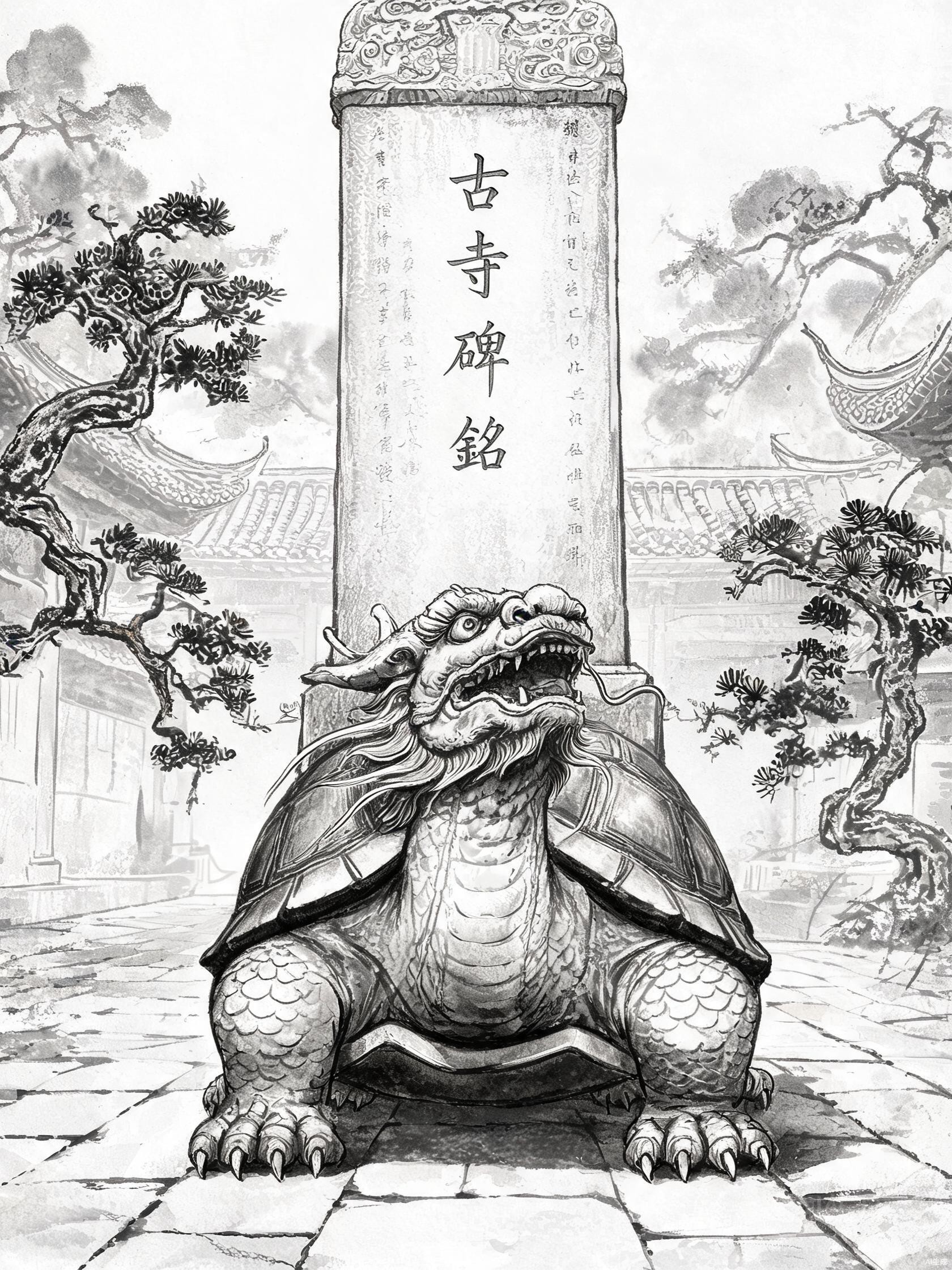
Bixi is the sixth son of the Dragon, and he has the head of a dragon and the body of a great turtle. He is immensely strong and, uniquely among the dragon sons, he loves to carry heavy things. Where his brothers pursue music, battle, or heights, Bixi finds purpose in bearing immense weight — and he never sets it down.
According to legend, Bixi is also known as Baxia (霸下), and in some versions of the myth he helped [Yu the Great](/myths/yu-tames-flood) (大禹) control the great floods by moving mountains and shifting earth with his prodigious strength. After the floods were tamed, his image was set beneath stone steles as a permanent testament to his endurance.
Bixi — the dragon-headed turtle who carries the weight of history on his back
Bixi is the sixth of the Dragon's Nine Sons, a dragon-headed turtle renowned for his immense strength and love of heavy burdens. He bears carved stone steles on his back across China, carrying the records of emperors, scholars, and temples for centuries without rest.
Powers & Symbols
Attributes & Artefacts
Click each card to reveal the details behind Bixi's divine attributes.
Historical & Cultural Meaning
Beyond the Myth
Bixi in Architecture and Art
Bixi is one of the most recognizable figures in Chinese public art. He appears as the base (碑座) of countless stone steles across China — at imperial tombs, temple courtyards, government offices, and memorial sites. His dragon head rises from a massive turtle shell, his four thick legs planted firmly as he supports the carved stone above.
These steles record everything from imperial decrees to commemorations of great scholars, and Bixi's role is to ensure they endure. By placing the record on the back of a creature legendary for longevity and strength, the Chinese expressed their hope that the words would last as long as the creature that carried them.
Symbolism and Cultural Meaning
Bixi symbolizes endurance, longevity, and the preservation of memory. The turtle is already a symbol of long life in Chinese culture; combined with the dragon's head and the dragon son's divine nature, Bixi becomes the ultimate emblem of permanence — a creature that outlasts dynasties and carries history itself.
He also represents willing service and the dignity of labor. Unlike his brothers, who pursue their own pleasures, Bixi devotes his immense strength to bearing the records of others. In this way he embodies the Confucian virtue of dedication to a greater purpose, carrying the weight of civilization without complaint.
The Nine Sons of the Dragon
[Bi](/gods/bi-deng)xi is the sixth of the Nine Sons of the [Dragon](/zodiac/zodiac-dragon) (龙生九子), the legendary sons of the [Chinese dragon](/creatures/chinese-dragon), each defined by a unique form and passion. The proverb 'the dragon has nine sons, and each is different' (龙生九子,各有不同) became an idiom for the diversity found within a single family.
Among the nine, [Bixi](/creatures/bixi) is the bearer — the son whose strength is devoted not to war or display but to the patient support of memory. Ming dynasty sources record his turtle form and his love of heavy loads, and his image remains one of the most commonly encountered dragon sons in China today.
Sources & References
Primary classical texts: Shanhaijing (山海经, Classic of Mountains and Seas, c. 4th-2nd century BCE) · Fengshen Yanyi (封神演义, Investiture of the Gods, c. 16th century) · Journey to the West (西游记, Xiyouji, c. 16th century) · Records of the Grand Historian (史记, Shiji, by Sima Qian, c. 91 BCE) · Classic of Mountains and Seas commentary (郭璞注 Shanhaijing, c. 4th century) · Bamboo Annals (竹书纪年, c. 4th century BCE onwards)
Classical translations: Legge, James (trans.). The Sacred Books of the East (1879-1910, 50 volumes covering Chinese classics) · Girardot, Norman J. Myth and Meaning in Early Taoism (University of California Press, 1983) · Werner, E.T.C. A Dictionary of Chinese Mythology (Shanghai: Kelly & Walsh, 1932)
Modern academic references: Birrell, Anne. Chinese Mythology: An Introduction (Baltimore: Johns Hopkins University Press, 1993) · Yang, Lihui, and Deming An. Handbook of Chinese Mythology (New York: Oxford University Press, 2005) · Strassberg, Richard E. A Chinese Bestiary: Strange Creatures from the Guideways Through Mountains and Seas (Berkeley: University of California Press, 2002)
Digital encyclopedias and online resources: Wikipedia — Chinese mythology portal (continuously updated, citations to primary sources) · Encyclopedia Britannica — Mythology and Religion section
Mythology Network
Connections & Relationships
Bixi is woven into a larger web of gods, creatures, and legends. Explore the connections below.
Bixi
赑屃


Explore the Topic
Bixi in the Mythology Network
Go deeper — read the topic guides that gather every creature like Bixi.