Topic · Classical Novel
The Investiture of the Gods (Fengshen Yanyi)
封神演義 — The Investiture of the Gods
One of the four great classical novels of Chinese literature — a cosmic war between the decadent Shang Dynasty and the virtuous Zhou, featuring 365 celestial offices, the Twelve Golden Immortals, and the most famous demons in Chinese myth.
Quick Facts
What Is the Investiture of the Gods?
The Investiture of the Gods (封神演義, Fēng Shén Yǎn Yì) is one of the four great classical novels of Chinese literature, along with Romance of the Three Kingdoms, Journey to the West, and Water Margin. Written by Xu Zhonglin in the late Ming Dynasty (c. 1590s), it narrates the cosmic transition from the Shang Dynasty to the Zhou Dynasty — a war that is at once historical, mythological, and theological.
The novel combines elements from three traditions: it preserves fragments of pre-ancient Chinese mythology (especially from the Shang Dynasty), integrates the philosophical framework of Taoism (particularly the Three Pure Ones and the Twelve Golden Immortals), and incorporates Buddhist figures (notably the Buddha himself) as participants in the cosmic drama. It is the foundational text for virtually all depictions of Chinese mythological figures in modern culture.
The plot is deceptively simple: the decadent last king of Shang (King Zhou) is corrupted by a fox spirit (Daji) and descends into monstrous depravity. Heaven decides that the Shang Mandate has been forfeited and dispatches Jiang Ziya — an old fisherman with a straight hook — to assist the virtuous Zhou cause. A cosmic war ensues, featuring hundreds of gods, demons, and immortals. The novel ends with the founding of the Zhou Dynasty and the appointment of 365 celestial officers — each given an office in the cosmic bureaucracy.
Beneath this simplicity lies a profound theological meditation. The Investiture of the Gods asks: what is the relationship between divine authority and human virtue? When does heaven withdraw its mandate? How does cosmic order operate when gods and demons are at war? The novel gives no easy answers, but its battles, characters, and cosmic framework have shaped Chinese imagination for over four hundred years.
The Three Sects of Taoism
At the heart of the Investiture of the Gods is a theological conflict between three branches of Taoism. These are not ordinary human institutions — they are cosmic lineages, each tracing its origin to a different primordial Taoist principle.
The Chan Sect (闡教) is the orthodox Taoist lineage, led by Yuanshi Tianzun (元始天尊, the Heavenly Lord of Primordial Beginning) — the first of the Three Pure Ones. The Chan Sect is headquartered at Kunlun Mountain and includes the Twelve Golden Immortals (十二金仙), immortal masters such as Guang Cheng Zi, Chi Jing Zi, and Yu Ding. Jiang Ziya and the chief Zhou generals are disciples of this sect.
The Jie Sect (截教, to intercept) is the more permissive rival lineage, led by Tongtian Jiaozhu (通天教主, Grand Master Who Connects Heaven). His disciples include many demonic figures: the Three Demon Brothers of Mount Mei, the fox spirit family of Daji, and the Three Maidens of Mount Peng. The Jie Sect believes in the cosmic value of all beings — humans, demons, and animals alike.
The third lineage is the Chan-Wei Sect (闡微教), implicitly represented by Laozi (太老君, the second of the Three Pure Ones). Laozi plays a crucial cosmic role, helping to break the Immortal-Slaying Sword Formation. Buddhism is also represented through the Buddha, who joins forces with the Chan Sect in the final cosmic confrontation.
The Decadence of the Shang Dynasty
The novel begins with the rise of King Zhou — the last ruler of the Shang Dynasty — who begins his reign as a wise and virtuous king but is gradually corrupted by Daji, the nine-tailed fox spirit who becomes his consort. Daji's malice drives King Zhou to commit monstrous acts: building the Lake of Wine and Forest of Flesh (酒池肉林), torturing loyal ministers, persecuting innocents, and desecrating the temples of heaven.
These atrocities are not merely moral failings — they are cosmic disruptions. The novel repeatedly notes that as King Zhou's virtue wanes, natural disasters strike the land: droughts, famines, monster sightings, and strange celestial phenomena. Heaven responds by withdrawing its Mandate from the Shang and commissioning a new dynasty.
Several loyal ministers of Shang try to save the dynasty by appealing to King Zhou's conscience. Most famous among them is Su Hu, the Grand Tutor, who repeatedly remonstrates with the king. All are rewarded with execution. Wen Zhong, the chief loyalist general, fights on the king's side out of pure devotion until the dynasty's final defeat.
The decadence of the Shang is the moral foundation of the entire novel. Without Daji's corruption, there would be no war, no cosmic transition, no investiture of new celestial officers. The novel thus links cosmic history to moral failure — a hallmark of traditional Chinese political philosophy.
Jiang Ziya and the Founding of Zhou
While the Shang descends into decadence, the novel turns to its hero: Jiang Ziya, an old man who has spent decades on Kunlun Mountain studying under Yuanshi Tianzun. At the age of seventy-two, he is given his cosmic mission: to descend to the world and assist the virtuous Zhou house in overthrowing the Shang.
Jiang Ziya's first appearance is famously strange. He goes to the Wei River to fish — but uses a straight hook three feet above the water. When onlookers mock him, he replies: 'The hook catches not fish but kings — those who are destined to be kings.' This bizarre behavior attracts the attention of Ji Zi Ya (later Ji Fa, King Wen of Zhou), who recognizes Jiang Ziya as a sage and recruits him as the chief strategist of the Zhou cause.
Over the next decade, Jiang Ziya recruits, trains, and deploys a remarkable army: Nezha, Yang Jian, Lei Zhenzi, Huang Fei Hu, Wu Ji, and many other legendary figures. He fights not only against the Shang armies but against the demonic disciples of Tongtian Jiaozhu — using his signature weapons, the Wuji Demeanor Flag and the Demon-Slaying Immortal Whip.
The novel's climax is the Battle of Muye (牧野之戰), in which King Wu of Zhou (son of King Wen) leads a coalition army against the Shang forces. With divine support and strategic brilliance, the Shang armies collapse, and King Zhou retreats to the Deer Terrace Pavilion (鹿臺), which he sets aflame. He dies in the flames, ending the Shang Dynasty forever.
The Twelve Golden Immortals and Their Disciples
The Twelve Golden Immortals (十二金仙) are the chief disciples of Yuanshi Tianzun at Kunlun Mountain. Each is an immortal master who has disciples of their own, many of whom become the chief generals of the Zhou army. The Twelve represent different aspects of cosmic cultivation, and their varied disciples reflect the diversity of Taoist paths.
Key immortals include Yu Ding (玉鼎真人) at Jinlian Island, master of Yang Jian; Guang Cheng Zi (廣成子), master of the Yellow Emperor; Chi Jing Zi (赤精子), master of Yin Hong; and many others. Each is named and characterised in the novel, with their own dwelling place, magical abilities, and distinctive teaching style.
The Twelve Immortals are at the heart of the cosmic conflict. They train the Zhou warriors, intervene in critical battles, and ultimately help to break Tongtian Jiaozhu's Immortal-Slaying Sword Formation. After the novel's conclusion, they receive celestial appointments and continue their cosmic work as part of the new cosmic order.
Their disciples — Yang Jian, Lei Zhenzi, Nezha, Huang Fei Hu, Yin Jiao, Yin Hong, and others — represent some of the most beloved figures in Chinese mythology. Many of these figures were originally historical people later incorporated into the mythological framework of the novel.
The Jie Sect and Tongtian Jiaozhu's Defiance
The Jie Sect (截教), founded by Tongtian Jiaozhu, is the novel's principal antagonist among divine beings. Unlike the Chan Sect, which believes in selective cultivation and the moral worthiness of beings, the Jie Sect believes in universal cultivation — that any being, no matter how demonic, can achieve immortality through cultivation.
Tongtian Jiaozhu's disciples include the Three Demon Brothers of Mount Mei (Bi Deng, Wu Fang, Yu Ying), the fox spirit family (Jiu Yao Suan, Daji, Hu Ji Mei), the Three Maidens of Mount Peng (Yun Xiao, Qiong Xiao, Bi Xiao), and many other demonic figures. These are not merely villains — many are portrayed sympathetically as beings caught up in cosmic politics beyond their control.
The novel's most spectacular cosmic confrontation occurs when Tongtian Jiaozhu deploys the Immortal-Slaying Sword Formation (誅仙劍陣) — an array of four cosmic swords that can kill any immortal caught within it. The combined forces of the Chan Sect, Laozi, and the Buddha are required to break this formation. Tongtian Jiaozhu is finally defeated and exiled by the Buddha — but the novel makes clear that his defeat was as much due to his pride and refusal to submit to cosmic harmony as to military inferiority.
The Tongtian Jiaozhu character represents a fundamental Taoist theme: the danger of cosmic pride. He believes his cultivation is so powerful that he can defy the Mandate of Heaven itself. The novel teaches that even the most powerful immortals are subject to cosmic order — and that defiance, however majestic, ultimately fails.
The Investiture of 365 Celestial Officers
The novel's climax — and the source of its title — is the Investiture (封神, fēng shén), the grand ceremony in which Yuanshi Tianzun and Jiang Ziya appoint 365 celestial officers (神位). Each fallen hero, warrior, or significant figure of the war receives a specific office in the cosmic bureaucracy.
These offices range from the highest positions in the celestial hierarchy — such as the Jade Emperor's chief ministers — down to the lowest positions in the underworld bureaucracy. Together, they form the working cosmic order: the gods who govern the world after the Shang-Zhou transition.
Many of the 365 offices are real positions in later Chinese folk belief. For example, the position of Caishen (God of Wealth) is given to Bi Gan, a loyal Shang minister who was tortured to death by King Zhou. The position of City God is given to various loyalists who died defending their cities. The names and offices became a kind of cosmic registry that Chinese folk belief draws upon to this day.
The Investiture is the novel's most important theological statement. It asserts that cosmic order requires constant maintenance. Wars are fought, heroes die, and the survivors must rebuild the cosmos from the ruins. The 365 offices are not merely titles — they are functions, each necessary for the operation of the universe. This vision of cosmic bureaucracy has shaped Chinese religious belief for over four centuries.
The Lotus Lantern Subplot
Embedded within the larger Shang-Zhou narrative is one of China's most beloved stories: the tale of the Lotus Lantern (寶蓮燈). The lotus subplot tells the story of Sansheng Mu (三聖母, Third Holy Mother), the sister of Erlang Shen, who bears a son (Chen Xiang) by a mortal scholar Liu Shan Chang.
When her brother Erlang Shen discovers this transgression — a goddess marrying a mortal — he imprisons Sansheng Mu beneath Mount Hua. Chen Xiang grows up, trains as a warrior under his uncle (Erlang Shen, without knowing their relationship), and ultimately uses the divine Lotus Lantern — an artifact that can split mountains — to rescue his mother.
This subplot, sometimes called The Splitting of Mount Hua (劈山救母), is one of the most famous Chinese family legends. It explores themes of filial piety, divine punishment, and the tension between cosmic rules and human love. The Lotus Lantern has inspired countless operas, films, and television dramas.
The lotus subplot is also significant because it brings Chen Xiang into the cosmic order as a powerful warrior. His story parallels those of other filial heroes like Yu Gong (who moved mountains through perseverance). Together, these stories establish that even the cosmic hierarchy can be challenged — and that divine bureaucracy is not immune to moral pressure.
Themes and Theological Significance
The Investiture of the Gods explores several profound themes that have shaped Chinese thought for centuries. The first is the relationship between the Mandate of Heaven and human virtue. The novel shows that heaven withdraws its mandate when rulers become decadent — a foundational Chinese political concept articulated by the Zhou dynasty philosophers themselves.
The second theme is the role of Taoist cultivation in cosmic affairs. The novel suggests that the universe is structured around cultivation lineages, each tracing back to a primordial Taoist principle. The Three Pure Ones (Yuanshi Tianzun, Lingbao Tianzun, Daode Tianzun) are the source of all cosmic authority. Cultivation lineages are the channels through which cosmic order is maintained.
The third theme is the relationship between human and cosmic time. The novel takes place over many decades — Jiang Ziya waits seventy-two years before his destiny activates, the war lasts several years, and the cosmic bureaucracy takes generations to stabilize. The pace is deliberately slow, suggesting that cosmic history moves on a much grander scale than human affairs.
The fourth theme is the redemptive potential of even the most demonic figures. Many of the Jie Sect disciples — the Three Demon Brothers, the fox spirits, the Three Maidens of Mount Peng — are not portrayed as evil by nature but as beings who made wrong choices. The novel ends with many of them receiving celestial offices as well, suggesting that even cosmic errors can be redeemed through proper recognition of cosmic order.
Cultural Impact and Modern Adaptations
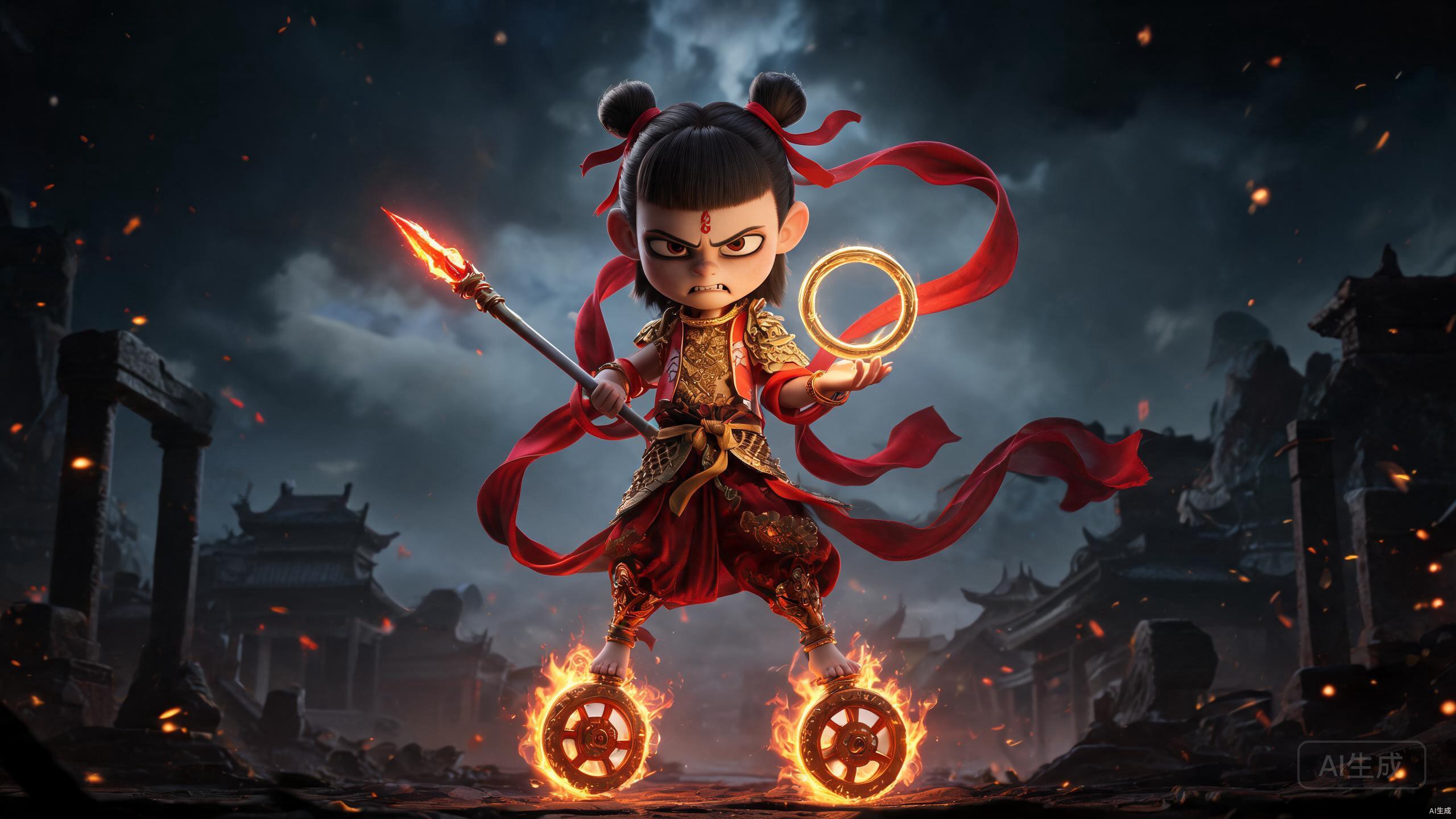
Nezha — born in the Investiture of the Gods, now a cultural icon across East Asia
The Investiture of the Gods is the source text for countless modern Chinese cultural productions. The novel has been adapted into over 100 films, including the 2016 monster film series and numerous animated features. The 2019 Chinese animated film Nezha (哪吒之魔童降世, Nezha: Birth of the Demon Child) became one of China's highest-grossing films, reimagining the novel's hero for contemporary audiences.
In video games, the novel's characters, weapons, and cosmology have become standard. Black Myth: Wukong draws on the Investiture's cosmic structure for some of its boss designs. Honor of Kings, Identity V, and similar MOBAs/asymmetric games feature many characters directly from the novel. Mobile RPGs and strategy games draw heavily on the 365 celestial offices for character rosters.
In contemporary Chinese culture, the Investiture of the Gods is a fixture of everyday reference. Phrases like the Lake of Wine and Forest of Flesh are used to describe decadence. Jiang Ziya's straight hook is invoked to describe patient waiting for the right moment. The novel has become a cultural vocabulary — a shared framework that allows Chinese speakers to make sophisticated allusions in everyday conversation.
In the wider world, the novel is less known than Journey to the West, but it is increasingly being translated and appreciated. The Chinese state has supported major film adaptations of the novel, recognizing its cultural importance. The novel's vision of cosmic bureaucracy — its 365 divine offices — has become a model for how Chinese people imagine the relationship between heaven, earth, and the underworld.
Reading the Investiture of the Gods Today
Several English translations of the Investiture of the Gods are now available. The standard scholarly translation is Gu Zhichuan's 2012 version. Modern retellings and anthologies — including W.J.F. Jenner's 'Journey to the West' and various anthologies of Chinese mythology — include substantial excerpts from the novel.
For Chinese readers, the standard annotated edition is Xu Zhonglin's original Ming Dynasty text, supplemented by modern commentary. Many editions with explanatory notes are available, and the novel is widely taught in Chinese literature courses.
When reading the Investiture of the Gods, it helps to keep in mind that it is not a single-author novel in the modern Western sense. The text accumulated over centuries, with Xu Zhonglin's contribution being primarily a compilation and shaping of older materials. The result is a text that combines historical narrative, mythological fragments, Taoist theology, and folk legend into a single grand story.
Above all, the Investiture of the Gods is a story about cosmic transition. It tells how the world we live in came to be — why there are gods at all, why they have specific offices, and why cosmic order takes the form it does. In this sense, the novel is not merely entertainment but a fundamental cosmological text — one of the great foundational stories that help Chinese people understand what the universe is and how it works.