Topic
The Eight Immortals (Ba Xian)
八仙 — The Eight Taoist Immortals
The most beloved figures in Chinese folk religion — eight legendary beings who achieved immortality through Taoist cultivation and continue to inspire art, literature, and popular culture across East Asia.
Quick Facts
Who Are the Eight Immortals?
The Eight Immortals (Ba Xian, 八仙) are a group of legendary Taoist figures who achieved immortality through spiritual cultivation, alchemy, or divine favor. They are among the most widely depicted characters in Chinese art, literature, and folk religion — appearing in paintings, sculptures, operas, and modern media.
Unlike the remote gods of the celestial bureaucracy, the Eight Immortals are approachable and human. They include men and women, old and young, rich and poor, scholar and beggar. This inclusivity is central to their appeal — they represent the Taoist belief that anyone, regardless of their station in life, can achieve transcendence.
The group as we know it today crystallized during the Ming Dynasty (1368-1644), though individual immortals have older origins. Their most famous adventure, 'The Eight Immortals Cross the Sea' (八仙过海), tells how each used their unique power to cross the ocean without a boat — giving rise to the Chinese idiom 'like the Eight Immortals crossing the sea, each shows their special prowess.'
Li Tieguai (Iron Crutch Li)
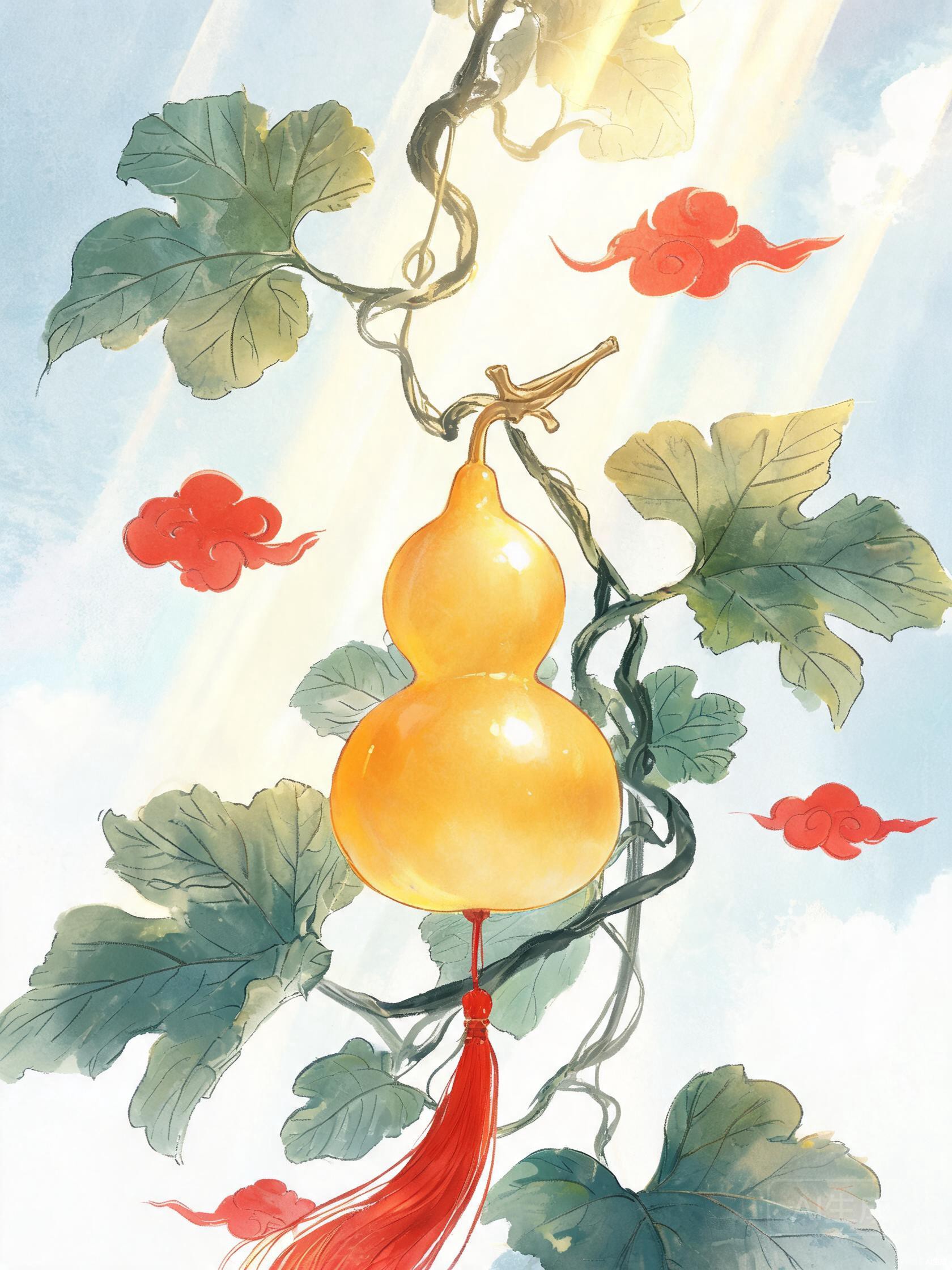
Li Tieguai — the eldest immortal, recognizable by his iron crutch and medicine gourd
Li Tieguai (李鐵拐) is the eldest and most recognizable of the Eight Immortals. He appears as a beggar with an iron crutch, a gourd of medicine, and a wizened, crippled body — but his spirit is powerful and his wisdom is vast.
His origin story is one of the most dramatic in Chinese mythology. Originally a handsome scholar named Li Xuan, he practiced meditation so advanced that his spirit could leave his body. Once, while his spirit was visiting Laozi in heaven, his disciple mistakenly cremated his body, thinking he was dead. When Li's spirit returned, he had no body to inhabit — so he entered the corpse of a crippled beggar he found by the roadside.
Li Tieguai is the patron of pharmacists and the sick. His iron gourd contains miraculous medicine that can cure any ailment. He represents the Taoist principle that appearances are deceiving — the most powerful sage may hide in the humblest form.
Zhongli Quan (Han Zhongli)
Zhongli Quan (鐘離權), also known as Han Zhongli, is a powerful general who became an immortal after meeting a Taoist sage who taught him the secrets of alchemy and immortality. He is depicted as a large, bearded man with a bare belly, holding a feather fan.
According to legend, Zhongli Quan was a Han Dynasty general who, after losing a battle, wandered into the mountains and encountered the sage Donghua Dijun, who taught him the secrets of the golden elixir. He then renounced his military career and devoted himself to Taoist cultivation.
Zhongli Quan is credited as the master of Lu Dongbin, another of the Eight Immortals, making him an important link in the Taoist transmission lineage. His feather fan has the power to bring the dead back to life and to transform stones into gold.
Lu Dongbin (Lu Yan)
Lu Dongbin (呂洞賓) is the most famous and complex of the Eight Immortals. A scholar, poet, and swordsman, he is the patron of scholars and barbers. He carries a flywhisk and a demon-slaying sword called Chunyang.
Born during the Tang Dynasty, Lu Dongbin failed the imperial examinations twice — a devastating blow for a scholar. He then encountered Zhongli Quan, who taught him Taoist alchemy. Lu Dongbin achieved immortality and devoted himself to helping people, slaying demons, and testing human virtue.
Lu Dongbin is famous for his flaw: he is susceptible to romantic temptation. Numerous folk tales tell of him being tempted by beautiful women, including the story of 'Three Dreams of Mudan,' in which he falls in love with a courtesan. This very human weakness makes him the most relatable of the immortals.
His sword, Chunyang, can slice through illusion and evil. He uses it not for warfare but to cut through deception and protect the innocent. He is the most widely worshipped of the Eight, with temples dedicated to him across China.
Zhang Guolao
Zhang Guolao (張果老) is the oldest-looking of the Eight Immortals, depicted as a white-bearded old man riding a white mule backwards. He carries a bamboo drum with iron sticks, which he uses to accompany his singing.
According to legend, Zhang Guolao was already ancient when he was discovered by the Tang Emperor Xuanzong. When the emperor tried to test his powers, Zhang performed miraculous feats — including restoring himself to life after being boiled in a cauldron.
His white mule has magical properties: it can travel thousands of li in a day, and when not needed, Zhang folds it up like paper and stores it in his pocket. The reason he rides backwards is often interpreted as a Taoist metaphor — he is not focused on where he is going, but on where he has been.
Zhang Guolao is the patron of elderly people and is associated with longevity. His image is often displayed in homes to wish for long life.
He Xiangu (Immortal Woman He)

He Xiangu — the only female immortal, bearing a lotus flower
He Xiangu (何仙姑) is the only unambiguously female member of the Eight Immortals. She is depicted as a beautiful young woman holding a lotus flower, symbolizing purity and spiritual perfection.
According to legend, He Xiangu was a Tang Dynasty girl who, while gathering herbs, encountered an immortal who gave her a magic peach. After eating it, she no longer needed food and could travel across mountains instantly. She devoted herself to Taoist cultivation and eventually ascended to immortality.
In some versions of her story, she was a peasant girl who fled an arranged marriage by ascending to heaven. This aspect of her legend has made her a symbol of female independence in Chinese culture.
He Xiangu is the patron of women, particularly those seeking spiritual growth or independence. Her lotus flower can heal diseases and purify the mind.
Lan Caihe
Lan Caihe (藍采和) is the most enigmatic of the Eight Immortals. Their gender is ambiguous — depicted sometimes as a young man, sometimes as a woman, often wearing a blue robe and carrying a basket of flowers.
According to legend, Lan Caihe was a street performer who sang songs of impermanence and the futility of worldly pursuits. They wore only one shoe, and their behavior was eccentric — they gave away money to the poor and lived as a beggar despite having great spiritual power.
One day, while performing in a tavern, Lan Caihe rose into the air and flew away on a crane, achieving immortality before a crowd of astonished witnesses.
Lan Caihe represents the Taoist ideal of the 'holy fool' — someone who appears mad or simple but possesses deep wisdom. Their basket of flowers has the power to wither and bloom at will, symbolizing the cycles of life and death.
Han Xiangzi
Han Xiangzi — the patron of musicians who plays a jade flute
Han Xiangzi (韓湘子) is the patron of musicians and is depicted as a young scholar playing a jade flute. He is traditionally identified as the nephew of the Tang Dynasty scholar-official Han Yu.
According to legend, Han Xiangzi studied Taoism under Lu Dongbin and achieved immortality. When his uncle Han Yu urged him to pursue a government career, Han Xiangzi responded by demonstrating his supernatural powers — most famously, he made peonies bloom in winter with characters written on their petals predicting Han Yu's future exile.
This story, known as 'The Peonies of Winter,' is one of the most beloved tales in Chinese literature. It illustrates the conflict between worldly ambition and spiritual cultivation — a central theme in Taoist philosophy.
Han Xiangzi's jade flute can summon animals, calm storms, and make flowers bloom. His music represents the harmony between heaven and earth, and he is often invoked by musicians seeking inspiration.
Cao Guojiu (Royal Uncle Cao)
Cao Guojiu (曹國舅), the 'Royal Uncle,' is the most aristocratic of the Eight Immortals. He is depicted as a court official wearing imperial robes and holding a jade tablet — the symbol of his rank.
According to legend, Cao Guojiu was the brother of a Song Dynasty empress. When his younger brother committed murder and abused his imperial connections to avoid punishment, Cao Guojiu was so ashamed of his family's corruption that he abandoned his wealth and status to become a Taoist hermit.
In the mountains, he met Lu Dongbin and Han Zhongli, who tested his resolve and then taught him the secrets of immortality. He achieved transcendence and became the last member of the Eight Immortals.
Cao Guojiu represents the Taoist principle that spiritual worth is not determined by social rank — even the highest noble must cultivate virtue to achieve immortality. His jade tablet can purify the air and ward off evil spirits.
The Eight Immortals Cross the Sea

The Eight Immortals Cross the Sea — each using their unique power to cross the ocean
The most famous story featuring all Eight Immortals together is 'Crossing the Sea' (八仙過海). According to the legend, the Eight were invited to a banquet by the Queen Mother of the West on Mount Penglai, one of the mythical islands of immortality.
On their way, they came to the Eastern Sea. Rather than taking a boat, each immortal decided to use their unique power to cross. Li Tieguai rode his iron crutch, Zhongli Quan used his feather fan, Lu Dongbin flew on his sword, Zhang Guolao rode his paper mule, He Xiangu floated on her lotus, Lan Caihe rode their flower basket, Han Xiangzi rode his flute, and Cao Guojiu used his jade tablet.
When they arrived, the Dragon King of the East Sea was enraged that they had crossed his waters without permission. A great battle ensued, during which the Eight Immortals captured the Dragon King's son. The conflict was eventually resolved through the intervention of Guanyin, the bodhisattva of compassion.
This story gave rise to one of the most famous Chinese idioms: '八仙过海,各显神通' — 'Like the Eight Immortals crossing the sea, each demonstrates their special prowess.' It is used to describe situations where each person uses their unique talents to achieve a common goal.
Cultural Influence and Modern Legacy
The Eight Immortals — ubiquitous in Chinese painting, opera, and decorative art
The Eight Immortals are ubiquitous in Chinese visual culture. They appear in paintings, woodblock prints, porcelain, jade carvings, furniture decoration, and temple architecture. Their images are believed to bring good fortune and are commonly displayed in homes during festivals.
In Chinese opera, stories of the Eight Immortals are among the most popular repertoires. The Peking Opera 'The Eight Immortals Cross the Sea' remains a beloved performance piece, with each immortal's distinctive costume and movement style.
The Eight Immortals also influenced other East Asian cultures. In Japan, they are known as the Hassen and appear in Edo-period art. In Korea, they are called the Palseon and are incorporated into folk religion. In Vietnam, they appear in temple decoration and folk tales.
In modern times, the Eight Immortals have appeared in films, TV series, video games, and comics. They represent a distinctly Chinese vision of transcendence — not the solitary, austere immortality of Western traditions, but a communal, joyful, and deeply human form of eternal life.