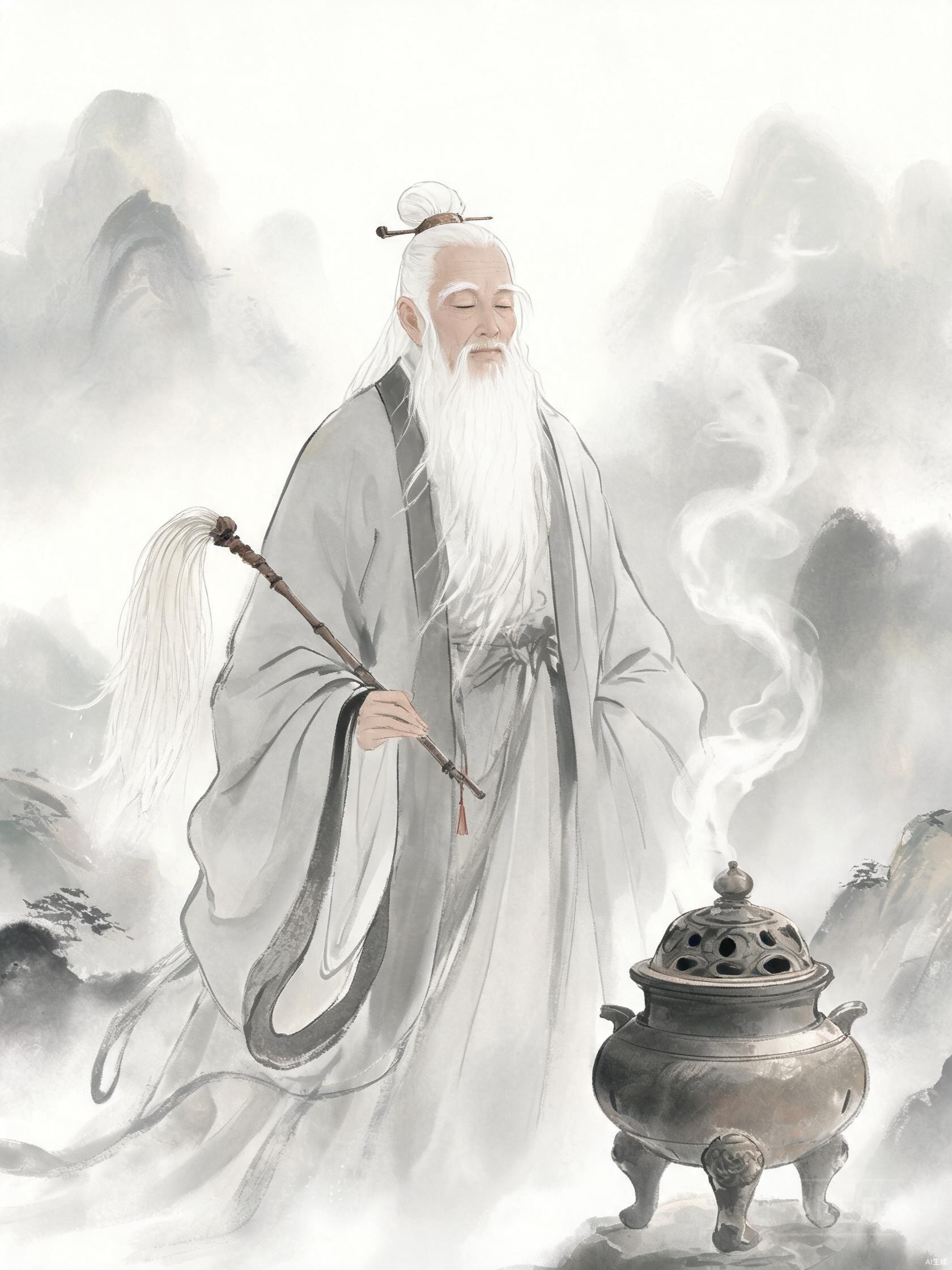
Taishang Laojun
太上老君
The deified Laozi — founder of Taoism and supreme alchemist of heaven.
Origin Story
Who Is Taishang Laojun?
Taishang Laojun, meaning 'Supreme Lord Lao,' is the divine form of Laozi, the semi-legendary sage credited with writing the Tao Te Ching around the 6th century BCE. In Taoist theology, Laozi was not merely a philosopher but an incarnation of the Tao itself, who appeared in the world to teach humanity the way of harmony.
He is one of the Three Pure Ones (Sanqing), the three highest deities in the Taoist cosmos. The Three Pure Ones represent the three stages through which the Tao manifested the universe: from formless potential, to differentiation, to concrete existence. Taishang Laojun is the third, the one most directly involved with the world and with humanity.
Unlike many gods who rule or govern, Taishang Laojun embodies the Taoist ideal of wu-wei — non-action, effortlessness, letting things follow their nature. He does not command; he simply is.
Taishang Laojun is the deified form of Laozi, the legendary author of the Tao Te Ching and one of the Three Pure Ones, the highest deities in the Taoist pantheon. He embodies the Tao itself — eternal, formless, and the source of all existence.
Powers & Symbols
Attributes & Artefacts
Click each card to reveal the details behind Taishang Laojun's divine attributes.
Magical Artifacts & Weapons
Taishang Laojun's Divine Arsenal
The legendary weapons and treasures wielded by Taishang Laojun — each with its own origin story, powers, and mythological significance.
Historical & Cultural Meaning
Beyond the Myth
Taishang Laojun in Mythology
In Journey to the West, Taishang Laojun resides in the Tushita Palace in heaven, where he operates the Eight Trigrams Furnace ([Bagua](/symbols/bagua-symbolism) Lu) — an alchemical crucible that refines elixirs of immortality and magical weapons. His most famous creation, the Golden-Banded Staff (Ruyi Jingu Bang), was later claimed by Sun Wukong as his signature weapon.
When Sun Wukong wreaked havoc in heaven, it was Taishang Laojun who attempted to refine the Monkey King in the Eight Trigrams Furnace. For forty-nine days, the furnace blazed, but Sun Wukong survived by hiding in the smoke and emerged stronger than ever, with fiery golden eyes that could see through all illusion.
In another famous episode, Taishang Laojun descended to earth as Laozi and rode westward on a water buffalo through the Hangu Pass. At the request of the pass keeper Yin Xi, he left behind the Tao Te Ching — five thousand characters of wisdom — before vanishing into the west. This story symbolizes the sage's departure from the world and the gift of wisdom left behind.
Worship and Cultural Significance
Taishang Laojun is worshipped as the supreme deity of Taoism and the eternal patriarch of the religion. He is invoked in Taoist rituals, alchemical practices, and internal cultivation disciplines. The Tao Te Ching, his earthly legacy, remains the most translated Chinese text in the world and the foundational scripture of Taoist philosophy.
His presence is felt in nearly every Taoist temple, where he is typically enshrined alongside the other Two Pure Ones — Yuanshi Tianzun (Primordial Heavenly Worthy) and Lingbao Tianzun (Numinous Treasure Heavenly Worthy). Devotees pray to him for wisdom, longevity, and alignment with the natural order.
According to legend, [Laozi](/gods/laozi) was carried in his mother's womb for eighty-one years before being born from her left side under a plum tree — already with white hair, hence the name Laozi, meaning 'Old Child' or 'Old Master.' This miraculous birth symbolizes the paradoxical nature of the Tao: ancient yet ever-new, hidden yet everywhere present.
Taishang Laojun in Popular Culture
In modern Chinese fantasy literature, film, and gaming, [Taishang Laojun](/gods/taishang-laojun) frequently appears as the archetypal Taoist sage — an elderly, white-bearded figure in flowing robes, wielding a fly whisk or a palm-leaf fan. His Eight Trigrams Furnace is a recurring motif in works that draw on [Journey to the West](/myths/journey-to-the-west).
He also appears in the growing genre of xianxia (immortal hero) web novels and dramas, where his alchemical arts and cosmic authority provide the framework for cultivation systems and heavenly hierarchies.
Sources & References
Primary classical texts: Shanhaijing (山海经, Classic of Mountains and Seas, c. 4th-2nd century BCE) · Fengshen Yanyi (封神演义, Investiture of the Gods, c. 16th century) · Journey to the West (西游记, Xiyouji, c. 16th century) · Records of the Grand Historian (史记, Shiji, by Sima Qian, c. 91 BCE) · Classic of Mountains and Seas commentary (郭璞注 Shanhaijing, c. 4th century) · Bamboo Annals (竹书纪年, c. 4th century BCE onwards)
Classical translations: Legge, James (trans.). The Sacred Books of the East (1879-1910, 50 volumes covering Chinese classics) · Girardot, Norman J. Myth and Meaning in Early Taoism (University of California Press, 1983) · Werner, E.T.C. A Dictionary of Chinese Mythology (Shanghai: Kelly & Walsh, 1932)
Modern academic references: Birrell, Anne. Chinese Mythology: An Introduction (Baltimore: Johns Hopkins University Press, 1993) · Yang, Lihui, and Deming An. Handbook of Chinese Mythology (New York: Oxford University Press, 2005) · Strassberg, Richard E. A Chinese Bestiary: Strange Creatures from the Guideways Through Mountains and Seas (Berkeley: University of California Press, 2002)
Digital encyclopedias and online resources: Wikipedia — Chinese mythology portal (continuously updated, citations to primary sources) · Encyclopedia Britannica — Mythology and Religion section
Mythology Network
Connections & Relationships
Taishang Laojun is woven into a larger web of gods, creatures, and legends. Explore the connections below.
Taishang Laojun
太上老君




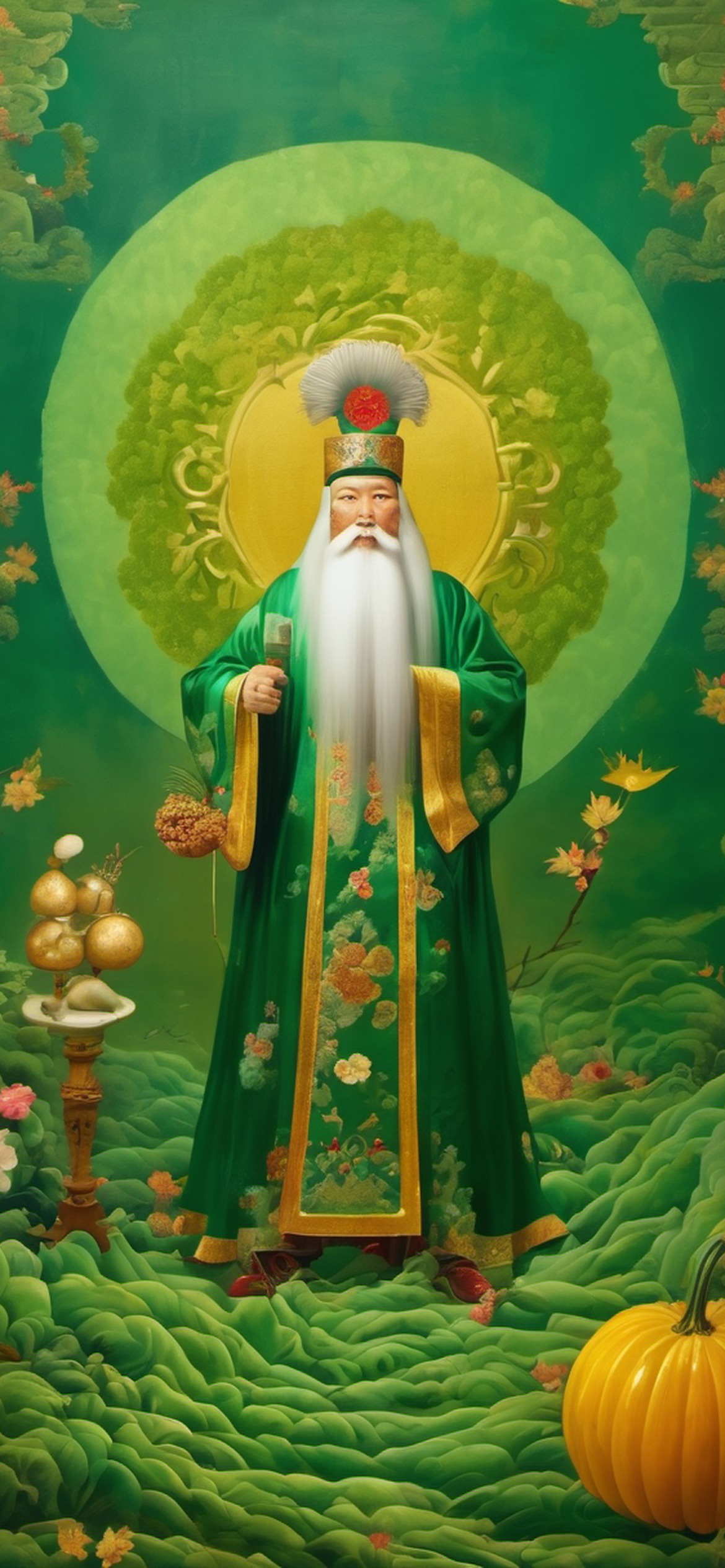
📱 Wallpaper · $2.99
Take 太上老君 with you
High-resolution phone wallpaper of Taishang Laojun (太上老君) — iconography drawn from classical Chinese sources, painted in traditional style.
📜 Iconography sources
The deified Laozi of 《道德经》 (Tao Te Ching) tradition, revered as the Daoist Three Pure Ones' 道德天尊 (Heavenly Worthy of the Dao and Its Virtue). Daoist canon and temple statuary give him the now-familiar form: flowing white hair and beard, lotus daoist crown, bagua-trigram robe, palm-leaf fan, with the green ox and elixir furnace recalling the legend of his departure west through the Hangu Pass.
Buy & download
Explore the Topic
Taishang Laojun in the Mythology Network
Go deeper — read the topic guides that gather every deity like Taishang Laojun.