Ranked
Top 10 Most Powerful Chinese Gods
中国神话最强神仙排行 — The Divine Power Ranking
A definitive ranking of the most powerful beings in Chinese mythology — from the creator who shaped the cosmos to the trickster who defied heaven itself.
Quick Facts
How We Ranked the Gods
Ranking Chinese gods by power is inherently subjective, because Chinese mythology has no single canonical text that defines a clear power hierarchy. Unlike Greek mythology, where Zeus is unambiguously the king of gods, Chinese deities belong to overlapping systems — folk religion, the Taoist pantheon, Buddhist cosmology — that don't always agree.
Our ranking considers several factors: cosmic scope of power (ability to affect the universe itself), cultural importance (how widely worshipped and influential the deity is), narrative power (what they accomplish in myths and stories), and hierarchical position (where they sit in the divine bureaucracy).
It's important to remember that in Chinese mythology, power is not simply about who would win in a fight. A god who controls rain may be more practically powerful than a god who can move mountains, because rain affects millions of lives. Similarly, a bodhisattva who embodies compassion may be considered more spiritually powerful than a warrior god who defeats armies.
#1. Pangu — The Creator
At the very top of the ranking is Pangu (盤古), the primordial giant who created the universe itself. Before Pangu, there was only chaos — a formless egg of mixed yin and yang. Pangu emerged from this egg and separated heaven from earth, holding them apart for 18,000 years.
When Pangu died, his body became the world: his breath became the wind, his voice the thunder, his left eye the sun, his right eye the moon, his blood the rivers, his flesh the soil, and his parasites became humanity. He literally IS the universe — every mountain, river, and star is a part of his body.
No other Chinese deity can match this level of cosmic power. Pangu created the very framework within which all other gods operate. He is the foundation of everything — and while he is no longer an active deity (having sacrificed himself to become the world), his power is absolute and unparalleled.
Power Level: Infinite — he is the universe itself.
#2. The Jade Emperor — King of Heaven
The Jade Emperor (Yu Huang Da Di, 玉皇大帝) is the supreme ruler of the Chinese pantheon. As the head of the celestial bureaucracy, he commands all gods, spirits, and immortals. He oversees the weather, human fate, the natural order, and the entire cosmic administration.
The Jade Emperor's power is institutional rather than personal — he commands vast armies of deities and spirits, controls the Book of Life and Death (through his subordinate Yanluo Wang), and has the authority to promote or demote any god in the pantheon. His word is law in all three realms: heaven, earth, and the underworld.
Despite his immense authority, the Jade Emperor is not omnipotent. In Journey to the West, Sun Wukong causes havoc in heaven and the Jade Emperor cannot stop him — he must appeal to the Buddha for help. This illustrates the Chinese conception of power: even the highest authority has limits.
Power Level: Supreme — commands the entire celestial bureaucracy.
#3. Nuwa — Mother of Humanity and Sky-Mender
Nuwa (女媧) ranks third for two extraordinary achievements: she created humanity and she repaired the sky. These are cosmic-level feats that place her above nearly all other deities.
As the creator of humans, Nuwa shaped people from yellow clay. When she grew tired of hand-shaping each figure, she dragged a rope through the mud, creating the common people — a myth that simultaneously explains human origins and justifies social hierarchy (the hand-shaped nobility vs. the rope-made commoners).
When the water god Gong Gong smashed Mount Buzhou, one of the pillars of heaven, the sky tore open and floods devastated the world. Nuwa melted five-colored stones to patch the heavens and cut the legs off a giant turtle to prop up the four corners of the sky. She literally saved the universe from collapse.
Nuwa's power is creative and restorative — she brings things into being and repairs what is broken. This makes her one of the most fundamentally powerful deities in any mythology, not just Chinese.
Power Level: Cosmic — created humanity and repaired the universe.
#4. The Three Pure Ones (San Qing)
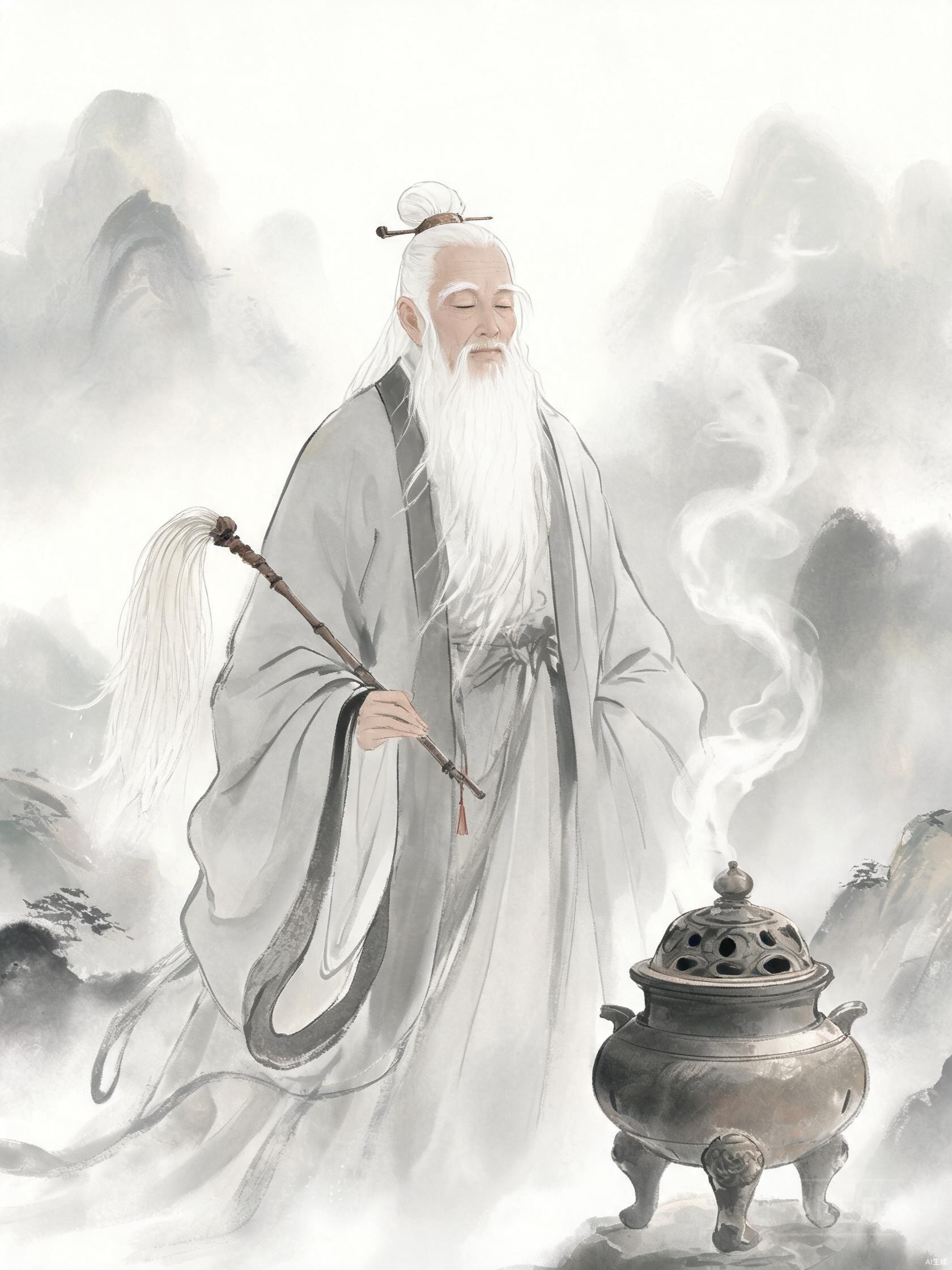
The Three Pure Ones (#4) — the three emanations of the Tao itself
The Three Pure Ones (三清) are the highest deities in Taoist theology — the three emanations of the Tao itself. They are Yuanshi Tianzun (The Heavenly Lord of Primordial Beginning), Lingbao Tianzun (The Heavenly Lord of Numinous Treasure), and Daode Tianzun (The Heavenly Lord of the Way and its Virtue, identified with Laozi).
In Taoist cosmology, the Three Pure Ones are the source of all existence. They predate the Jade Emperor and represent the three stages of cosmic emanation: the creation of the universe, the establishment of its laws, and the teaching of these laws to humanity.
While the Jade Emperor is the administrative head of the celestial bureaucracy, the Three Pure Ones are its spiritual foundation. They are so transcendent that they rarely intervene in worldly affairs — they exist in a state of supreme stillness beyond the concerns of gods and humans.
In practice, the Three Pure Ones are primarily worshipped in formal Taoist ritual. They are less well-known in popular culture than gods like Sun Wukong or Guanyin, but in theological terms, they are the highest expression of divine power in the Chinese pantheon.
Power Level: Transcendent — they are the Tao itself, the source of all existence.
#5. Taishang Laojun (Laozi) — The Grand Pure One
Taishang Laojun (太上老君) is the deified form of Laozi, the author of the Tao Te Ching and the founder of philosophical Taoism. As one of the Three Pure Ones, he represents the Tao manifest in human history.
In Taoist theology, Taishang Laojun is so powerful that he has appeared in multiple incarnations throughout history — as Laozi in the 6th century BCE, and in earlier forms as advisor to the Yellow Emperor and other ancient rulers. He is the teacher of gods and humans alike, the source of Taoist wisdom and practice.
In Journey to the West, Taishang Laojun is the divine alchemist who created the pills of immortality and the golden pill that Sun Wukong stole. His furnace is where immortal elixirs are forged, and his diamond snare is one of the few weapons that can capture the Monkey King.
What makes Taishang Laojun uniquely powerful is that he embodies knowledge itself. While other gods wield physical power or institutional authority, Taishang Laojun commands the fundamental principles of reality — the Tao, yin and yang, the five elements. Understanding these principles is, in Chinese thought, the highest form of power.
Power Level: Fundamental — embodies the Tao and commands the laws of reality.
#6. Sun Wukong — The Monkey King
Sun Wukong (孫悟空), the Monkey King, is the most rebellious and unpredictable power in Chinese mythology. Born from a stone egg on Mount Huaguo, he acquired immense powers through Taoist cultivation: 72 transformations, cloud-riding (somersaulting 108,000 li in a single leap), and near-invulnerability.
Sun Wukong's power is demonstrated through his feats: he single-handedly defeated the entire army of heaven, crossed out his name in the Book of Life and Death, stole the pills of immortality from Taishang Laojun's furnace, and took the Ruyi Jingu Bang from the Dragon King. He was ultimately subdued only by the Buddha himself.
What makes Sun Wukong so powerful is his combination of raw strength, cunning, and immortality. He has been granted multiple forms of immortality — through cultivation, by eating heaven's peaches, by drinking the elixir of life, and by surviving Taishang Laojun's furnace. He is effectively unkillable.
His weakness is not physical but spiritual — he lacks the wisdom to use his power responsibly, which is why the Buddha traps him under a mountain for 500 years until he learns discipline. His journey on the pilgrimage to India is ultimately a story about power learning humility.
Power Level: Near-infinite — defeated heaven's army, only the Buddha could stop him.
#7. The Buddha (Tathagata)
In the Chinese mythological universe, the Buddha (如來, Rulai/Tathagata) represents a power that transcends the Chinese pantheon entirely. In Journey to the West, when the Jade Emperor cannot control Sun Wukong, he appeals to the Buddha — who effortlessly traps the Monkey King under Five Elements Mountain with a single bet.
The Buddha's power is fundamentally different from that of Chinese gods. While gods wield cosmic forces — thunder, rain, fire, death — the Buddha commands the underlying nature of reality itself. He understands the illusion of existence and can manipulate the fundamental fabric of the cosmos.
In Chinese folk religion, the Buddha is often treated as the highest spiritual authority, above even the Jade Emperor. This reflects the deep integration of Buddhism into Chinese religious life — for many practitioners, Buddhist teachings represent a higher truth than the concerns of the celestial bureaucracy.
Power Level: Ultimate — transcends the entire Chinese cosmic system.
#8. Guanyin — The Goddess of Mercy
Guanyin (觀音), the bodhisattva of compassion, may not have the raw destructive power of Sun Wukong or the cosmic authority of the Jade Emperor, but her influence on the Chinese spiritual imagination is unmatched. She is the most widely worshipped figure in Chinese religion — more beloved than any god in the official pantheon.
Guanyin's power is compassion itself. In the Lotus Sutra, she is described as having the ability to appear in any form needed to help those in distress — a king, a monk, a woman, a child, an animal. She can hear the cries of all sentient beings (the literal meaning of her name, 觀音, is 'perceiver of sounds') and responds to sincere prayer.
In Chinese mythology, Guanyin is the one who resolves the conflict in 'The Eight Immortals Cross the Sea,' freeing the Dragon) King's son and restoring peace. She also plays a crucial role in Journey to the West, where she guides and protects the pilgrims.
Guanyin's power is not about domination or control — it's about response. She does not impose her will; she responds to need. This makes her uniquely powerful in the Chinese spiritual imagination: she is the deity who actually listens.
Power Level: Infinite compassion — can manifest in any form and hear all prayers.
#9. The Yellow Emperor (Huangdi)
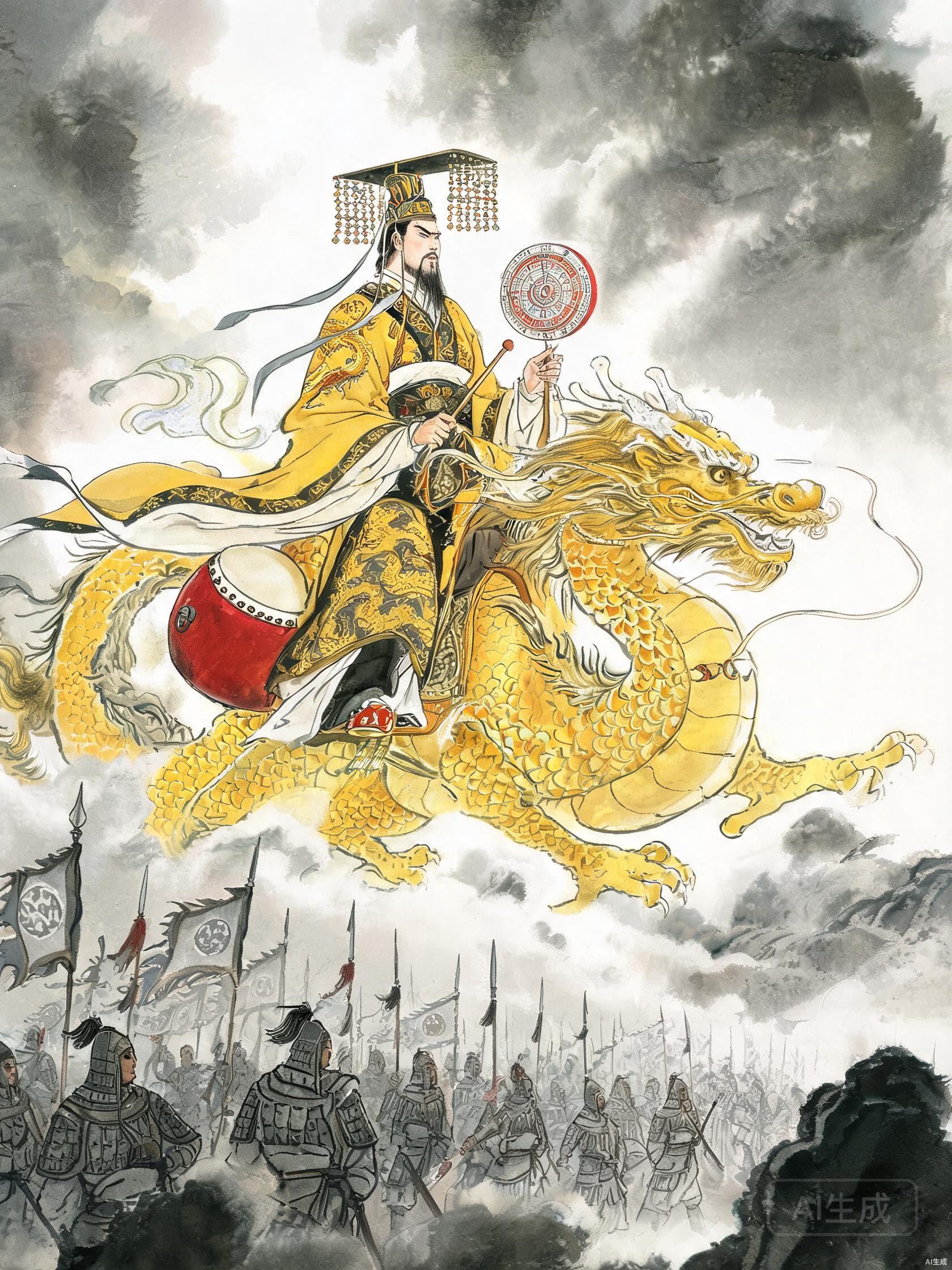
The Yellow Emperor (#9) — the mythic ancestor who defeated Chiyou
The Yellow Emperor (黃帝) sits at the intersection of mythology and history. As one of the Five Emperors, he is considered the ancestor of the Chinese people — the founder of Chinese civilization itself. He is credited with inventing the wheel, the calendar, mathematics, writing, and medicine.
In mythological terms, the Yellow Emperor's greatest feat was defeating Chiyou, the god of war, at the Battle of Zhuolu. Chiyou had a copper head and iron forehead, could create fog to blind the enemy, and commanded an army of spirits. The Yellow Emperor countered with the South-Pointing Chariot (to navigate through the fog) and the drum made from the skin of the Kui (a one-legged thunder beast) — whose sound could be heard across 500 li and terrified Chiyou's army.
The Yellow Emperor also practiced Taoist alchemy and, according to some traditions, achieved immortality by ascending to heaven on the back of a dragon. He is both a cultural hero (teaching humans civilization) and a divine being (ruling the cosmos).
Power Level: Foundational — founded Chinese civilization and defeated the god of war.
#10. Yanluo Wang — King of Hell
Yanluo Wang (閻羅王), the King of Hell, rounds out our top ten. While he may not have the creative power of Pangu or Nuwa, his authority over death itself makes him one of the most feared and respected deities in Chinese mythology.
As the ruler of Diyu (the Chinese underworld), Yanluo Wang commands the entire afterlife bureaucracy. He controls the Book of Life and Death, which records the birth and death of every living being. His court judges every soul, assigns punishments in the 18 levels of hell, and determines the form of reincarnation.
In Journey to the West, Sun Wukong's invasion of the underworld and his crossing out of names in the Book of Life and Death is an act of defiance against Yanluo Wang's ultimate authority. That even the Monkey King felt the need to go to the underworld to deal with death shows how fundamental Yanluo Wang's power is.
Yanluo Wang's power is absolute within his domain — no one, not even the Jade Emperor, can override his judgments on the dead. He represents the ultimate limit of all earthly power: no matter how powerful a god or hero may be, they must eventually face the King of Hell.
Power Level: Absolute over death — controls the afterlife for all beings.
Honorable Mentions

Honorable mentions — Erlang Shen, Nezha, Mazu, and other powerful deities
Several gods narrowly missed the top ten but deserve mention for their power and influence:
Erlang Shen (二郎神) — The warrior god with a third eye that sees through all illusions. He was the only deity who could fight Sun Wukong to a standstill before the Buddha intervened. His power is martial excellence combined with divine perception.
Nezha (哪吒) — The child god who defeated the Dragon) King's son and fought alongside his father Li Jing. Nezha's power is transformation and rebirth — after killing himself to repay his parents, he was reborn from a lotus, making him immortal in a unique way.
Mazu (媽祖) — The goddess of the sea, worshipped by millions of sailors and fishermen across coastal China. Her power is practical and immediate — she calms storms, guides ships to safety, and protects those who travel on water.
Zhang Daoling — The first Celestial Master of Taoism, who received direct revelation from Taishang Laojun. He founded the Way of the Celestial Masters, the oldest organized Taoist tradition, and is said to have defeated demons and even subdued the gods of local mountains.