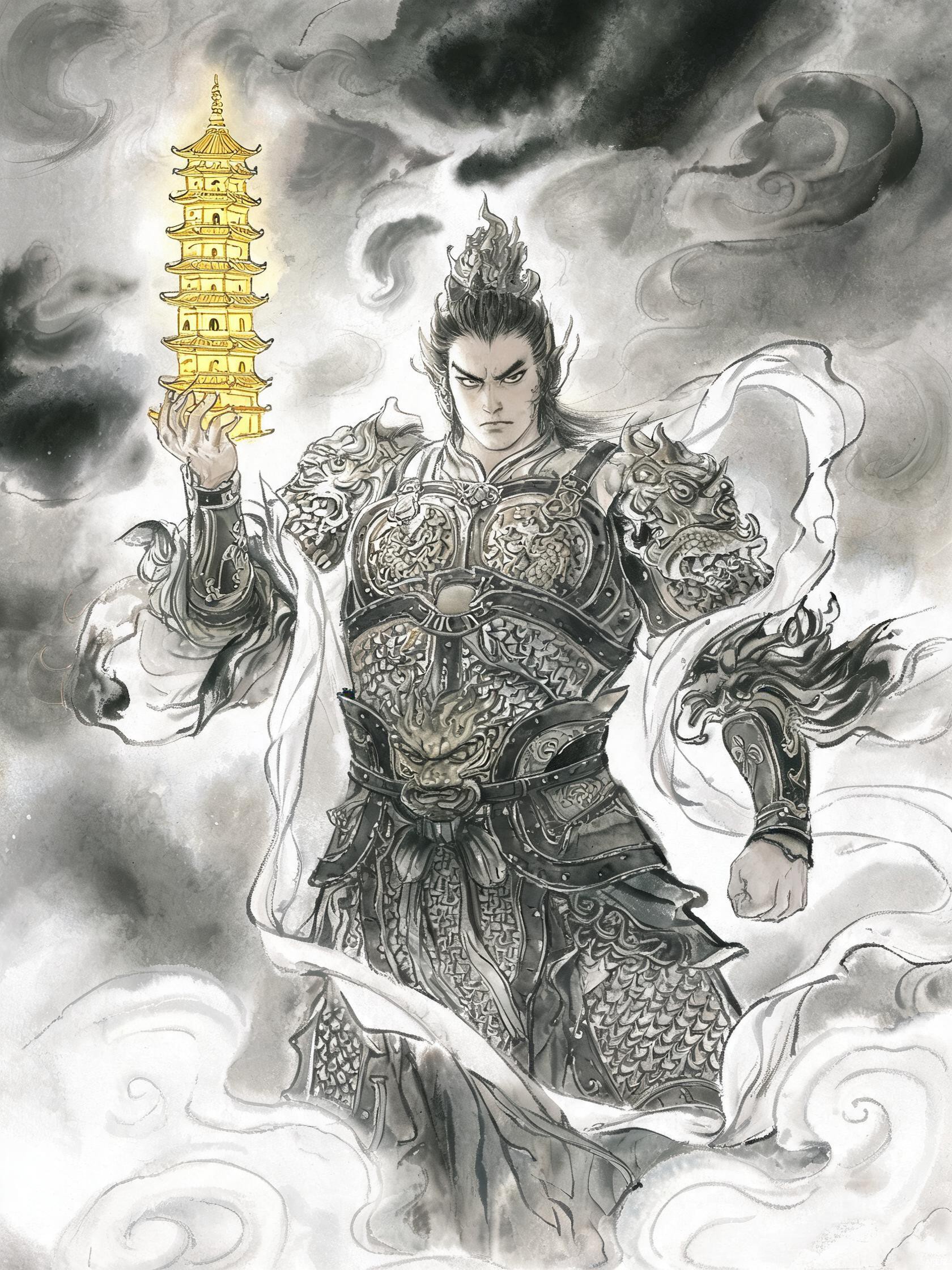
Li Jing
李靖
The Pagoda-Bearing Heavenly King — commander of heaven's armies and father of Nezha.
Origin Story
Who Is Li Jing?
Li Jing, known as the Pagoda-Bearing Heavenly King (Tuota Tiangwang), is a prominent warrior deity in Chinese folk religion and Taoism. He serves as the commander of the heavenly army, a position that places him at the front line of every celestial conflict — from demon invasions to rebellious immortals.
He is instantly recognizable by the exquisite pagoda he holds in one hand — a seven-story golden tower that serves as both a weapon and a prison. The pagoda can shrink to the size of a fist or expand to trap armies, and its radiance can subdue any foe. It was given to him by the immortal Randan Denggong to discipline his unruly son Nezha.
Li Jing's historical roots lie in the real Tang Dynasty general Li Jing (571–649 CE), a brilliant military commander whose victories expanded the Tang empire. Over centuries, the historical general merged with mythological traditions, becoming the deity known from Investiture of the Gods and Journey to the West.
Li Jing, the Pagoda-Bearing Heavenly King (Tuota Tiangwang), is a warrior deity and commander of the heavenly army. Wielding the exquisite seven-story pagoda, he is best known as the father of Nezha and a central figure in Investiture of the Gods.
Powers & Symbols
Attributes & Artefacts
Click each card to reveal the details behind Li Jing's divine attributes.
Magical Artifacts & Weapons
Li Jing's Divine Arsenal
The legendary weapons and treasures wielded by Li Jing — each with its own origin story, powers, and mythological significance.
Historical & Cultural Meaning
Beyond the Myth
Li Jing and Nezha
The relationship between Li Jing and his son Nezha is one of the most emotionally charged father-son dynamics in Chinese mythology. When Nezha killed the Dragon King's son and brought catastrophe upon the family, Li Jing's anger and threat of punishment drove Nezha to return his flesh and bone — effectively committing suicide to sever all filial bonds.
After Nezha was resurrected in lotus form by the immortal Taiyi Zhenren, he sought revenge on his father, hunting Li Jing across the heavens. No weapon could stop the reborn Nezha, and no god could intervene — until Li Jing received the Exquisite Pagoda from Randan Denggong. The pagoda's radiance subdued Nezha, forcing him to submit, and father and son were finally reconciled.
This story is a study in the tension between parental authority and filial independence. The pagoda, in this context, is not just a weapon — it is the symbol of order, hierarchy, and the father's mandate, without which the household (and heaven) would fall to chaos.
Li Jing in Chinese Culture
Li Jing is worshipped as a protector of homes, cities, and the nation. His image — a stern, armored warrior holding a golden pagoda — guards the gates of countless temples. In Buddhist tradition, he is sometimes syncretized with Vaisravana (Duowen Tiangwang), the Heavenly King of the North, one of the Four Heavenly Kings who guard the four directions.
In Journey to the West, Li Jing appears repeatedly as the commander heaven sends to deal with crises — from [Sun Wukong](/gods/sun-wukong)'s rebellion to rampaging demons. Though often outmatched by the story's heroes, his role as the military backbone of the celestial bureaucracy is always clear.
Together with Nezha, [Erlang](/gods/erlang-shen) Shen, and the Four Heavenly Kings, Li Jing forms part of the martial pantheon that Chinese soldiers, police, and martial artists have invoked for protection and victory for centuries.
Li Jing in Popular Culture
Li Jing appears in nearly every adaptation of Investiture of the Gods and [Journey to the West](/myths/journey-to-the-west), from classic Peking opera to modern CGI films. He is typically portrayed as a stern but ultimately just commander, whose authority is challenged by his son but never truly overthrown.
In the recent wave of Chinese mythological animation, including the 2019 [Nezha](/gods/nezha) film and its sequels, [Li Jing](/gods/li-jing) is given a more sympathetic portrayal — a father who loves his son deeply but is bound by duty, law, and the impossible demands of heaven.
Sources & References
Primary classical texts: Shanhaijing (山海经, Classic of Mountains and Seas, c. 4th-2nd century BCE) · Fengshen Yanyi (封神演义, Investiture of the Gods, c. 16th century) · Journey to the West (西游记, Xiyouji, c. 16th century) · Records of the Grand Historian (史记, Shiji, by Sima Qian, c. 91 BCE) · Classic of Mountains and Seas commentary (郭璞注 Shanhaijing, c. 4th century) · Bamboo Annals (竹书纪年, c. 4th century BCE onwards)
Classical translations: Legge, James (trans.). The Sacred Books of the East (1879-1910, 50 volumes covering Chinese classics) · Girardot, Norman J. Myth and Meaning in Early Taoism (University of California Press, 1983) · Werner, E.T.C. A Dictionary of Chinese Mythology (Shanghai: Kelly & Walsh, 1932)
Modern academic references: Birrell, Anne. Chinese Mythology: An Introduction (Baltimore: Johns Hopkins University Press, 1993) · Yang, Lihui, and Deming An. Handbook of Chinese Mythology (New York: Oxford University Press, 2005) · Strassberg, Richard E. A Chinese Bestiary: Strange Creatures from the Guideways Through Mountains and Seas (Berkeley: University of California Press, 2002)
Digital encyclopedias and online resources: Wikipedia — Chinese mythology portal (continuously updated, citations to primary sources) · Encyclopedia Britannica — Mythology and Religion section
Mythology Network
Connections & Relationships
Li Jing is woven into a larger web of gods, creatures, and legends. Explore the connections below.
Li Jing
李靖
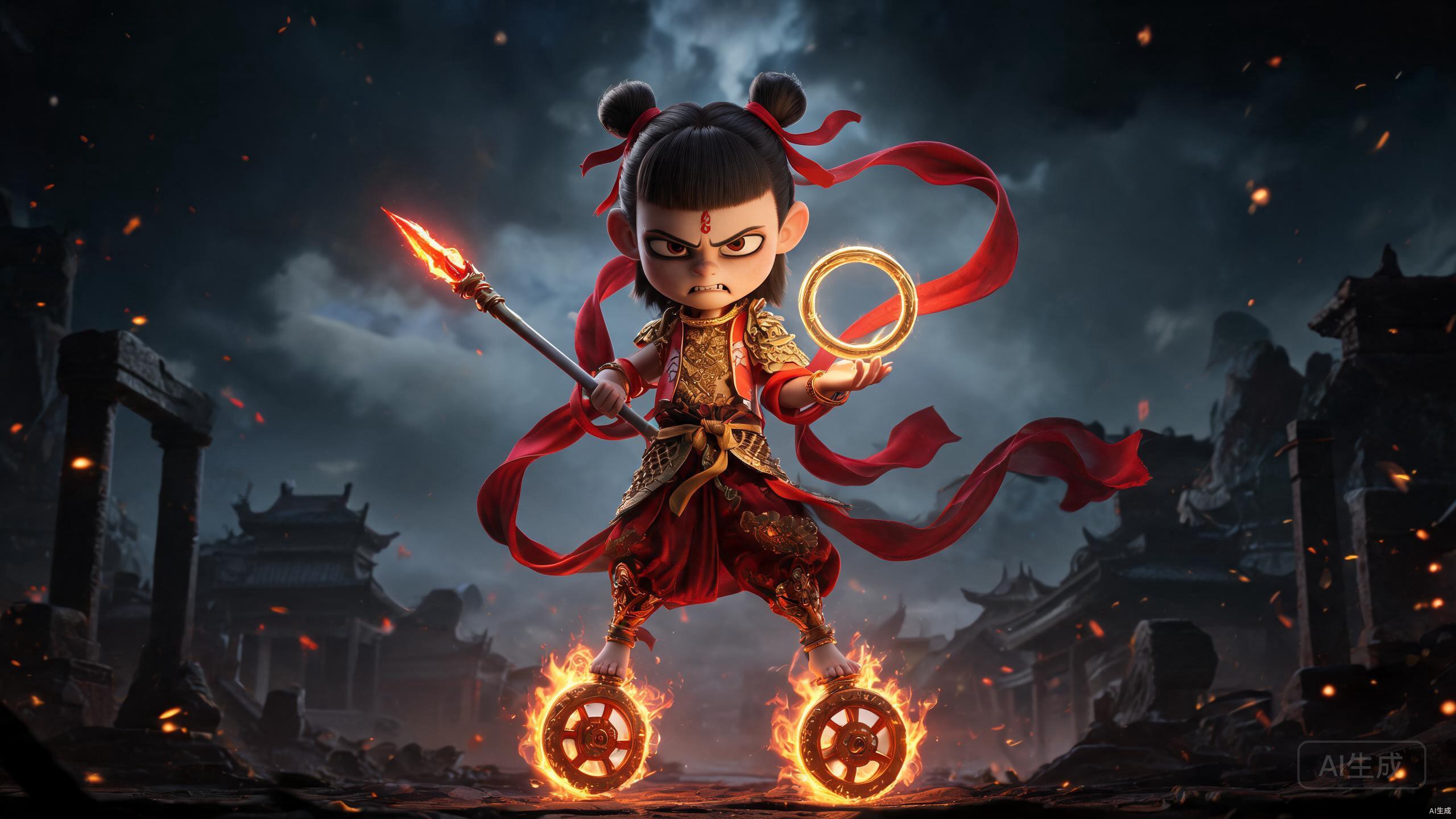


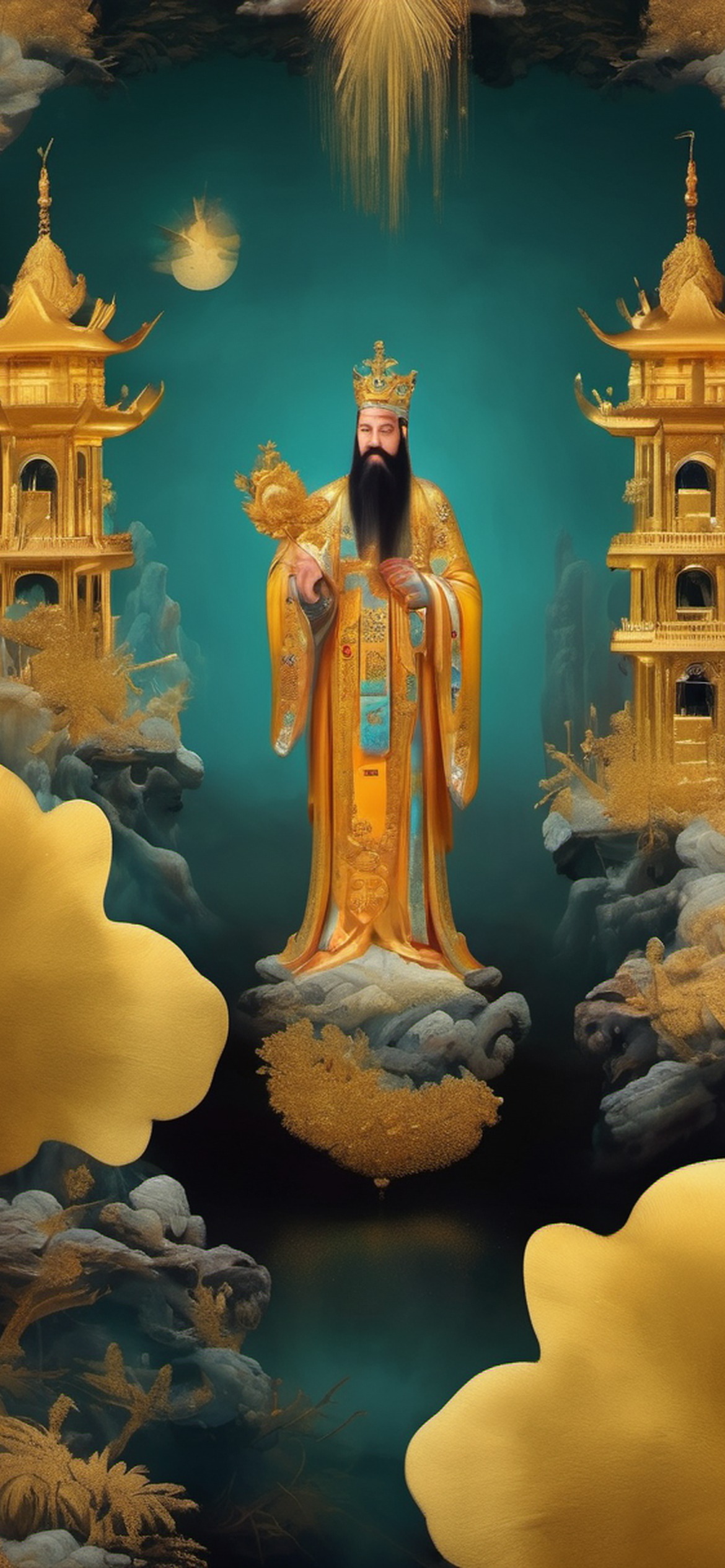
📱 Wallpaper · $2.99
Take 托塔天王李靖 with you
High-resolution phone wallpaper of Heavenly King Li Jing (托塔天王李靖) — iconography drawn from classical Chinese sources, painted in traditional style.
📜 Iconography sources
In 《封神演义》 (Investiture of the Gods) Li Jing is the garrison commander of Chentang Pass, father of Nezha; the pagoda enters the story when Randeng Daoren gives him the seven-treasure golden tower to subdue his rebellious son. 《西游记》 carries the same image into heaven: Marshal Li, pagoda in raised right hand, guarding the celestial court.
Buy & download
Explore the Topic
Li Jing in the Mythology Network
Go deeper — read the topic guides that gather every deity like Li Jing.