Topic
The Four Symbols (Si Xiang)
四象 — The Four Guardians of the Directions
The four mythological creatures that guard the cardinal directions — Azure Dragon (East), Vermilion Bird (South), White Tiger (West), and Black Tortoise (North). Rooted in ancient Chinese astronomy, they remain powerful symbols in feng shui, martial arts, and culture.
Quick Facts
What Are the Four Symbols?
The Four Symbols (Si Xiang, 四象) are four mythological creatures that correspond to the four cardinal directions in Chinese cosmology. They originated as constellations — ancient Chinese astronomers divided the sky into four quadrants, each containing seven lunar mansions, for a total of 28 mansions across the sky.
Each quadrant was associated with a creature, a direction, a season, an element, and a color. This system was not merely astronomical — it formed the foundation of Chinese cosmological thought, influencing feng shui, astrology, medicine, martial arts, and architecture for over two thousand years.
The Four Symbols are sometimes called the 'Four Guardians' or 'Four Gods' (四神), reflecting their protective role. In Chinese folk belief, they guard the four directions and maintain the balance of the cosmos. They appear in temples, on city walls, in tombs, and on banners carried into battle.
The Azure Dragon (Qing Long)
The Azure [Dragon)](/creatures/azure-dragon) (Qing Long, 青龍) guards the East. His color is azure (a blue-green), his element is Wood, and his season is Spring. He represents renewal, growth, and vitality — the energy of dawn and new beginnings.
In Chinese astronomy, the Azure Dragon) governs seven lunar mansions in the eastern sky: Jiao, Kang, Di, Fang, Xin, Wei, and Ji. These mansions correspond to the horns, neck, chest, abdomen, heart, tail, and winnowing basket of the dragon — forming a celestial dragon across the sky.
The Azure [Dragon](/creatures/azure-dragon) is distinct from the general Chinese dragon (long). While all Chinese dragons share water-and-rain associations, the Azure Dragon is specifically the guardian of the East and the embodiment of spring's yang energy. He is the most powerful of the Four Symbols and is often considered the leader.
In feng shui, the Azure [Dragon](/creatures/azure-dragon) represents the left side of a property (when facing the entrance). A strong 'dragon side' — elevated land, hills, or tall structures on the left — is considered auspicious, bringing growth, prosperity, and vitality to the occupants.
The Vermilion Bird (Zhu Que)
The Vermilion Bird (Zhu Que, 朱雀) guards the South. Its color is red (vermilion), its element is Fire, and its season is Summer. It represents passion, beauty, and transformation — the peak of yang energy.
The Vermilion Bird is often confused with the fenghuang (Chinese phoenix), but they are distinct beings. The Vermilion Bird is a constellation and cosmic guardian, while the fenghuang is a symbol of virtue and imperial harmony. The Vermilion Bird is more specifically a fire spirit, associated with the fierce heat of summer.
In Chinese astronomy, the Vermilion Bird governs seven lunar mansions in the southern sky: Jing, Gui, Liu, Xing, Zhang, Yi, and Zhen. These form the bird's well, ghost, willow, star, extended wing, wings, and chariot — creating a celestial bird spanning the southern heavens.
In feng shui, the Vermilion Bird represents the space in front of a property. An open, bright, and welcoming front area is said to attract good fortune — the Vermilion Bird brings opportunity and recognition to those who honor it.
The White Tiger (Bai Hu)
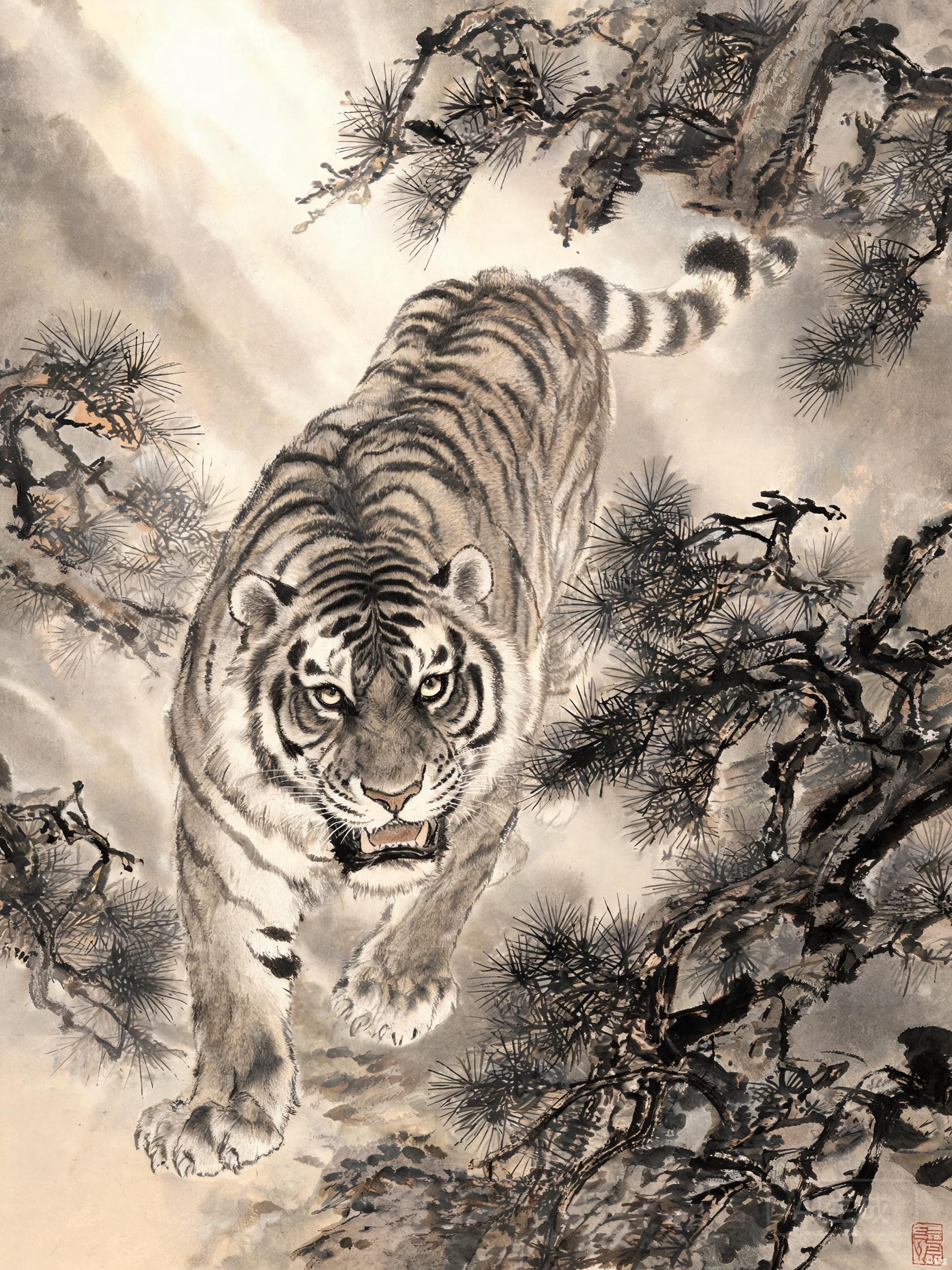
The White Tiger (Bai Hu) — guardian of the West, element of Metal and Autumn
The White [Tiger](/creatures/white-tiger) (Bai Hu, 白虎) guards the West. His color is white, his element is Metal, and his season is Autumn. He represents strength, courage, and justice — the fierce, protective energy of the setting sun.
In Chinese astronomy, the White Tiger governs seven lunar mansions in the western sky: Kui, Lou, Wei, Mao, Bi, Zi, and Shen. These form the tiger's legs, backbone, stomach, mane, neck, eyes, and mouth — creating a celestial tiger prowling the western heavens.
The White [Tiger](/creatures/white-tiger) is associated with warfare and military prowess. In ancient China, the White Tiger was the symbol of the military — the Emperor's war banner often bore a white tiger. The animal was believed to appear only when a virtuous emperor ruled justly, making it a symbol of righteous authority.
In feng shui, the White [Tiger](/creatures/white-tiger) represents the right side of a property (when facing the entrance). The 'tiger side' should ideally be lower and gentler than the dragon side — a balance that prevents the tiger's fierce energy from overwhelming the occupants. However, a complete absence of tiger energy can leave a property vulnerable.
In Chinese mythology, the White [Tiger](/creatures/white-tiger) is also associated with the West Queen Mother (Xi Wangmu), who rides a tiger and commands an army of tiger spirits. The tiger's metallic nature connects it to weapons, armor, and the martial arts.
The Black Tortoise (Xuan Wu)
The Black Tortoise (Xuan Wu, 玄武), also translated as the Black Warrior, guards the North. Its color is black, its element is Water, and its season is Winter. It represents endurance, wisdom, and longevity — the quiet, yin energy of the dark season.
The Black Tortoise is typically depicted as a tortoise entwined with a snake. This creature combination is ancient and symbolizes the union of yin and yang — the tortoise (shell = heaven, body = earth) represents stability, while the snake represents transformation and renewal.
In Chinese astronomy, the Black Tortoise governs seven lunar mansions in the northern sky: Dou, Niu, Nu, Xu, Wei, Shi, and Bi. These form the dipper, ox, girl, emptiness, rooftop, house, and wall — creating a celestial fortification across the northern heavens.
The Black Tortoise is also associated with the Taoist deity Zhenwu (Perfect Warrior), one of the most important gods in the Taoist pantheon. Zhenwu is depicted as a warrior in black robes holding a sword, with a tortoise and snake at his feet. The Wudang Mountains, one of the most sacred Taoist sites, are dedicated to Zhenwu.
In feng shui, the Black Tortoise represents the area behind a property. A solid, elevated backing — a hill, wall, or tall building — provides protection and stability. This is considered the most important direction in feng shui, as it represents the foundation and support for everything else.
The Fifth Symbol: The Yellow Dragon
Less commonly discussed is the fifth symbol: the Yellow Dragon) (Huang Long, 黃龍), which represents the Center. Its color is yellow, its element is Earth, and it has no specific season — it represents the axis around which all other directions rotate.
The Yellow Dragon) is associated with the Yellow Emperor (Huangdi), the legendary ancestor of the Chinese people. In Chinese cosmology, the Center is the most important direction — it is the throne of the emperor, the heart of the nation, and the still point around which the universe turns.
While the Four Symbols guard the four directions, the Yellow Dragon) sits at the center, unifying them. This five-symbol system maps perfectly onto the Five Elements (Wu Xing): Wood (East/Azure Dragon), Fire (South/Vermilion Bird), Earth (Center/Yellow Dragon), Metal (West/White [Tiger](/creatures/white-tiger)), and Water (North/Black Tortoise).
The Four Symbols in Chinese Culture

The Four Symbols permeate architecture, martial arts, and feng shui to this day
The Four Symbols permeate Chinese culture in ways both obvious and subtle. In architecture, they determine the ideal placement and orientation of buildings — from imperial palaces to ordinary homes. The Forbidden City in Beijing was designed with the Four Symbols in mind: Jingshan Park (a man-made hill) serves as the Black Tortoise to the north, while the Tiananmen Square area provides the open Vermilion Bird space to the south.
In martial arts, the Four Symbols inspire fighting styles. Tiger style is aggressive and powerful, Crane style is graceful and evasive, Dragon) style is fluid and unpredictable, and Snake style is fast and precise. Many kung fu schools incorporate all four animal styles into their curriculum.
In modern popular culture, the Four Symbols appear in anime (especially 'Fushigi Yugi' and 'Yu Yu Hakusho'), video games (including 'Street Fighter' and various RPGs), and Chinese fantasy novels. They have also influenced Korean, Japanese, and Vietnamese mythology, where they appear with slight variations.
The Four Symbols represent a uniquely Chinese way of understanding the universe — not as a linear progression from past to future, but as a balanced, cyclical system where every direction, season, and element has its place and its guardian. This holistic worldview is one of the most enduring legacies of Chinese civilization.