Topic
Creation Myths of China
创世神话 — The Origins of Heaven, Earth, and Humanity
From the cosmic egg of primordial chaos to the yellow clay that became humanity — explore the creation stories that founded Chinese civilization and shaped its understanding of the cosmos.
Quick Facts
The Cosmic Egg: Chaos Before Creation

The cosmic egg — Hundun, the primordial chaos from which all creation emerged
Before the world existed, there was no heaven, no earth, no sun, and no moon — only a formless, chaotic substance called Hundun (混沌). This primordial state was often imagined as a cosmic egg, a vast sphere in which the opposing forces of yin and yang were not yet separated but churned together in turbulent mixture. The Chinese conception of pre-creation chaos is distinct from Western traditions: rather than a void or darkness, Hundun was a plenum of raw potential, a cosmic soup from which all things would eventually emerge.
The egg metaphor is central to Chinese cosmology. Just as an egg contains a living thing waiting to develop, the cosmic egg contained the entire universe in embryonic form. Within this egg, the light, clear elements (yang) were gradually rising, while the heavy, turbid elements (yin) were sinking. This natural separation — driven by the inherent tendency of yin and yang to find their proper places — set the stage for the emergence of Pangu, the first being, who would complete the work of differentiation that the egg had begun.
This concept of creation from a cosmic egg is one of the oldest and most widespread mythological motifs in the world, appearing in Indian, Polynesian, and Finnish traditions as well. In China, however, the egg is not merely a vessel but a philosophical statement: it encodes the Taoist principle that order arises naturally from chaos through the self-organizing interaction of yin and yang. Creation, in the Chinese view, is not an act of divine command spoken into nothingness, but a process of sorting, separating, and structuring what was already there.
Pangu Separates Heaven and Earth

Pangu — the primordial giant who separated heaven from earth and became the world itself
From within the cosmic egg, Pangu (盤古) awakened. He was a giant of incomprehensible size — some accounts say he grew ten feet taller every day. Finding himself trapped in the formless chaos, Pangu took up a great axe and a chisel and struck the egg with all his might. The blow cracked the shell, and the light, clear yang elements rose upward to become heaven (tian), while the heavy, turbid yin elements sank downward to become earth (di). For the first time, there was a distinction between above and below, between the divine and the material.
But the separation was fragile. Heaven and earth kept pressing back together, threatening to return to chaos. For 18,000 years, Pangu stood between them, his head holding up the sky and his feet planted on the earth. Each day, the sky rose ten feet higher, the earth thickened ten feet deeper, and Pangu grew ten feet taller, maintaining the space between them with his own body. This image of the creator literally becoming the scaffolding of the cosmos is one of the most powerful in world mythology — creation here is not a moment but an epoch of sustained, bodily labor.
When the separation was finally stable, Pangu collapsed and died — but his death was itself an act of creation. His breath became the wind and clouds, his voice the thunder, his left eye the sun and his right eye the moon. His blood became the rivers, his muscles the soil, his hair the stars, his skin the vegetation, his bones the minerals and jade, his sweat the rain, and the fleas on his body became the ancestors of humanity. In this way, Pangu did not merely create the world — he became the world. His sacrifice is the foundation of the Chinese understanding that the natural world is not separate from the divine but is, literally, the body of the creator.
Nuwa Creates Humanity from Yellow Clay

Nuwa crafting humanity from yellow clay — the mother goddess of Chinese mythology
With the world formed but empty, Nuwa (女媧) appeared. She is one of the oldest and most revered figures in Chinese mythology — a goddess with a human head and a serpent's body, sister and consort to Fuxi. According to the most widespread version of the myth, preserved in texts like the Fengsu Tongyi (風俗通義), Nuwa was walking through the newly created world and felt lonely. There were mountains, rivers, and animals, but no beings capable of appreciating the beauty of creation or returning the gods' love.
Nuwa knelt beside the bank of the Yellow River and began to fashion humans from yellow clay. She shaped each figure carefully, endowing it with the capacity for thought, emotion, and speech. But the work was slow, and the world was vast. Growing impatient, Nuwa dipped a vine into the mud and flicked it — each droplet of clay that fell became a person. This detail is profoundly significant in Chinese social thought: the carefully crafted figures became the nobility, while the flicked droplets became the common people. The myth thus explains both the origin of humanity and the existence of social hierarchy, while simultaneously asserting that all humans share the same divine origin.
Nuwa is not only the creator of humanity but also its protector. When the water god Gonggong, in a rage after losing a battle, smashed his head against Mount Buzhou — one of the pillars holding up the sky — the heavens tilted, the earth cracked, and fires and floods ravaged the world. Nuwa melted five-colored stones to patch the broken sky, cut the legs off a giant cosmic turtle to use as new pillars, and slew the black dragon that was devastating the land. Her act of cosmic repair (補天, 'mending the sky') is one of the most iconic images in Chinese mythology — a goddess not just creating life but saving it from annihilation.
Yu the Great Tames the Flood
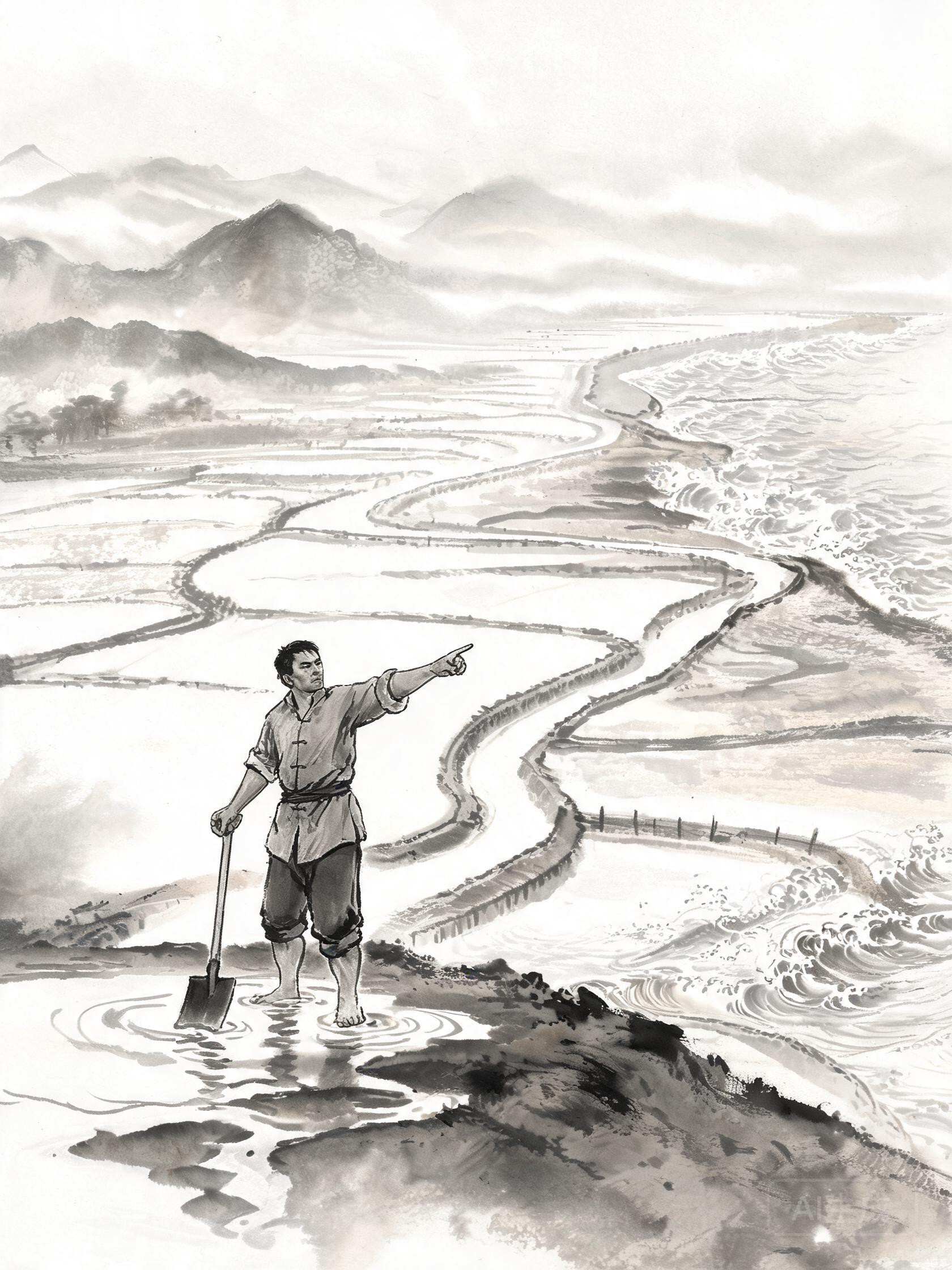
Yu the Great — the hero who tamed the flood and founded the first Chinese dynasty
After the age of creation came the age of crisis: the Great Flood (大洪水). According to texts like the Shujing (Book of Documents) and the Shanhaijing, a catastrophic deluge engulfed ancient China, drowning farmland, submerging cities, and driving people to the mountaintops. The sage emperor Yao first appointed Yu's father, Gun, to control the waters. Gun attempted to build dikes and dams to contain the flood, but after nine years of failure, he was executed — his approach of fighting water with walls was fundamentally flawed.
Yu (禹), known as Yu the Great (大禹), took up his father's mission but adopted a radically different strategy. Rather than trying to contain the water, Yu dredged channels and dug canals to guide the floodwaters toward the sea. He worked alongside the people, laboring in the mud for thirteen years, wearing through his tools, developing calluses on his hands, and wearing the nails off his fingers. Legend says he passed his own doorway three times during his labors and heard his wife and children inside — but he never stopped to visit, so devoted was he to saving the people from the flood.
Yu's flood control was not merely engineering but cosmological. According to the Shanhaijing, Yu was assisted by the dragon Yinglong, who used its tail to carve channels in the earth, and by a divine tortoise that carried away the mud. Yu's labors effectively remapped China: he divided the land into Nine Provinces (九州), establishing the geographic and political framework that would define Chinese civilization for millennia. For his service, Yu was chosen as the founder of the Xia Dynasty — the first hereditary dynasty in Chinese history. The myth of Yu the Great thus marks the transition from the age of mythological creation to the age of human civilization, where the raw forces of nature have been tamed and the structures of government can begin.
The Continuing Legacy of Chinese Creation Myths
Chinese creation myths differ from their Western counterparts in one crucial respect: they do not present a single, authoritative narrative. The story of Pangu comes from southern Chinese traditions, likely of the San Miao people, and was only recorded in writing in the 3rd century CE by Xu Zheng in the Sanwu Liji. The story of Nuwa is far older, appearing in the Shanhaijing and the Songs of Chu. The story of Yu is preserved in historical texts. These myths coexist, overlap, and sometimes contradict each other — and that is entirely by design.
In Chinese tradition, creation is not a one-time event but an ongoing process. Pangu created the world, Nuwa created humanity and repaired the sky, and Yu reshaped the land — but creation continues in every act of cultural innovation, every sage who teaches new knowledge, every dynasty that restores order after chaos. This is why Chinese creation myths emphasize labor over command: Pangu works for 18,000 years, Nuwa molds clay one figure at a time, and Yu digs canals for thirteen years. The cosmos was not spoken into being; it was built, molded, and dredged into existence through sustained effort.
These creation stories also encode the core values of Chinese civilization. Pangu's sacrifice embodies selflessness — the creator gives his own body for the world. Nuwa's clay-crafting embodies both the dignity of labor and the universality of human worth. Yu's flood control embodies the Confucian virtue of public service above family. Together, these myths do not just explain how the world began — they teach how people should live within it.