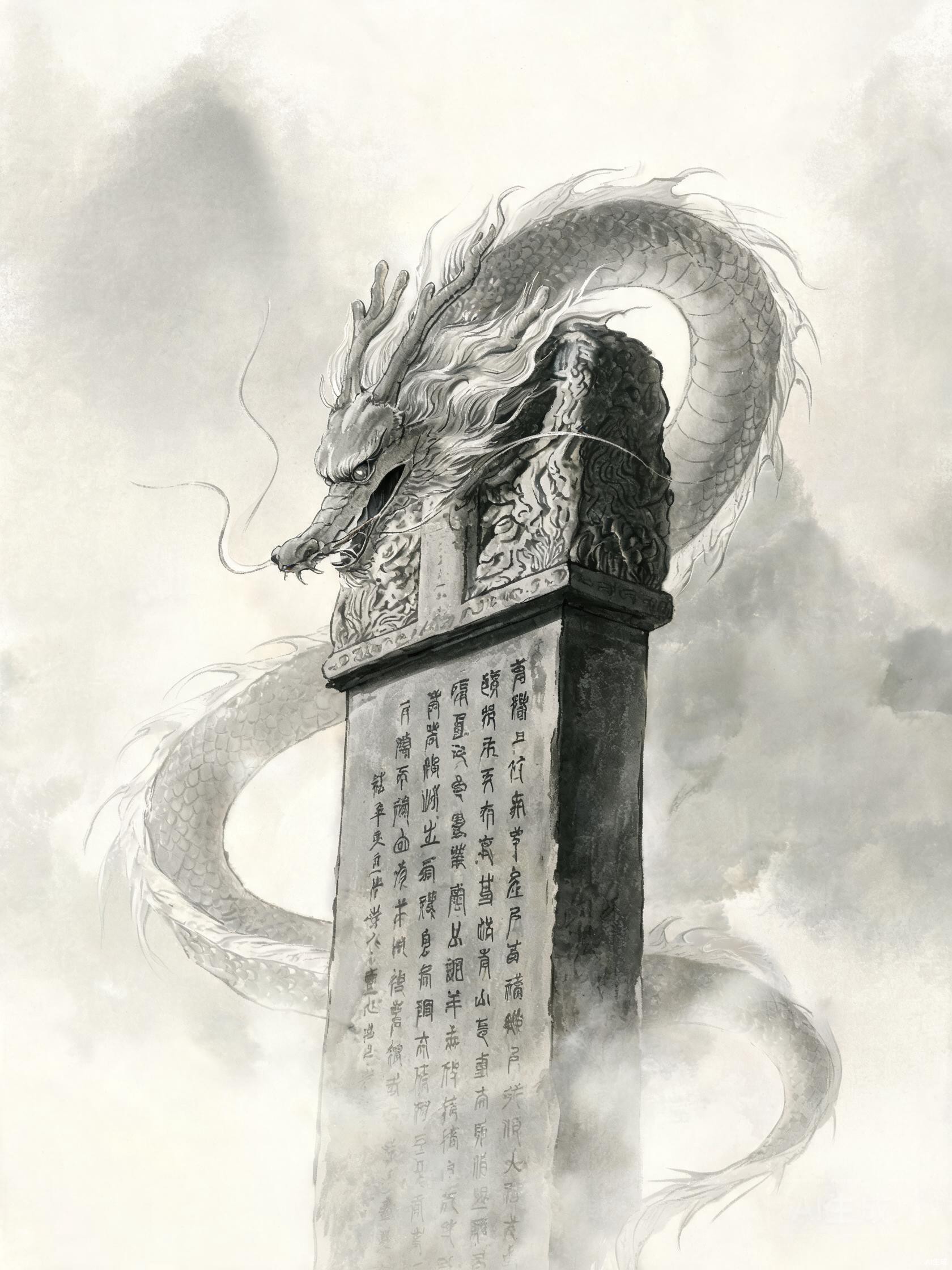
Fuxi
负屃
The scholarly dragon son who coils around the crowns of carved stone tablets.
Origin Story
What Is Fuxi?
Fuxi (not to be confused with the creator god Fuxi 伏羲) is the eighth son of the Dragon, and his passion is the written word. He is a true dragon in form — serpentine and majestic — but his temperament is scholarly. He loves literature, inscriptions, and the carved records of human achievement, and he chooses to dwell among them.
Where his brother Bixi carries the stele on his back, Fuxi coils around its crown, gazing down at the inscriptions as though reading them. The two brothers thus form a complementary pair: Bixi provides the strength to hold the record aloft, while Fuxi provides the reverence that honors what is written there.
Fuxi is the eighth of the Dragon's Nine Sons, a refined dragon with a love of literature and inscribed stone. He coils around the tops of steles, where he perpetually contemplates the carved words of emperors, scholars, and sages below him.
Powers & Symbols
Attributes & Artefacts
Click each card to reveal the details behind Fuxi's divine attributes.
Historical & Cultural Meaning
Beyond the Myth
Fuxi in Architecture and Art
Fuxi appears as the carved dragon coiled around the top section (碑首) of stone steles. His body wraps the stone in elegant curves, his head often raised as if in contemplation of the text below. He is a common sight at temple courtyards, imperial tombs, and memorial sites throughout China.
The placement reflects his character: Fuxi does not guard gates or weapons but attends to the written record. By crowning a stele with his image, the Chinese expressed their reverence for literature itself — the dragon's own son choosing to spend eternity among the words of the worthy.
Symbolism and Cultural Meaning
Fuxi symbolizes scholarship, literary refinement, and the deep Chinese reverence for the written word. In a culture that venerated texts — from imperial edicts to philosophical treatises — Fuxi stood as the divine patron of literacy itself, a dragon son who chose books and inscriptions over battle or treasure.
His pairing with [Bixi](/creatures/bixi) is especially meaningful: together, the two dragon sons embody the union of strength and wisdom that supports civilization. [Bi](/gods/bi-deng)xi supplies the endurance to preserve the record; [Fuxi](/gods/fuxi) supplies the intellect that gives it meaning. A stele graced by both brothers was considered both physically enduring and spiritually honored.
The Nine Sons of the Dragon
[Fuxi](/gods/fuxi) is the eighth of the Nine Sons of the [Dragon](/zodiac/zodiac-dragon) (龙生九子), the legendary offspring of the [Chinese dragon](/creatures/chinese-dragon), each with a unique form and passion. The proverb 'the dragon has nine sons, and each is different' (龙生九子,各有不同) became a familiar idiom for the variety found within a single lineage.
Among the nine, [Fuxi](/gods/fuxi) is the scholar — the son whose devotion is to the written word rather than to war, music, or guardianship. Ming dynasty sources record his love of literature and his place atop steles, where he continues to read the words of the past in perpetual, silent contemplation.
Sources & References
Primary classical texts: Shanhaijing (山海经, Classic of Mountains and Seas, c. 4th-2nd century BCE) · Fengshen Yanyi (封神演义, Investiture of the Gods, c. 16th century) · Journey to the West (西游记, Xiyouji, c. 16th century) · Records of the Grand Historian (史记, Shiji, by Sima Qian, c. 91 BCE) · Classic of Mountains and Seas commentary (郭璞注 Shanhaijing, c. 4th century) · Bamboo Annals (竹书纪年, c. 4th century BCE onwards)
Classical translations: Legge, James (trans.). The Sacred Books of the East (1879-1910, 50 volumes covering Chinese classics) · Girardot, Norman J. Myth and Meaning in Early Taoism (University of California Press, 1983) · Werner, E.T.C. A Dictionary of Chinese Mythology (Shanghai: Kelly & Walsh, 1932)
Modern academic references: Birrell, Anne. Chinese Mythology: An Introduction (Baltimore: Johns Hopkins University Press, 1993) · Yang, Lihui, and Deming An. Handbook of Chinese Mythology (New York: Oxford University Press, 2005) · Strassberg, Richard E. A Chinese Bestiary: Strange Creatures from the Guideways Through Mountains and Seas (Berkeley: University of California Press, 2002)
Digital encyclopedias and online resources: Wikipedia — Chinese mythology portal (continuously updated, citations to primary sources) · Encyclopedia Britannica — Mythology and Religion section
Mythology Network
Connections & Relationships
Fuxi is woven into a larger web of gods, creatures, and legends. Explore the connections below.
Fuxi
负屃

Explore the Topic
Fuxi in the Mythology Network
Go deeper — read the topic guides that gather every creature like Fuxi.