Topic
The Nine Sons of the Dragon
龍生九子 — Nine Heirs of the Dragon, None of Them Dragons
According to one of China's most enduring legends, the dragon fathered nine sons — and not one of them grew into a dragon. Instead, each son inherited a single appetite of the dragon's boundless nature, and each was given a permanent post in Chinese art and architecture: on the crowns of steles, the hooks of bells, the hilts of swords, and the ridges of palaces.
Quick Facts
What Does 'Nine Sons of the Dragon' Mean?

The dragon (long) — father of nine sons, each a fragment of his power
The phrase "nine sons of the dragon" (long sheng jiu zi, 龙生九子) comes from one of the best-known idioms in the Chinese language: long sheng jiu zi, ge you suo hao (龙生九子,各有所好) — "the dragon gave birth to nine sons, and each has his own tastes." For centuries the idiom has been used to describe siblings of the same parents whose characters are entirely different: the farmer's son who becomes a soldier, the merchant's daughter who becomes a poet. It is said with affection rather than disappointment — even the mightiest lineage, the tradition suggests, produces infinite variety.
In Chinese cosmology, "nine" is not a literal count. Nine is the extreme yang number, the largest single digit, and a conventional way of saying "many." The legend's point is not arithmetic but character: the dragon, the most potent creature in the Chinese imagination, sired nine sons who each embodied one fragment of his power. One loved music, one loved battle, one loved literature, one loved to doze in incense smoke, one loved to carry heavy loads. And none of them became dragons — each remained a hybrid being, part dragon and part turtle, wolf, lion, clam, or fish, and each was assigned a lasting role in Chinese material culture.
The legend in its written form is surprisingly late. It was fixed during the Ming Dynasty, when the Hongzhi Emperor (r. 1488–1505) reportedly asked his Grand Secretary Li Dongyang to identify the dragon's nine sons for an imperial inscription. Li could not answer at once; he consulted colleagues and old records, delivered a list, and later recorded the exchange in his collected works, the Huai Lu Tang Ji (怀麓堂集). His answer — nine creatures, nine passions — became the canonical roster. A few decades later the great scholar Yang Shen (1488–1559) published a competing list in his Sheng'an Wai Ji (升庵外集), and the polite argument between the two versions has continued ever since.
The Complete List of the Nine Sons

The Taotie — the bronze-vessel glutton whom Yang Shen counted among the dragon's sons
In the version most commonly cited today — descended from Li Dongyang's Ming Dynasty answer — the nine sons are: Qiuniu (囚牛), the eldest, who loves music and rests on the heads of stringed instruments; Yazi (睚眦), the warrior, who glares from the hilts of swords; Chaofeng (嘲风), the climber, who rides the corner eaves of palaces; Pulao (蒲牢), the roarer, who hangs from the hooks of great bells; Suanni (狻猊), the tranquil one, who sleeps in the smoke of incense burners; Bixi (赑屃), the bearer, who carries stone steles on his shell; Bi'an (狴犴), the judge, who guards prison gates; Fuxi (负屃), the scholar, who coils around the crowns of steles; and Chiwen (鸱吻, also written 螭吻), the youngest, who swallows the ridgepoles of roofs to guard against fire.
The roster, however, is not fixed, and no ancient scripture defines it. Li Dongyang's own original list called the stele-bearer Baxia (霸下) and reserved the name Bixi (赑屃) for the lover of literature — names that later usage quietly exchanged, transferring Bixi to the turtle and coining Fuxi (负屃) for the scholar. Yang Shen's rival version made bolder substitutions: he dropped Qiuniu, Chaofeng, and Fuxi altogether and admitted instead the Taotie (饕餮), the glutton-face of Shang Dynasty bronzes; the Jiaotu (椒图), the snail-shaped guardian of doors; and the Gongfu (蚣蝮), the water-discharging beast of bridges. Later popular culture has largely settled on Li Dongyang's nine while borrowing Jiaotu from Yang Shen as an honorary tenth son. The variations are a feature rather than a flaw — they show the nine sons living as folklore, not as doctrine.
Where to Find Them: A Guide to Chinese Architecture
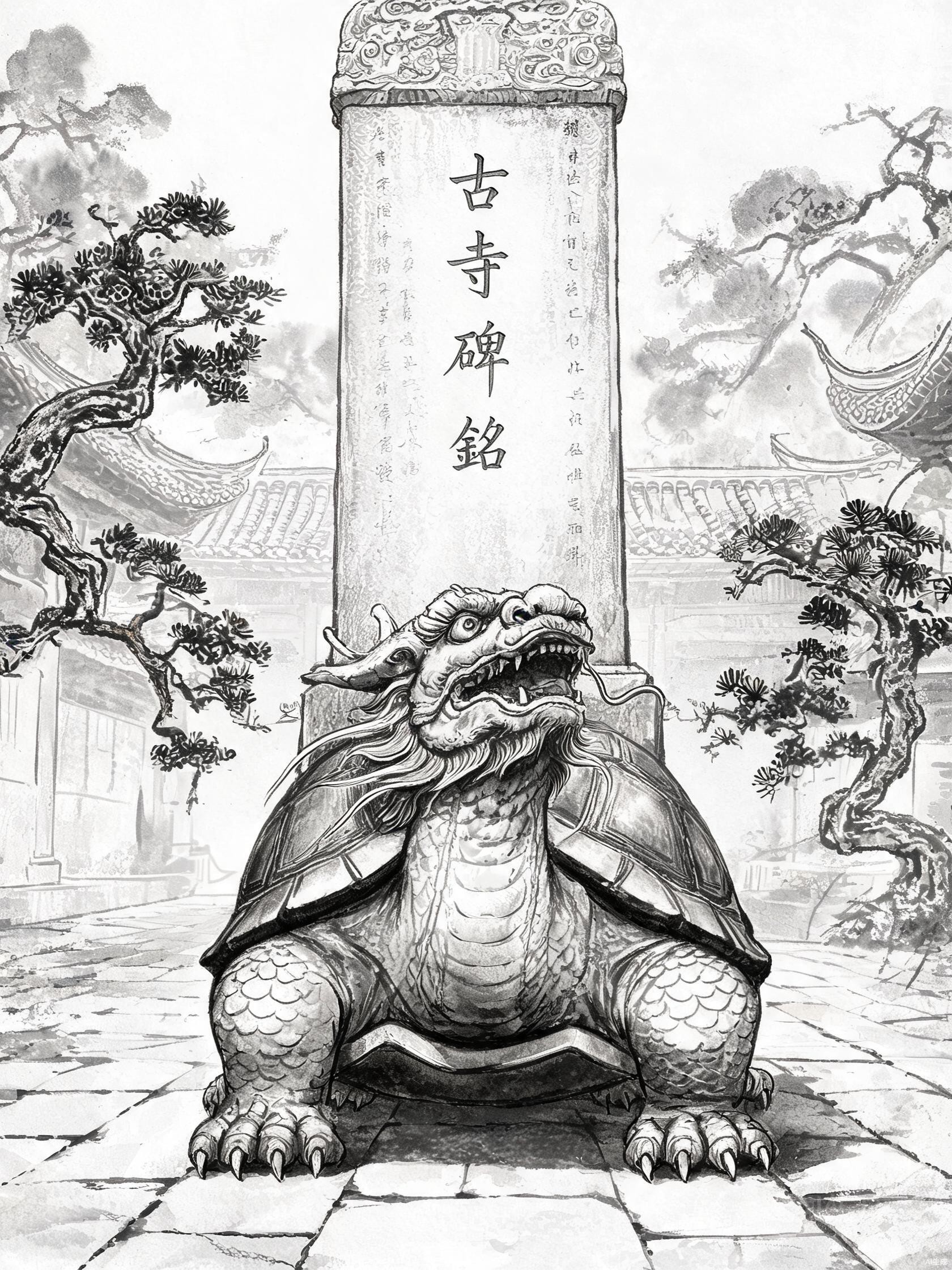
Bixi beneath a stone stele — the most easily spotted of the dragon's nine sons
The genius of the nine sons legend is that it does not live in books — it is written into the buildings and objects of China itself. Every traditional Chinese structure, from a village ancestral hall to the Forbidden City, is a scavenger hunt of dragon sons, each stationed where his particular passion does the most good. Once you can name the nine, you begin to see them everywhere.
Look down at the courtyard first: the vast turtle-shelled Bixi kneels beneath the great stone steles of temples, academies, and imperial monuments, bearing the inscription on his back — while above him, at the very crown of the same stele, his brother Fuxi coils around the carved title. Then look up at the roof: the fish-tailed Chiwen swallows both ends of the main ridge, holding water in his belly against fire, and along the upturned corner eaves Chaofeng rides among the processions of roof beasts. Enter the bell tower and the great bronze bell hangs from the hooked body of Pulao, who roars whenever he is struck. Sit in a temple hall and Suanni dozes on the lid of the incense burner, wreathed in fragrant smoke. At an old courthouse or city gate, the tiger-faced Bi'an glares from the doors of the prison and the magistrate's hall. And in quieter places the eldest sons keep their posts: Qiuniu listens from the carved head of a musician's erhu, and Yazi snarls from the hilt of a general's sword in the museum case.
The placements follow a precise apotropaic logic: each son was set where his love became a duty. The son who loves sound is struck so that he will roar; the son who fears fire is stationed on the roof to meet it; the son who loves justice is made to watch prisoners; the son who loves to carry is loaded with stone. Chinese craftsmen sustained this vocabulary of motifs across two thousand years of bronze-casting, carpentry, masonry, and instrument-making, so that the dragon's fragmented power guards the thresholds, melodies, verdicts, and inscriptions of the civilization.
The Sons in Detail
Each of the nine sons has a story, a temperament, and a two-thousand-year career in Chinese art. Brief portraits of all nine follow below — each links to a full profile where you can explore that son's legend, symbolism, and appearances in depth.
Remember that the list is porous at its edges. In Yang Shen's Ming Dynasty version, the door guardian Jiaotu (椒图) and the bronze glutton Taotie (饕餮) take seats among the nine, and many popular retellings add Jiaotu as a tenth brother regardless of version. Their profiles are included here for completeness.
Why None Became Dragons: The Meaning of the Legend
The strangest and most poignant detail of the legend is its premise: the dragon — supreme among creatures, master of water and sky — produced nine sons, and not one of them became a dragon. Each son is a partial creature, a single appetite of the father given a body of its own. The tradition never explains this as failure; it presents it as nature. The idiom drawn from the legend, "the dragon's nine sons, each with his own tastes," is invoked with a shrug and a smile at every family table where one brother farms and another paints.
The legend carries a quietly radical message: greatness does not require replication. The dragon's greatness lay precisely in containing multitudes — music and war, law and learning, fire and water — and no single son could hold all of it. So each son became the perfect bearer of one quality, and each became indispensable. Qiuniu is not a lesser being for loving music; he is the reason every huqin sings. Chinese thought, with its suspicion of the general and its affection for the particular, found in the nine sons a parable of specialization as a form of devotion — a family in which everyone is different, and everyone belongs.
This is also why Chinese builders and craftsmen embedded the sons in functional positions rather than displaying them as pure ornament. The sons transform the dragon's abstract, cosmic power into a distributed, practical presence: protection at the ridge, justice at the gate, music at the strings, permanence beneath the stele. To walk through a Chinese temple is to walk through a machine of small devotions, each powered by one fragment of dragon nature — a theology expressed not in scripture but in door knockers, bell hooks, and roof tiles.
Spotting Dragon Sons Today
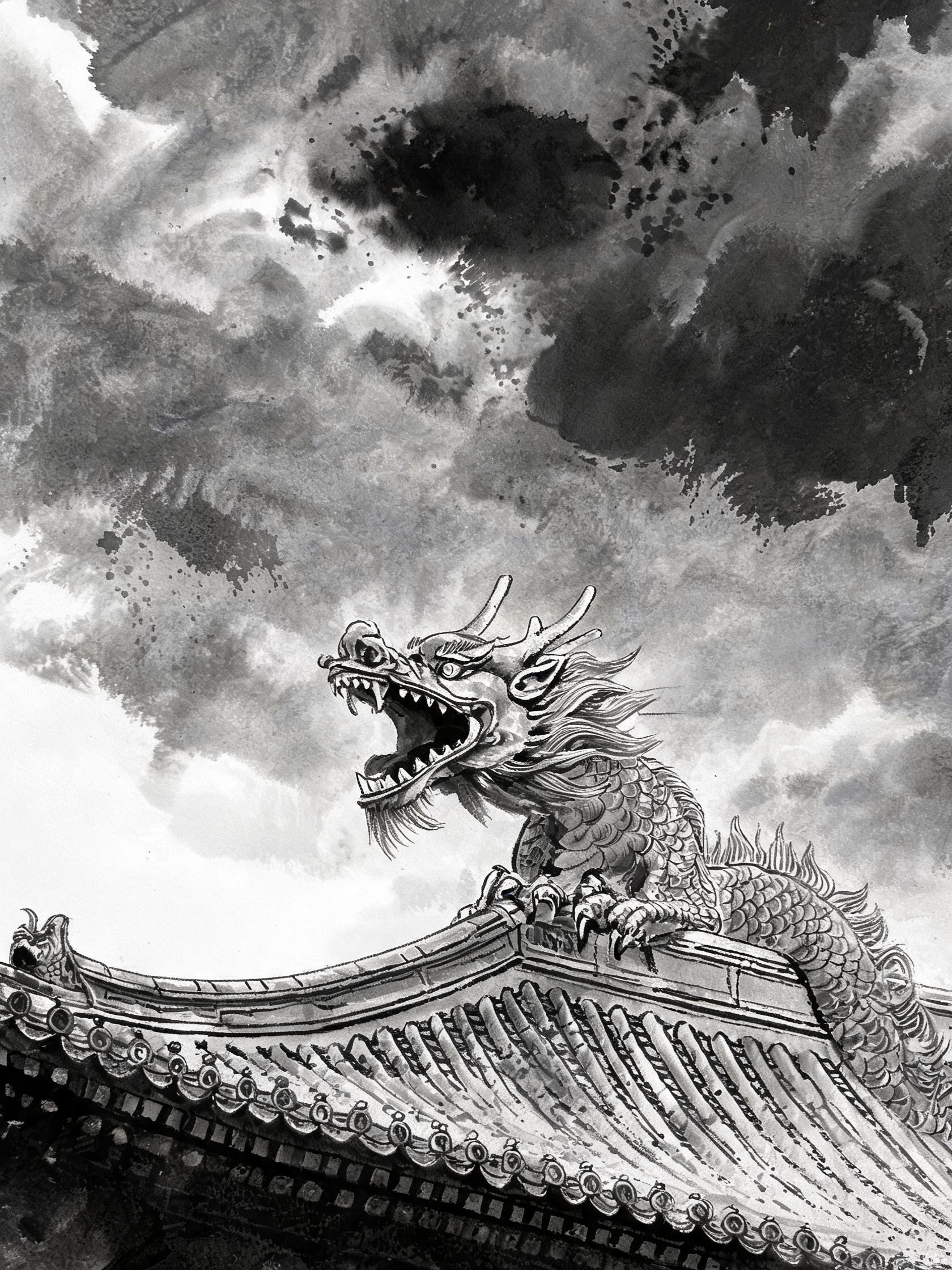
Chiwen on a palace roof — the fire guardian every visitor to the Forbidden City has already seen
The nine sons are not museum relics — they remain in daily view across China and in temples throughout the world, and hunting them is one of the quiet pleasures of Chinese travel. In Beijing's Forbidden City, begin on the roof of the Hall of Supreme Harmony: Chiwen swallows both ends of the main ridge, guarding the imperial throne below, while along the corner eaves the ranked roof beasts include his brother Chaofeng. At the palace gates, the bronze knocker-plates preserve the snail-shaped face of Jiaotu, sealed shut against intruders.
Any temple complex continues the hunt. In the bell towers of Buddhist and Taoist temples, great bronze and iron bells hang from Pulao's hooked back. In the courtyards, the sons of the stele stand together — Fuxi coiled around the crown, Bixi bearing the stone below — a pairing you can verify at the Temple of Confucius in Qufu or among the Forest of Steles in Xi'an. On the altars, Suanni sleeps on the censer lids, inhaling the incense. In the museums, Yazi waits on the bronze swords of the Warring States period, and the ritual vessels of the Shang Dynasty stare back with the face of Taotie.
Even outside China, any Chinatown gate, any garden pavilion, any antique erhu or reproduction censer will harbor a son or two. The lesson of the legend holds: once you can name the nine, the dragon's family assembles around you — the musician, the warrior, the climber, the roarer, the tranquil one, the bearer, the judge, the scholar, and the fire guardian, each at his post, each unmistakably himself.