Bi'an
狴犴
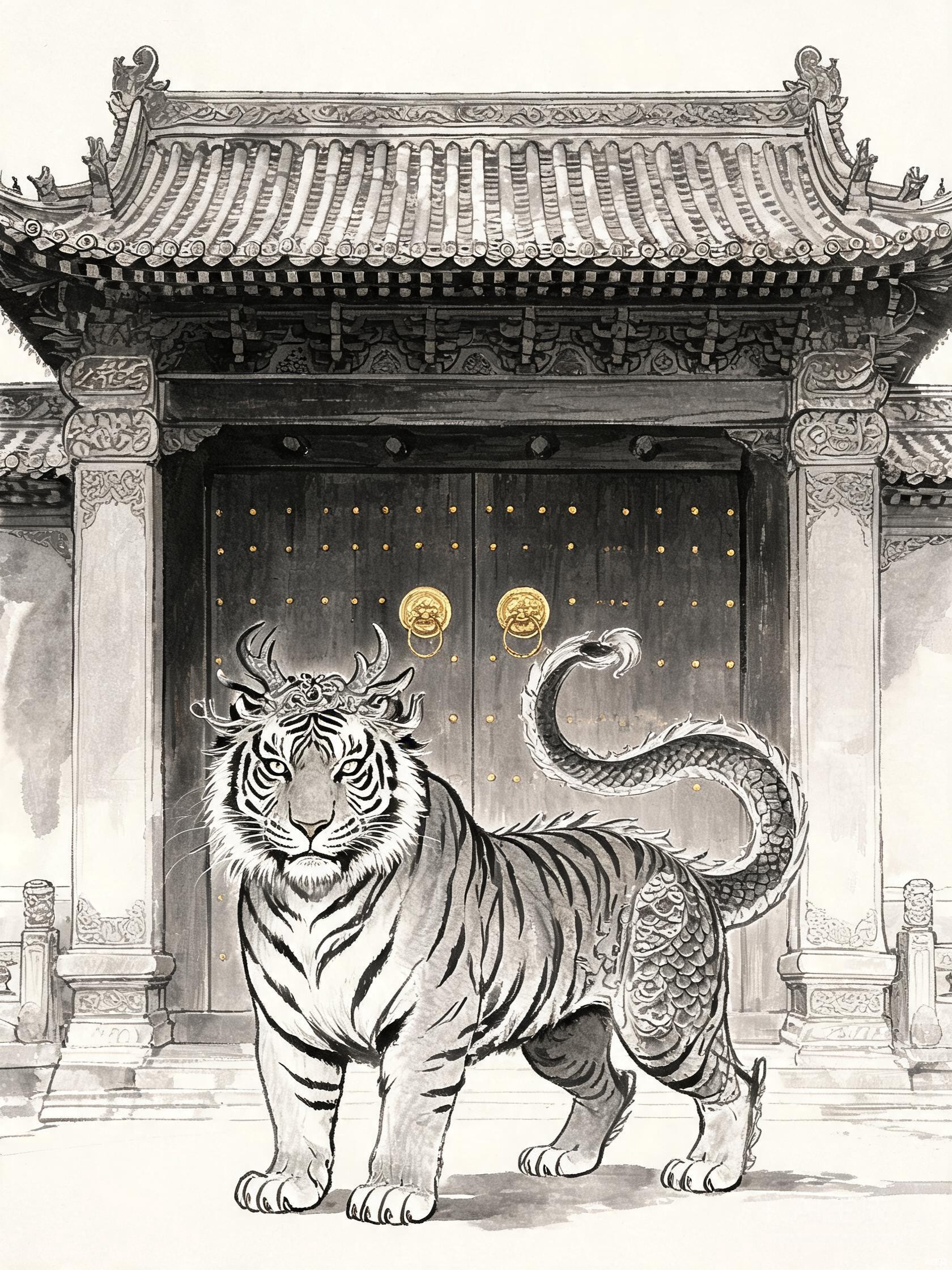
The tiger-like dragon son who guards the gates of justice and watches every trial.
Origin Story
What Is Bi'an?
Bi'an is the seventh son of the [Dragon](/symbols/dragon-symbolism), and he has the appearance of a tiger. Unlike his brothers, who love music, heights, or heavy loads, Bi'an is drawn to [court](/gods/yudi)s of law. He is said to be passionate about justice, fascinated by litigation, and incapable of tolerating corruption or false testimony.
His [tiger ](/folklore/hungry-ghosts)form is significant: in Chinese culture the tiger is the [king of beasts](/creatures/baihu), a symbol of authority and righteous power. By giving Bi'an the tiger's shape, the mythology cast him as the enforcer of justice — a being whose fierce appearance alone was enough to make the guilty tremble and the liars confess.
Bi'an is the seventh of the Dragon's Nine Sons, a [tiger](/creatures/baihu)-like creature devoted to justice and the law. He loves court proceedings and cannot abide wrongdoing, and his image stands at prison gates and courtroom doors, where he oversees trials and deters the corrupt.
Powers & Symbols
Attributes & Artefacts
Click each card to reveal the details behind Bi'an's divine attributes.
Historical & Cultural Meaning
Beyond the Myth
Bi'an in Architecture and Art
Bi'an's image was traditionally placed on the gates of prisons (监狱门) and the doors of government offices and courtrooms (衙门). His [tiger-li](/folklore/hungry-ghosts)ke figure stood watch over the entrances where the accused were brought in and the judged were led out, ensuring that proceedings remained fair and that no injustice passed through his gate.
He also appeared on the wooden boards and banners used in legal proceedings, sometimes bearing the name of the court or the law being enforced. In this capacity Bi'an was not merely a guardian but an active witness — a divine presence that presided over every trial and reminded officials that they, too, were judged.
Symbolism and Cultural Meaning
Bi'an symbolizes justice, integrity, and the impartial enforcement of the law. In [imperial](/gods/jade-emperor) China, where local magistrates held enormous power and corruption was a constant concern, Bi'an served as a divine check — a reminder that even the highest official answered to a higher standard of right and wrong.
His presence at prison gates also carried a dual meaning: he deterred the innocent from false conviction and the guilty from escaping punishment. Bi'an did not favor either side; he favored truth. This made him the patron of honest [magistrate](/gods/cheng-huang)s, advocates, and all who sought a fair hearing in an imperfect system.
The Nine Sons of the Dragon
Bi'an is the seventh of the Nine Sons of the [Dragon](/zodiac/zodiac-dragon) (龙生九子), the legendary offspring of the [Chinese dragon](/creatures/chinese-dragon), each with a distinct form and calling. The proverb 'the dragon has nine sons, and each is different' (龙生九子,各有不同) became a common expression for the surprising variety among siblings.
Among the nine, [Bi](/gods/bi-deng)'an is the magistrate — the son whose passion is not music or war but the fair administration of [law](/gods/cheng-huang). Ming dynasty sources record his tiger form and his love of justice, placing him at the gates of courts and prisons where his watchful presence upheld the integrity of the legal system.
Sources & References
Primary classical texts: Shanhaijing (山海经, Classic of Mountains and Seas, c. 4th-2nd century BCE) · Fengshen Yanyi (封神演义, Investiture of the Gods, c. 16th century) · Journey to the West (西游记, Xiyouji, c. 16th century) · Records of the Grand Historian (史记, Shiji, by Sima Qian, c. 91 BCE) · Classic of Mountains and Seas commentary (郭璞注 Shanhaijing, c. 4th century) · Bamboo Annals (竹书纪年, c. 4th century BCE onwards)
Classical translations: Legge, James (trans.). The Sacred Books of the East (1879-1910, 50 volumes covering Chinese classics) · Girardot, Norman J. Myth and Meaning in Early Taoism (University of California Press, 1983) · Werner, E.T.C. A Dictionary of Chinese Mythology (Shanghai: Kelly & Walsh, 1932)
Modern academic references: Birrell, Anne. Chinese Mythology: An Introduction (Baltimore: Johns Hopkins University Press, 1993) · Yang, Lihui, and Deming An. Handbook of Chinese Mythology (New York: Oxford University Press, 2005) · Strassberg, Richard E. A Chinese Bestiary: Strange Creatures from the Guideways Through Mountains and Seas (Berkeley: University of California Press, 2002)
Digital encyclopedias and online resources: Wikipedia — Chinese mythology portal (continuously updated, citations to primary sources) · Encyclopedia Britannica — Mythology and Religion section
Mythology Network
Connections & Relationships
Bi'an is woven into a larger web of gods, creatures, and legends. Explore the connections below.
Bi'an
狴犴


Explore the Topic
Bi'an in the Mythology Network
Go deeper — read the topic guides that gather every creature like Bi'an.