Yazi
睚眦
The dragon son of vengeance and war, etched onto every blade that seeks blood.
Origin Story
What Is Yazi?
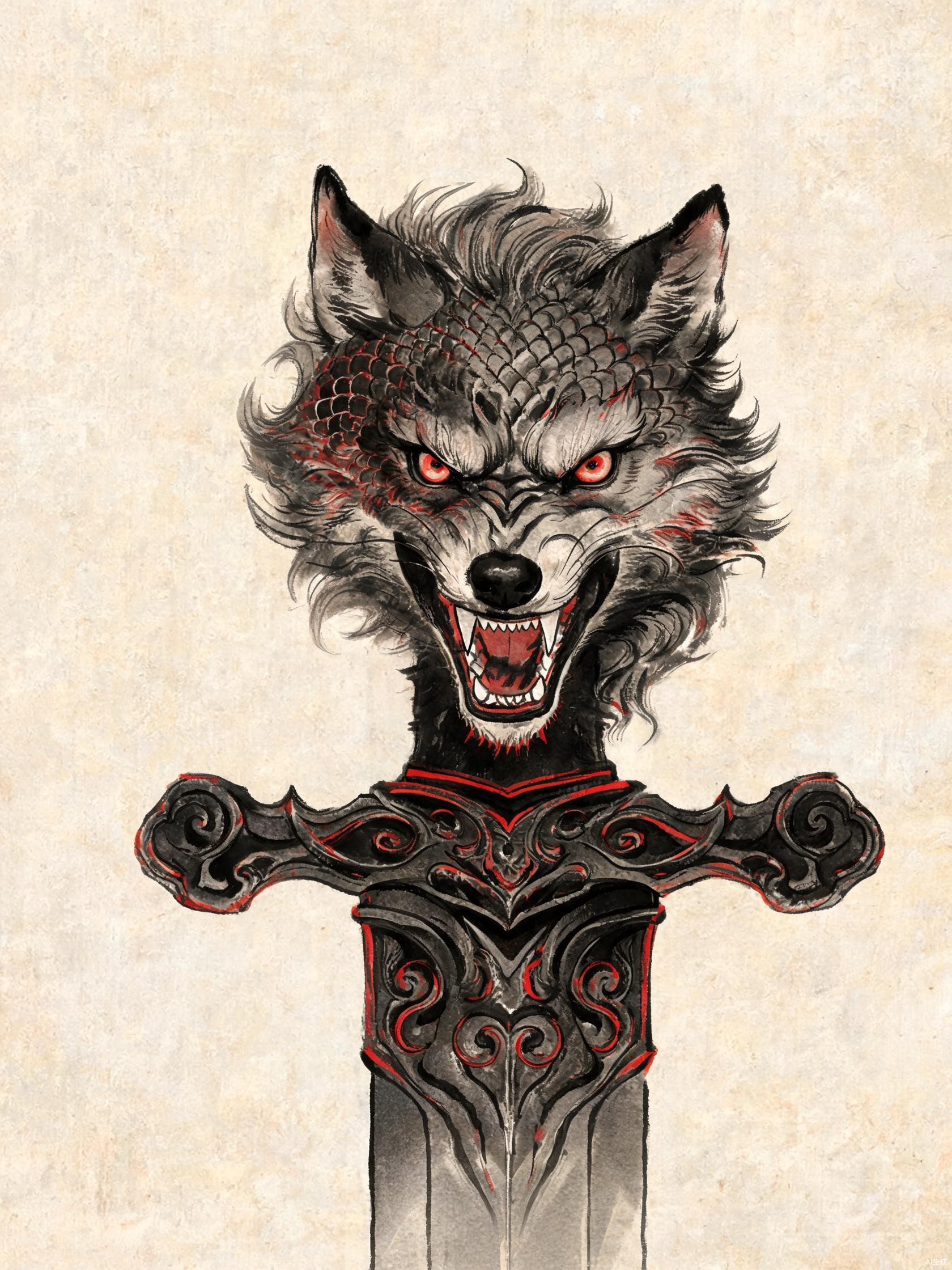
Yazi is the second son of the [Dragon](/symbols/dragon-symbolism) and the most violent of the nine. He is described as having the head of a wolf or jackal atop a dragon's body, with a perpetually snarling mouth full of sharp fangs. Where his elder brother [Qiuniu](/creatures/qiuniu) loves music, Yazi loves battle — and he is never satisfied without blood.
His name gave rise to the Chinese idiom 'yazi bi bao' (睚眦必报), meaning 'to avenge even a glare' — to hold a grudge for the smallest slight and repay it with force. This captures Yazi's essence: a creature of absolute, unflinching vengeance who never lets an offense pass, however small.
Yazi is the second of the Dragon's Nine Sons, a fierce and vengeful creature with the head of a wolf and the body of a dragon. He loves killing and combat, and his snarling likeness is forged onto the hilts and guards of swords, sabers, and axes to channel his bloodlust into every strike.
Powers & Symbols
Attributes & Artefacts
Click each card to reveal the details behind Yazi's divine attributes.
Historical & Cultural Meaning
Beyond the Myth
Yazi in Architecture and Art
Yazi's image is forged onto weapons rather than buildings. Sword smiths carved his snarling wolf-dragon head onto the hilts, guards, and pommels of swords, sabers, and daggers, believing his spirit would lend the blade ferocity and ensure no enemy escaped unavenged.
Unlike the protective dragon sons placed on roofs or bells to ward off misfortune, Yazi's purpose is aggressive: he exists to make weapons deadlier and warriors more ruthless. A blade bearing Yazi was considered not just a tool but a vessel of the creature's relentless hunger for combat.
Symbolism and Cultural Meaning
Yazi embodies the martial spirit and the concept of absolute justice through force. In Chinese warrior culture, he represented the conviction that wrongs must be answered and that a warrior's blade carries a duty of vengeance. He was the patron of soldiers, swordsmen, and those who lived by the code of repayment.
At the same time, Yazi serves as a cautionary symbol. The idiom 'yazi bi bao' warns against pettiness and disproportionate vengeance — the danger of treating every small slight as a mortal offense. He is both revered and feared, a reminder that the desire for retribution, while powerful, can consume those who indulge it too freely.
The Nine Sons of the Dragon
Yazi is the second of the Nine Sons of the [Dragon](/zodiac/zodiac-dragon) (龙生九子), the legendary offspring of the [Chinese dragon](/creatures/chinese-dragon), each with a unique form and nature. The proverb 'the dragon has nine sons, and each is different' (龙生九子,各有不同) highlights how even a single lineage can produce wildly varied temperaments.
Among the nine, [Yazi](/creatures/yazi) stands as the warrior — the son who inherited his father's power but none of his benevolence. His placement on blades, recorded in Ming dynasty sources, reflects a culture that understood violence as a necessary, if dangerous, instrument of order.
Sources & References
Primary classical texts: Shanhaijing (山海经, Classic of Mountains and Seas, c. 4th-2nd century BCE) · Fengshen Yanyi (封神演义, Investiture of the Gods, c. 16th century) · Journey to the West (西游记, Xiyouji, c. 16th century) · Records of the Grand Historian (史记, Shiji, by Sima Qian, c. 91 BCE) · Classic of Mountains and Seas commentary (郭璞注 Shanhaijing, c. 4th century) · Bamboo Annals (竹书纪年, c. 4th century BCE onwards)
Classical translations: Legge, James (trans.). The Sacred Books of the East (1879-1910, 50 volumes covering Chinese classics) · Girardot, Norman J. Myth and Meaning in Early Taoism (University of California Press, 1983) · Werner, E.T.C. A Dictionary of Chinese Mythology (Shanghai: Kelly & Walsh, 1932)
Modern academic references: Birrell, Anne. Chinese Mythology: An Introduction (Baltimore: Johns Hopkins University Press, 1993) · Yang, Lihui, and Deming An. Handbook of Chinese Mythology (New York: Oxford University Press, 2005) · Strassberg, Richard E. A Chinese Bestiary: Strange Creatures from the Guideways Through Mountains and Seas (Berkeley: University of California Press, 2002)
Digital encyclopedias and online resources: Wikipedia — Chinese mythology portal (continuously updated, citations to primary sources) · Encyclopedia Britannica — Mythology and Religion section
Mythology Network
Connections & Relationships
Yazi is woven into a larger web of gods, creatures, and legends. Explore the connections below.
Yazi
睚眦



Explore the Topic
Yazi in the Mythology Network
Go deeper — read the topic guides that gather every creature like Yazi.