Topic
Folk Deities of China
民间神祇 — Gods of Daily Life
Beneath the formal pantheons of Buddhism and Taoism lies a third layer — the folk deities of everyday Chinese life, the gods who guard the kitchen stove, the village gate, and the marriage bed.
Quick Facts
The Folk Gods of the Chinese Hearth

Guan Yu — the most beloved folk deity of war, brotherhood, and business success
Long before the formal systems of Buddhism, Taoism, and Confucianism were codified, the Chinese people worshipped the spirits of the hearth, the village, the field, and the ancestors. These folk beliefs — the most ancient layer of Chinese religion — gave rise to a vast pantheon of local deities whose role is to protect, prosper, and bless the ordinary events of daily life. Unlike the cosmic deities of Buddhism and Taoism, the folk gods are close to humans — they govern the kitchen stove, the marriage bed, the village gate, and the city wall.
The folk deities are often deified historical figures. Guan Yu (關羽), the famous general of the Three Kingdoms era, became a god of war and brotherhood. Bao Zheng (包拯), the upright Song Dynasty magistrate, became a god of justice. Lin Moniang (林默娘), the historical Fujianese girl who saved sailors, became Mazu, the goddess of the sea. The elevation of historical figures to divine status is a distinctive feature of Chinese folk religion — the gods are not distant cosmic beings but people who lived, suffered, and acted heroically, and whose virtues earn them eternal remembrance.
The structure of folk religion is decentralized. Each village has its own Earth God (Tudi Gong), each city has its City God (Cheng Huang), each home has its Kitchen God (Zao Jun). These local deities are organized into a hierarchy that mirrors the imperial bureaucracy — the Earth God reports to the City God, who reports to the provincial deities, who report to the Jade Emperor himself. This bureaucratic organization is one of the most distinctive features of Chinese folk religion, and it gives the entire supernatural world a familiar, earthly, administrative quality.
The folk deities are not in competition with Buddhism and Taoism — they coexist, often share temples, and are sometimes venerated by the same person. A Chinese family might worship Guanyin (Buddhist) at the family shrine, Guan Yu (folk) at the village temple, and Yuanshi Tianzun (Taoist) at the cosmic level. This syncretism is not seen as contradictory — it is a sign of the richness and flexibility of Chinese religious life, in which all the divine powers work together to bless the human world.
Guan Yu: God of War, Brotherhood, and Business
Guan Yu (關羽, c. 160–220 CE) was a famous general of the Three Kingdoms period who served Liu Bei of Shu Han alongside Liu Bei's sworn brother Zhang Fei. He was captured and executed by the rival state of Wu in 219 CE. In life, he was a fearsome warrior renowned for his loyalty, integrity, and martial prowess. After death, he became one of the most widely worshipped deities in China, with a religious role that has evolved across nearly two millennia.
In the early imperial period, Guan Yu was worshipped primarily as a god of war. Temples dedicated to him were built at strategic locations throughout China, and the imperial court conferred titles on him, eventually elevating him to 'Emperor Guan' (Guan Di, 關帝) — the divine lord Guan. The Buddhist tradition absorbed him as Sangharama (Qielan, 伽藍), the protector of Buddhist monasteries, and gave him a place of honor in the grounds of every Buddhist temple. The Taoist tradition also venerated him as one of its divine generals.
In modern Chinese folk religion, Guan Yu's role has expanded enormously. He is now worshipped as: a god of war and martial valor (his original role); a god of brotherhood and loyalty (the basis of sworn brotherhoods, business partnerships, and gang codes); a god of business and financial success (almost every Chinese business has a shrine to him); a god of justice and integrity (especially popular among police and judges); and a god of protection from evil (in Daoist exorcism rituals, he is the central figure). He is said to be especially powerful in the protection of contracts and the punishment of those who break their word.
Guan Yu's Red Faces Festival (Guan Sheng Di Jun Shengri) is celebrated on the thirteenth day of the fifth lunar month. His statues are found everywhere — in temples, in homes, in businesses, in police stations. His distinctive green robes and his long beard (he is called 'Lord Guan with the Beautiful Beard,' Meihou Guan, 美髯公) make him instantly recognizable. The opera tradition of 'Guan Yu's Appearance on Stage' (Guan Gong Qichu, 關公起出) is considered the most demanding role in Chinese opera — his face must be painted entirely red, his bearing must be solemn, and his bearing must convey both martial fury and moral integrity.
The Kitchen God: Watcher of the Hearth
The Kitchen God (Zao Jun, 灶君, also known as Zao Wang, 灶王) is the god who watches over the kitchen stove and the family hearth. He is one of the most intimate of Chinese deities — his statue (or name, written on red paper) is in nearly every traditional Chinese home, mounted near the kitchen stove. He watches over the family's behavior and reports annually to the Jade Emperor on the family's conduct.
According to folk belief, the Kitchen God ascends to heaven on the twenty-third day of the twelfth lunar month (called 'Little New Year,' Xiao Nian, 小年) to report on the family's deeds of the past year. On that day, families smear honey or sweet sticky rice on his image (so his words will be sweet to the Jade Emperor), burn incense, and offer sacrifices. When the image has been thoroughly burned (sending the god's spirit back to heaven), the family is ready to welcome the new year.
The Kitchen God's role is not just surveillance but also protection. He is the deity who ensures the family's prosperity and good fortune, and his image in the home is a constant reminder to live virtuously. The custom of welcoming a new Kitchen God (often by pasting a fresh image at New Year) is one of the most intimate Chinese religious rituals — it is the moment when the family welcomes a divine guest into the most private space of the home.
The origin of the Kitchen God is ancient and somewhat confused. Some traditions identify him as a deified historical figure — perhaps a minister of the legendary Yellow Emperor, or the moral scholar Zhang Lan. Other traditions see him as a generic spirit of the hearth — the spirit of fire that watches over the cooking and the family. The most common representation is a married couple (Zao Jun and his wife Zao Po, 灶婆) — the divine husband and wife who share the kitchen domain. In northern China, the Kitchen God is sometimes identified with Zao Wang Yeye (灶王爺爺, Grandpa Kitchen King), an elderly divine grandfather figure who is approachable and friendly.
The Earth God and the City God: Local Protectors
The Earth God (Tudi Gong, 土地公, also called Tudi Ye, 土地爺, 'Grandpa Earth') is the local protector of a specific piece of land — usually a village, a neighborhood, or a small district. His shrines (often small stone shrines, sometimes no more than a niche with a small statue) are found at the edges of villages, at the foot of bridges, at the entrances to fields, and in the corners of neighborhoods. He is the most local of Chinese deities — the god who watches over a specific piece of land and its inhabitants.
The Earth God's role is primarily to bless the local community with prosperity, fertility, and peace. He is invoked by farmers before planting, by merchants before opening a new business, by families before moving into a new home. His festivals are local and communal — the 'Earth God's Birthday' is celebrated on the second day of the second lunar month and on other dates, with offerings of food, incense, and firecrackers. He is approachable, sometimes even whimsical — he is depicted as a kindly elderly man with a long white beard, often accompanied by a tiger or a deer (his servants).
The City God (Cheng Huang, 城隍) is a higher-ranking local deity, presiding over an entire city. His temples (Cheng Huang Miao, 城隍廟) are found in every Chinese city — sometimes among the most important and elaborate temples in the city. The City God's role is broader than the Earth God's — he protects the city from disasters, punishes criminals, judges disputes, and oversees the local moral order. He is often identified with a deified local official whose virtue was especially notable.
The hierarchy of the Earth God, City God, and provincial deities forms the local layer of the cosmic bureaucracy. The Earth God reports to the City God; the City God reports to the provincial deities; and the provincial deities report to the Jade Emperor. This bureaucratic structure makes Chinese folk religion feel like an extension of the imperial administration into the supernatural world — even the gods are organized into ministries and jurisdictions. When something goes wrong in a community, it is the Earth God and City God who are first petitioned; only major concerns are taken to higher deities.
Yue Lao: The Matchmaker of the Heavens
Yue Lao (月老, 'Old Man Under the Moon') is the god of marriage and love, the celestial matchmaker who ties the red threads of fate. According to legend, he keeps a book listing every marriage that is destined to occur, and he binds each couple with a red thread tied to their ankles. The thread cannot be cut or untied; it pulls the two toward each other across any distance, any obstacle, any lifetime. He is the deity to whom young people pray when seeking a marriage partner, and he is widely revered in Chinese folk religion.
Yue Lao's iconography is distinctive: he is depicted as an elderly man with a long white beard, often smiling, and carrying a book (the Book of Fate) and a red thread. He appears most commonly at temples dedicated to him, which are often found near sites associated with the Mid-Autumn Festival (the festival of love and marriage). The Moon Temple in various Chinese cities has shrines to Yue Lao, where unmarried people come to pray for a good match.
The red thread (Hong Xian, 紅線) is Yue Lao's primary symbol. In popular belief, the red thread connects two destined partners from birth, no matter how far apart they may be. Many Chinese stories tell of lovers who meet through impossible coincidences, finding each other despite great obstacles — these are said to be the work of Yue Lao. Conversely, those who have difficulty finding a partner may be told that 'Yue Lao has not yet tied the thread' — meaning the destined match has not yet been made.
Yue Lao's mythology is closely associated with the Tang Dynasty novel 'A Marriage Predestined by the Gods' (Fengshen Yanyi). In the novel, he appears as a celestial bureaucrat who keeps the records of marriage and binds the threads. In modern popular culture, Yue Lao is a beloved figure — his shrines are often visited by single adults seeking a partner, especially around the Qixi Festival (the Chinese Valentine's Day, on the seventh day of the seventh lunar month) and during the Mid-Autumn Festival.
Caishen and the Gods of Wealth
Caishen (財神, 'God of Wealth') is the deity of prosperity and financial success, one of the most popularly worshipped deities in modern Chinese folk religion. He is invoked by businesses and individuals seeking wealth, success, and good fortune. There are several distinct Caishen figures in Chinese religion — most famously Bi Gan (比干), the Shang Dynasty loyal minister who gave his heart to save his king; Zhao Gongming (趙公明), the legendary Taoist deity of wealth; and the Five Gods of Wealth (Wu Lu Caishen, 五路財神), a group of five deities governing the five directions of wealth.
Bi Gan's story is particularly poignant. As the uncle of the tyrant King Zhou of Shang, Bi Gan remonstrated with his nephew's cruelty and was punished by having his heart cut out. He became a god of wealth because, according to legend, a man without a heart cannot be biased — he can dispense wealth with absolute impartiality. His worship spread during the Tang Dynasty, and today he is one of the most popular figures of Caishen veneration.
Zhao Gongming is the Taoist deity of wealth, said to have the power to bring riches from the five directions. He is associated with the Jade Emperor's forces in the Investiture of the Gods and is sometimes depicted with a black tiger (his mount) and a whip (which he uses to drive away bad luck). His temple festivals are popular occasions for seeking financial blessing, especially among merchants and small business owners.
The worship of Caishen involves many specific rituals. On the fifth day of the first lunar month (Caishen Dan, 財神誕), businesses reopen after the New Year with offerings of incense, firecrackers, and food. The Caishen image (usually a smiling figure holding a gold ingot) is placed in the household or business, often on the left side of the entryway (the side of wealth in Feng Shui). Caishen is closely associated with prosperity practices that blend folk religion, Feng Shui, and Taoist magic.
The Dragon Kings and Water Deities
The Dragon) Kings (Long Wang, 龍王) are the deities of the seas, rivers, and rainfall. According to Chinese mythology, the four seas of the world are each ruled by a Dragon King, and additional Dragon Kings govern the major rivers (the Yellow River, the Yangtze, the Pearl River) and the rain of the various regions. Their temples are often found near water — at harbors, river mouths, and wells — and they are invoked by sailors, fishermen, and farmers seeking favorable conditions.
The Dragon) Kings are not benign deities — they are temperamental and powerful, capable of drowning ships, flooding fields, or withholding rain. To placate them, communities hold regular festivals, offer sacrifices of food and incense, and stage elaborate dragon boat races. The Dragon Boat Festival (Duanwu Jie) is in part a celebration in honor of the Dragon Kings, in part a memorial to the loyal minister Qu Yuan. The rice dumplings (zongzi) thrown into the river were originally offerings to the dragons to prevent them from eating Qu Yuan's body.
The Dragon) Kings have their own celestial bureaucracy — under the supreme Dragon King of the Four Seas are countless lesser dragon officials, each governing a specific body of water or a specific weather pattern. The Monkey King Sun Wukong famously challenges the Dragon Kings in the Journey to the West, demanding his weapon from the Dragon King's underwater palace. The Dragon Kings' daughter in the novel even marries one of the pilgrims.
Modern folk religion still venerates the Dragon) Kings in many regions of China. Coastal communities hold Dragon King festivals at the start of the fishing season. Farmers in drought-stricken regions pray to the Dragon Kings for rain. The Dragon Kings embody the Chinese conception of water as a divine and unpredictable force — neither to be worshipped passively nor to be trifled with, but to be respected and propitiated through ritual.
Yanluo Wang and the Gods of the Underworld
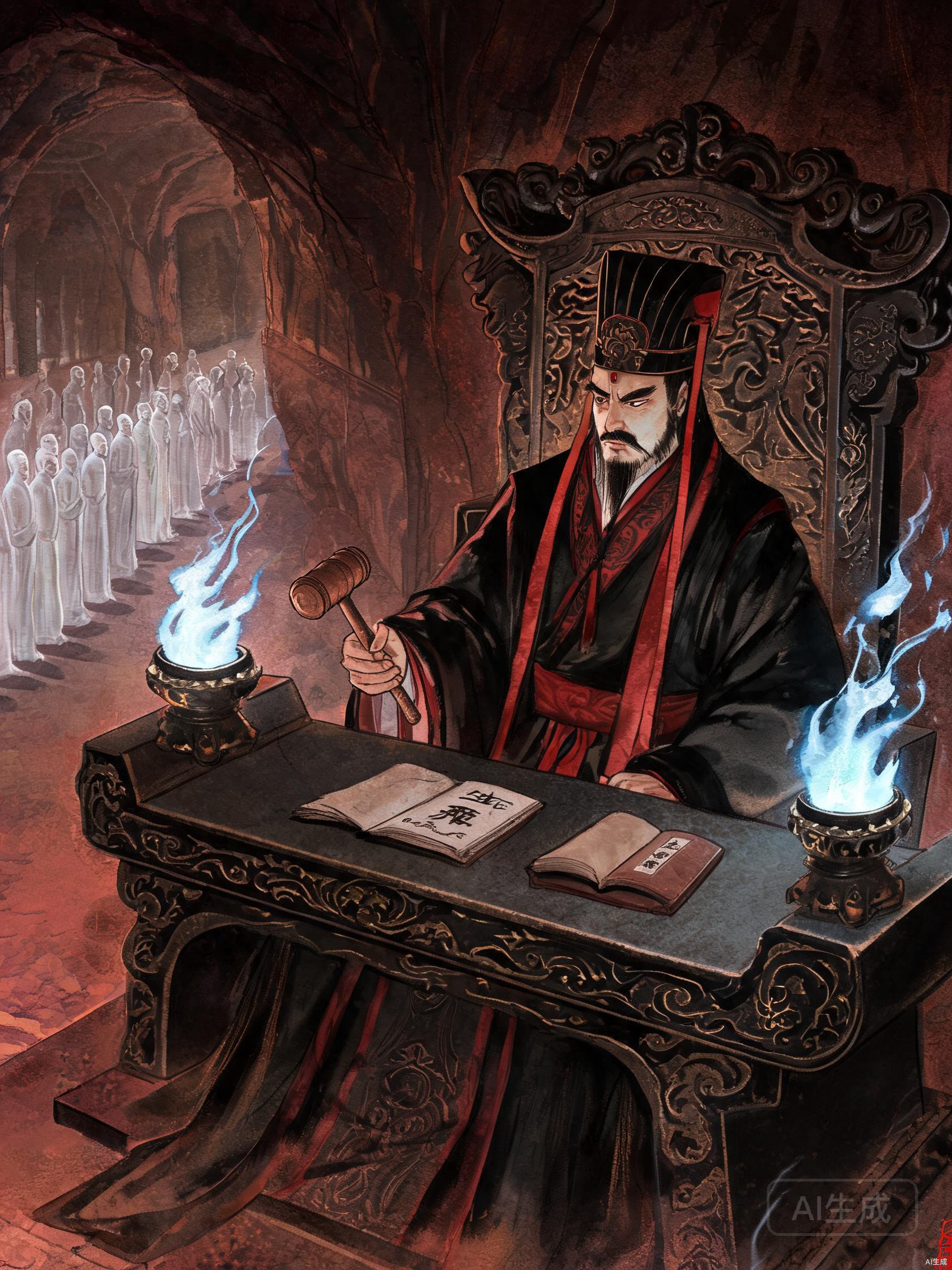
Yanluo Wang — the bureaucratic King of Hell
Yanluo Wang (閻羅王, King Yama, also called Yanluo or Yama) is the King of Hell and the supreme judge of the dead. Originally an Indian deity imported with Buddhism, Yanluo has been thoroughly sinicized into the head of a vast celestial bureaucracy governing the underworld. He is one of the Ten Kings of Hell, presiding over the fifth court, but is by far the most famous and most often depicted.
Yanluo Wang's temple or shrine is found in most Chinese cities, often within the City God temple complex. He is depicted as a stern, dignified figure in the robes of an imperial magistrate, seated behind a great desk, with his scribes recording the deeds of the dead. His assistants — the Ox-Head and Horse-Face, the Black and White Impermanence — escort the souls of the dead to his court. He is not a deity to be approached lightly; he is the final arbiter of moral conduct.
The mythology of Yanluo Wang combines Buddhist karma with Chinese bureaucratic imagery. The dead arrive at his court and are judged according to their deeds — the virtuous are sent to heaven or allowed to reincarnate, the wicked are sent to one of the eighteen hells for appropriate punishment. The punishments are elaborate and specific — a thief might be forced to have his hands cut off repeatedly, a liar might have his tongue pulled out, an adulterer might be ground between stones. After the sentence is served, the soul is reborn.
The living can help the deceased through Yanluo's court through merit transfer — by performing good deeds on behalf of deceased relatives, sponsoring Buddhist rituals, copying sutras, or commissioning temple artwork. This practical theology gives Buddhism and folk religion a central place in Chinese ancestor veneration. The Ghost Festival (Zhongyuan Jie) is in part a celebration of the underworld bureaucracy, when the gates of hell are opened and the dead are welcomed back to the world of the living.
Syncretism with Buddhism, Taoism, and Confucianism
Chinese folk religion is not an isolated tradition but a layer that permeates all of Chinese religious life. The folk deities are venerated in Buddhist temples (Guan Yu as Sangharama, Mazu as a Guanyin incarnation), in Taoist temples (the City God and Earth God as Taoist officials), and at Confucian shrines (ancestral tablets). The same person might pray to a Buddhist bodhisattva in the morning, a Taoist deity at noon, and a folk god in the evening — without seeing any contradiction.
This syncretism is the most distinctive feature of Chinese folk religion. The folk gods are not in competition with the higher deities — they are local specialists within a single, vast spiritual order. A farmer might pray to the Earth God for a good harvest, to the Dragon King for rain, to the Kitchen God for family harmony, to Guan Yu for protection from bandits, and to the Buddha or Taoist saints for spiritual liberation — all as part of one comprehensive religious life.
The folk religion also incorporates ancestor veneration — the most important practice of Chinese family religion. The ancestral tablets (zuxing pai, 祖姓牌) are venerated alongside the household gods, and the deceased are honored at festivals, at New Year, and at specific memorial days. The boundary between folk religion and ancestor veneration is permeable — deceased ancestors are often worshipped as gods, and folk gods are sometimes identified with deceased family members.
In modern China, despite the official secularization of the past century, folk religion continues to thrive. Many Chinese homes still have a small altar or shrine with images of the folk deities — Guan Yu, the Kitchen God, the Earth God, Caishen. Major festivals still bring families to temples for communal worship. The folk deities remain active in the Chinese religious imagination, governing the rhythms of daily life, protecting communities, and bringing prosperity, harmony, and good fortune to those who venerate them properly.