Ox-Head and Horse-Face
牛头马面
The fearsome guardians of the underworld who capture and drag souls to judgment.
Origin Story
The Enforcers of the Underworld
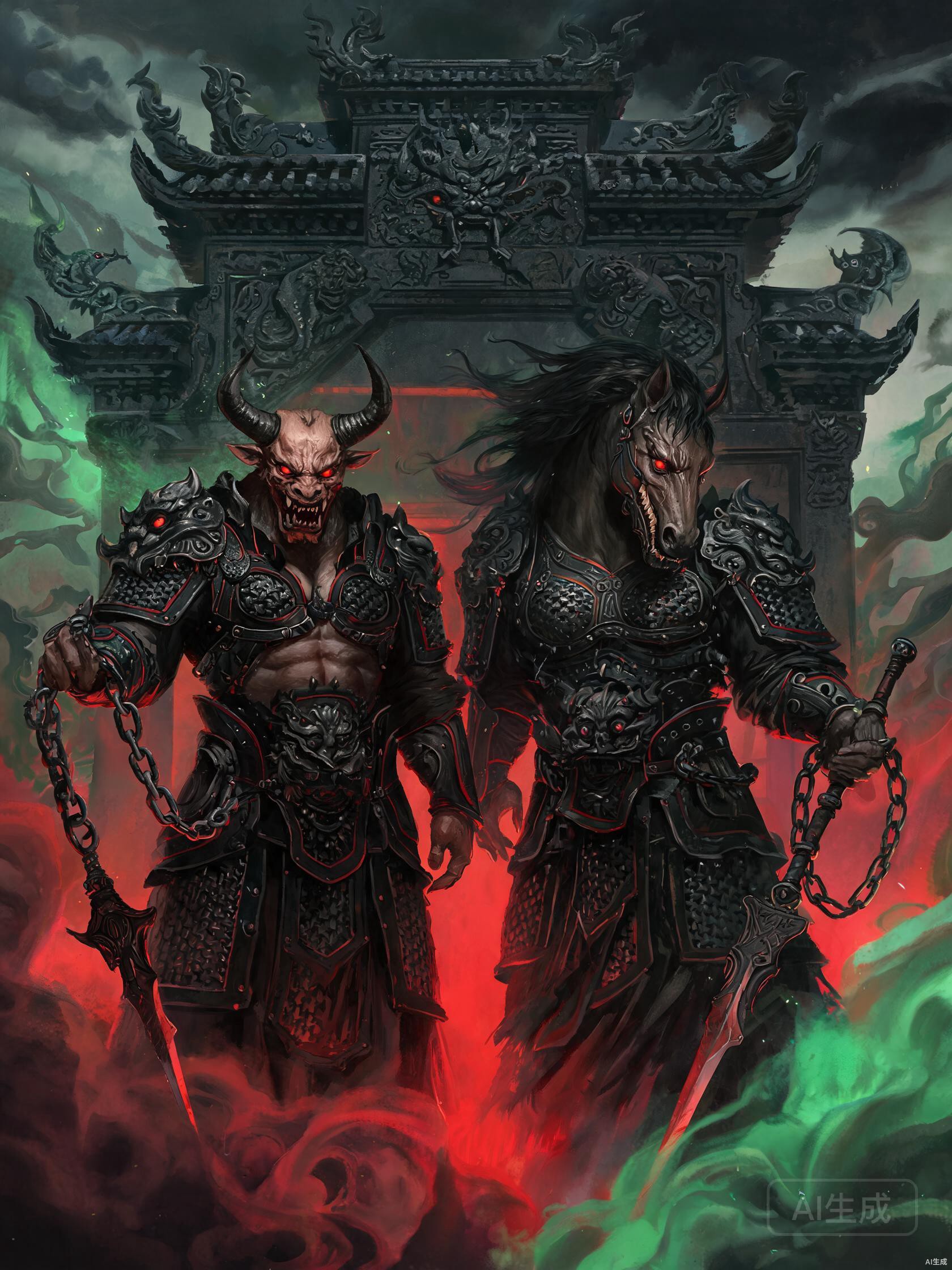
Ox-Head and Horse-Face are the muscle of the Chinese underworld. While the Black and White Impermanence escort souls who accept their death, Ox-Head and Horse-Face are dispatched for the difficult cases — souls who resist, hide, or try to escape their fate. They are the bounty hunters of the spirit world.
Ox-Head ([Niu Tou](/folklore/ox-head-horse-face)) is depicted as a towering figure with the head of a bull, wielding an iron fork or chain. His immense physical strength makes him impossible to resist. In some traditions, he is identified with a minor deity from Buddhist cosmology, adapted into Chinese folk religion as the underworld's primary enforcer.
Horse-Face (Ma Mian) has the head of a horse and is known for his speed — no soul can outrun him. Together, the pair complement each other: Ox-Head provides the power to restrain, and Horse-Face provides the speed to pursue. Their animal heads connect them to the ancient Chinese practice of animal sacrifice and the belief that animals served as intermediaries between the human and spirit worlds.
Ox-Head (Niu Tou) and Horse-Face (Ma Mian) are a pair of underworld guardians in Chinese folk religion. With the heads of a bull and a horse on human bodies, these fearsome beings serve as the enforcers of the underworld, capturing wandering souls and dragging them before Yanluo Wang, the King of Hell, for judgment.
Powers & Symbols
Attributes & Artefacts
Click each card to reveal the details behind Ox-Head and Horse-Face's divine attributes.
Historical & Cultural Meaning
Beyond the Myth
Guardians of the Underworld Gates
Beyond catching escaped souls, Ox-Head and Horse-Face serve as guards at the various gates and checkpoints of the underworld. They stand at the entrance to Diyu, ensuring that no soul enters or leaves without proper authorization. They also patrol the various hells, maintaining order among the suffering souls.
In some folk tales, they are not merely enforcers but also interrogators — questioning newly arrived souls about their deeds in life before escorting them to the appropriate hell for punishment. Their role thus combines the functions of prison guard, bounty hunter, and preliminary examiner.
Despite their fearsome appearance, they are not evil. They are functionaries of the karmic system, carrying out the cosmic justice that determines each soul's fate. Their animal heads are a visual reminder that the underworld operates by its own laws — laws that are older than civilization and as implacable as nature itself.
From Buddhism to Folk Religion
Ox-Head and Horse-Face likely originated from Buddhist cosmology, where animal-headed guardians (yakshas and pancikas) protected the underworld realms. As Buddhism merged with Chinese folk religion during the Tang and Song dynasties, these figures were adapted to fit the Chinese bureaucratic model of the underworld.
In pure Buddhist tradition, the underworld is a temporary place of purification, not eternal damnation. But in Chinese folk religion, which blended Buddhist, Taoist, and indigenous beliefs, the underworld became a complex bureaucratic system with [Yanluo Wang](/folklore/yanluo-wang) as its chief judge, assisted by a hierarchy of officials, guards, and functionaries — of which [Ox](/zodiac/zodiac-ox)-Head and [Horse](/zodiac/zodiac-horse)-Face are the most recognizable.
Today, their images are common in Chinese ghost temples and are especially prominent during the [Ghost Festival](/folklore/ghost-festival). Their vivid, unforgettable appearance — the bull's head and the horse's face on human bodies — makes them among the most iconic figures in Chinese supernatural lore, instantly recognizable to anyone who has grown up with Chinese ghost stories.
Sources & References
Primary classical texts: Shanhaijing (山海经, Classic of Mountains and Seas, c. 4th-2nd century BCE) · Fengshen Yanyi (封神演义, Investiture of the Gods, c. 16th century) · Journey to the West (西游记, Xiyouji, c. 16th century) · Records of the Grand Historian (史记, Shiji, by Sima Qian, c. 91 BCE) · Classic of Mountains and Seas commentary (郭璞注 Shanhaijing, c. 4th century) · Bamboo Annals (竹书纪年, c. 4th century BCE onwards)
Classical translations: Legge, James (trans.). The Sacred Books of the East (1879-1910, 50 volumes covering Chinese classics) · Girardot, Norman J. Myth and Meaning in Early Taoism (University of California Press, 1983) · Werner, E.T.C. A Dictionary of Chinese Mythology (Shanghai: Kelly & Walsh, 1932)
Modern academic references: Birrell, Anne. Chinese Mythology: An Introduction (Baltimore: Johns Hopkins University Press, 1993) · Yang, Lihui, and Deming An. Handbook of Chinese Mythology (New York: Oxford University Press, 2005) · Strassberg, Richard E. A Chinese Bestiary: Strange Creatures from the Guideways Through Mountains and Seas (Berkeley: University of California Press, 2002)
Digital encyclopedias and online resources: Wikipedia — Chinese mythology portal (continuously updated, citations to primary sources) · Encyclopedia Britannica — Mythology and Religion section
Mythology Network
Connections & Relationships
Ox-Head and Horse-Face is woven into a larger web of gods, creatures, and legends. Explore the connections below.
Ox-Head and Horse-Face
牛头马面
Explore the Topic
Ox-Head and Horse-Face in the Mythology Network
Go deeper — read the topic guides that gather every folk tradition like Ox-Head and Horse-Face.