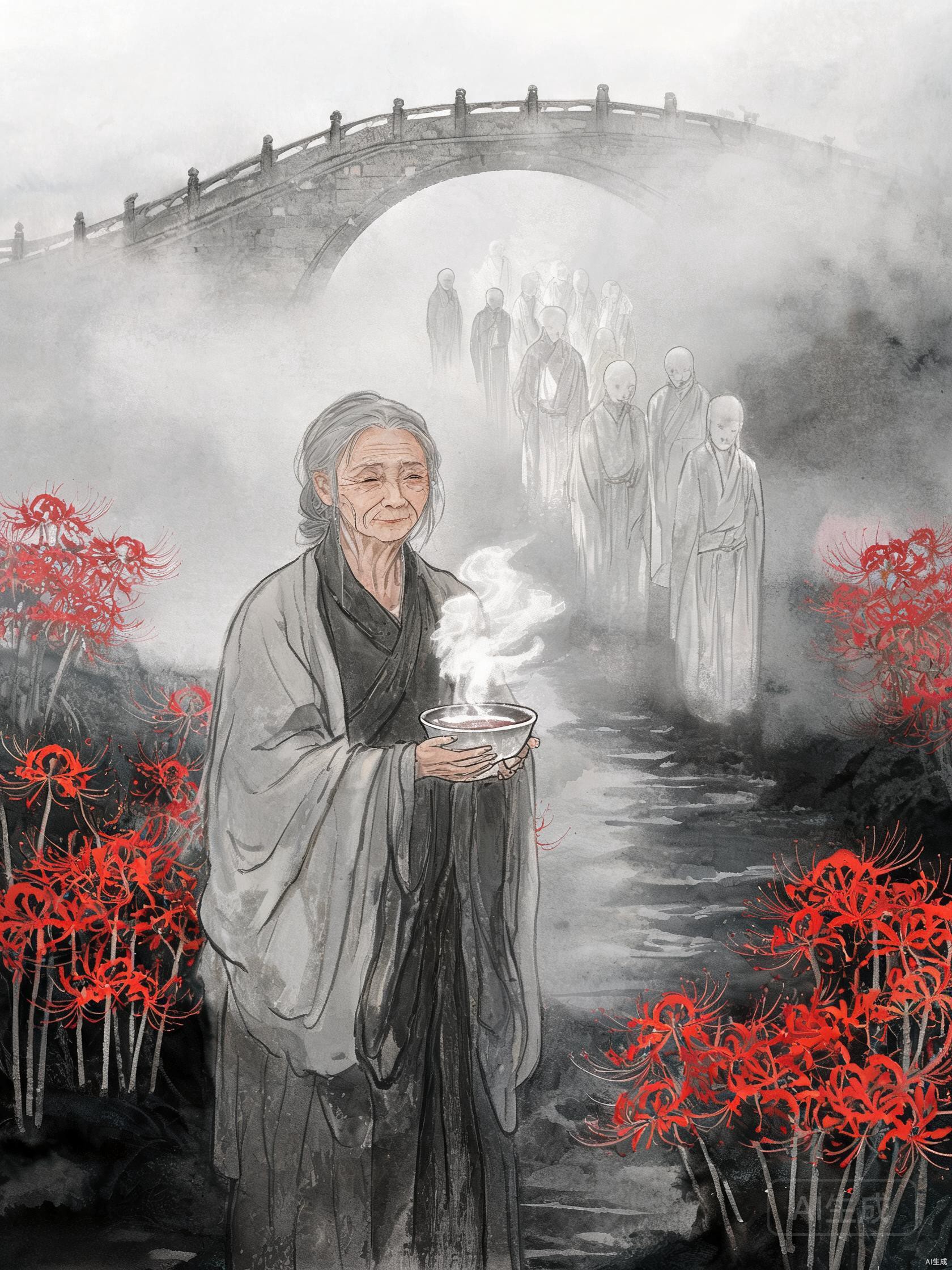
Lady Meng (Meng Po)
孟婆
The old woman of the underworld who brews the Soup of Forgetfulness.
Origin Story
The Bridge of Helplessness
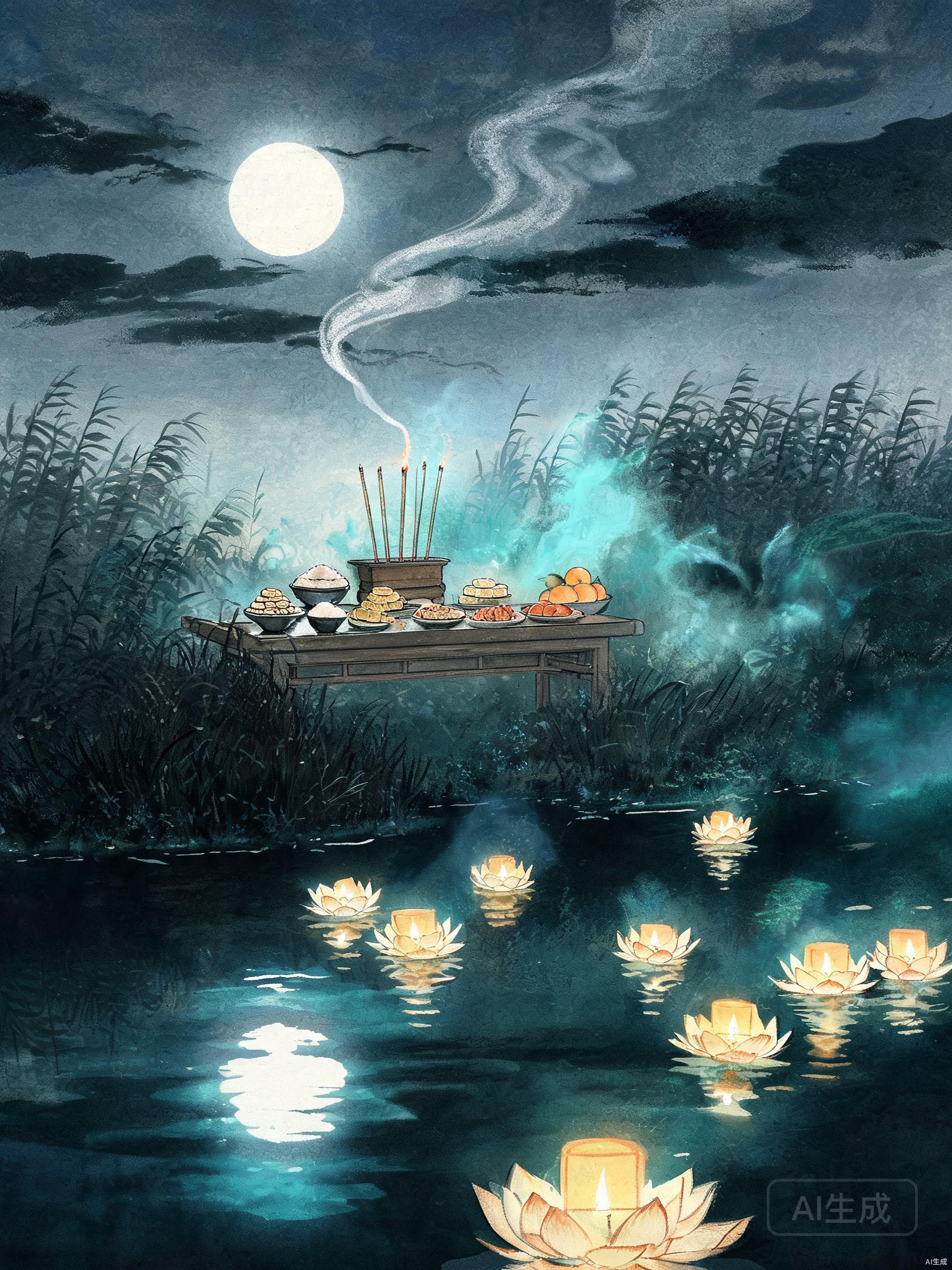
In Chinese folk cosmology, after a [soul has bee](/symbols/five-elements)n judged in the underworld and assigned its next reincarnation, it must cross the Bridge of Helplessness (Naihe Qiao) to be reborn. The bridge spans the River of Forgetfulness, and at its midpoint stands Lady Meng, an elderly woman tending a cauldron of simmering soup.
No [soul can re](/symbols/five-elements)fuse the soup. Some traditions say that those who resist are forced to drink it by the underworld guards; others say that the soul's own longing for release makes it drink willingly. A few tales speak of souls who managed to avoid drinking — these are the rare individuals who claim to remember past lives.
The bridge itself has symbolic layers. In some versions, it has three spans: the upper for the virtuous, the middle for the ordinary, and the lower — treacherous and slime-covered — for the wicked. The [sou](/folklore/tea-ceremony)l's path across the bridge is determined by its deeds in life, a final measure of karmic accounting before rebirth.
Lady Meng (Meng Po) is the underworld figure who guards the Bridge of Helplessness (Naihe Qiao). She brews the Five-Flavored Soup of Forgetfulness (Meng Po Tang), which every [soul](/folklore/hungry-ghosts) must drink before being reincarnated, erasing all memories of their previous life and their time in the underworld.
Powers & Symbols
Attributes & Artefacts
Click each card to reveal the details behind Lady Meng (Meng Po)'s divine attributes.
Historical & Cultural Meaning
Beyond the Myth
The Five Flavors of Life
Meng Po's soup is brewed from the five flavors — bitter, sour, sweet, spicy, and salty. Each flavor represents the full spectrum of human experience: the bitterness of loss, the sourness of disappointment, the sweetness of love, the spiciness of passion, and the saltiness of tears. To drink the soup is to consume the essence of all earthly experience one last time before letting it go.
Some traditions say the soup is made from the tears of all humanity — the collected sorrows of every person who has ever lived. Others say it is brewed from the waters of a special well in the underworld that contains the runoff of all human emotions. In all versions, the soup is a distillation of life itself.
The act of drinking is a moment of profound transition. With one sip, the [soul s](/folklore/hungry-ghosts)urrenders its identity, its loves, its hates, its regrets, and its achievements. It becomes a blank slate, ready to begin a new life with no memory of what came before. This is both a mercy — freeing the soul from the burden of accumulated pain — and a tragedy, as every connection made in life is permanently erased.
The Compassion of Forgetting
Lady Meng is not a punisher but a caretaker. Her role reflects a deeply compassionate understanding of human nature: if [souls re](/gods/shennong)membered their past lives, they would be tormented by old griefs, consumed by old loves, and unable to fully inhabit their new existence. The Soup of Forgetfulness is a gift, not a curse.
In some folk tales, Lady Meng was once a mortal woman who, after experiencing the pain of losing everyone she loved across multiple lifetimes, begged to serve in the underworld and help others let go of their attachments. Her story mirrors the Buddhist teaching that attachment is the root of suffering.
The figure of [Meng Po](/folklore/meng-po) also provides a comforting answer to one of life's deepest questions: why don't we remember our past lives? In Chinese folk belief, it is not because we had none, but because a kind old woman gave us the mercy of forgetting — allowing each life to begin fresh, unburdened by what came before.
Sources & References
Primary classical texts: Shanhaijing (山海经, Classic of Mountains and Seas, c. 4th-2nd century BCE) · Fengshen Yanyi (封神演义, Investiture of the Gods, c. 16th century) · Journey to the West (西游记, Xiyouji, c. 16th century) · Records of the Grand Historian (史记, Shiji, by Sima Qian, c. 91 BCE) · Classic of Mountains and Seas commentary (郭璞注 Shanhaijing, c. 4th century) · Bamboo Annals (竹书纪年, c. 4th century BCE onwards)
Classical translations: Legge, James (trans.). The Sacred Books of the East (1879-1910, 50 volumes covering Chinese classics) · Girardot, Norman J. Myth and Meaning in Early Taoism (University of California Press, 1983) · Werner, E.T.C. A Dictionary of Chinese Mythology (Shanghai: Kelly & Walsh, 1932)
Modern academic references: Birrell, Anne. Chinese Mythology: An Introduction (Baltimore: Johns Hopkins University Press, 1993) · Yang, Lihui, and Deming An. Handbook of Chinese Mythology (New York: Oxford University Press, 2005) · Strassberg, Richard E. A Chinese Bestiary: Strange Creatures from the Guideways Through Mountains and Seas (Berkeley: University of California Press, 2002)
Digital encyclopedias and online resources: Wikipedia — Chinese mythology portal (continuously updated, citations to primary sources) · Encyclopedia Britannica — Mythology and Religion section
Mythology Network
Connections & Relationships
Lady Meng (Meng Po) is woven into a larger web of gods, creatures, and legends. Explore the connections below.
Lady Meng (Meng Po)
孟婆
Explore the Topic
Lady Meng (Meng Po) in the Mythology Network
Go deeper — read the topic guides that gather every folk tradition like Lady Meng (Meng Po).