Topic
The Dragon in Chinese Mythology
龍 — The Divine Serpent of Heaven, Water, and Empire
Unlike the fire-breathing monsters of the West, the Chinese dragon (long) is a benevolent deity of water, sky, and good fortune — the supreme symbol of imperial power, cosmic balance, and the enduring spirit of Chinese civilization.
Quick Facts
Dragon Symbolism: Why the Chinese Dragon Is Divine, Not Monstrous

The Chinese dragon — benevolent, divine, and the supreme symbol of yang energy
The Chinese dragon (long, 龍) is the most revered creature in all of Chinese mythology — and its meaning is almost the opposite of the Western dragon. In European tradition, dragons are fire-breathing monsters to be slain by knights; in Chinese tradition, the dragon is a benevolent being of water and sky, associated with rain, fertility, wisdom, and supreme good fortune. This fundamental difference reflects two civilizations' contrasting relationships with nature: the West conquered it, while China sought to harmonize with it.
The dragon embodies the yang principle — the active, masculine, creative force of the cosmos. It is composed of the features of nine different animals: the horns of a deer, the head of a camel, the eyes of a demon, the neck of a snake, the abdomen of a clam, the scales of a carp, the claws of an eagle, the paws of a tiger, and the ears of an ox. This chimeric form is not random — each animal contributes its symbolic essence, making the dragon a synthesis of all the powers of the natural world. It is, in effect, a living encyclopedia of Chinese animal symbolism.
The dragon's connection to water is central to its identity. Chinese dragons are said to live in rivers, lakes, oceans, and clouds. They control the rain, and by extension, the harvest. This is why dragons were prayed to during droughts, why emperors performed dragon- invocation rituals at the Temple of Heaven, and why every river in China was believed to have its own dragon spirit. The dragon is not merely a symbol of power — it is a symbol of the life-giving power of water, the most precious resource in an agricultural civilization.
Types of Dragons: A Cosmic Hierarchy
Chinese mythology classifies dragons into several types based on their realm, function, and spiritual attainment. The most important distinction is between the celestial dragon (tianlong, 天龍), which lives in heaven and serves as a mount for the gods; the divine dragon (shenlong, 神龍), which controls the weather and rain; the earth dragon (dilong, 地龍), which governs rivers and streams; and the treasure dragon (fucanglong, 伏藏龍), which guards hidden wealth and precious minerals underground.
Beyond these functional categories, dragons are also classified by their level of spiritual evolution. According to the Buddhist-influenced hierarchy recorded in the Shanhaijing and later texts, a dragon must cultivate itself for 500 years before it can become a kioh-lung (a horned dragon), another 1,000 years to become a yinglong (a winged dragon), another 500 years to become a yinglong with full powers, and a final 1,000 years to become a dragon king. This progression mirrors the Taoist concept of spiritual cultivation — even the mightiest beings must earn their power through sustained practice over vast stretches of time.
There are also dragons that are not truly dragons at all, but are called dragons by analogy. The mo (摩), a giant sea-creature said to be so large it could swallow ships, is sometimes classified as a type of dragon. The jiao (蛟), a river serpent that can become a true dragon after 1,000 years of cultivation, represents the larval or transitional stage of dragonhood. This rich taxonomy reveals that in Chinese thought, 'dragon' is not a single species but a spiritual category — a rank in a cosmic hierarchy that beings can ascend through cultivation and merit.
The Dragon Kings of the Four Seas

The Dragon Kings — rulers of the Four Seas and masters of rain and storm
The most powerful dragons in Chinese mythology are the Four Dragon Kings (Si Hai Long Wang, 四海龍王), who rule the seas in the four cardinal directions. Ao Guang rules the East Sea, Ao Qin the South Sea, Ao Run the West Sea, and Ao Shun the North Sea. Each dwells in a magnificent crystal palace beneath the waves, served by shrimp soldiers, crab generals, and an entire aquatic bureaucracy that mirrors the imperial court on land.
The Dragon) Kings are responsible for the weather across their domains. They control rain, wind, and storms, and they can be petitioned — or confronted — by humans and gods alike. In Journey to the West, Sun Wukong famously invades Ao Guang's palace and demands the Ruyi Jingu Bang, the golden staff that was originally used to measure the depth of the sea. The Dragon King, unable to resist the Monkey King's overwhelming power, reluctantly surrenders the weapon — a scene that dramatizes the relationship between raw spiritual power and institutional authority.
The Dragon) Kings also appear in the legend of Nezha, where Nezha kills Ao Bing, the son of Ao Guang, triggering a cosmic feud between the child god and the Dragon King of the East Sea. And in the story of the Eight Immortals Crossing the Sea, the Dragon King battles the Immortals after they cross his waters without permission. These stories consistently portray the Dragon Kings as powerful but not invincible — they are celestial bureaucrats who must enforce their authority, but who can be outwitted or overpowered by those with greater spiritual attainment. The Dragon Kings thus represent the Chinese vision of cosmic governance: even the mightiest forces of nature are organized into a system of rules, ranks, and jurisdictions.
The Nine Sons of the Dragon
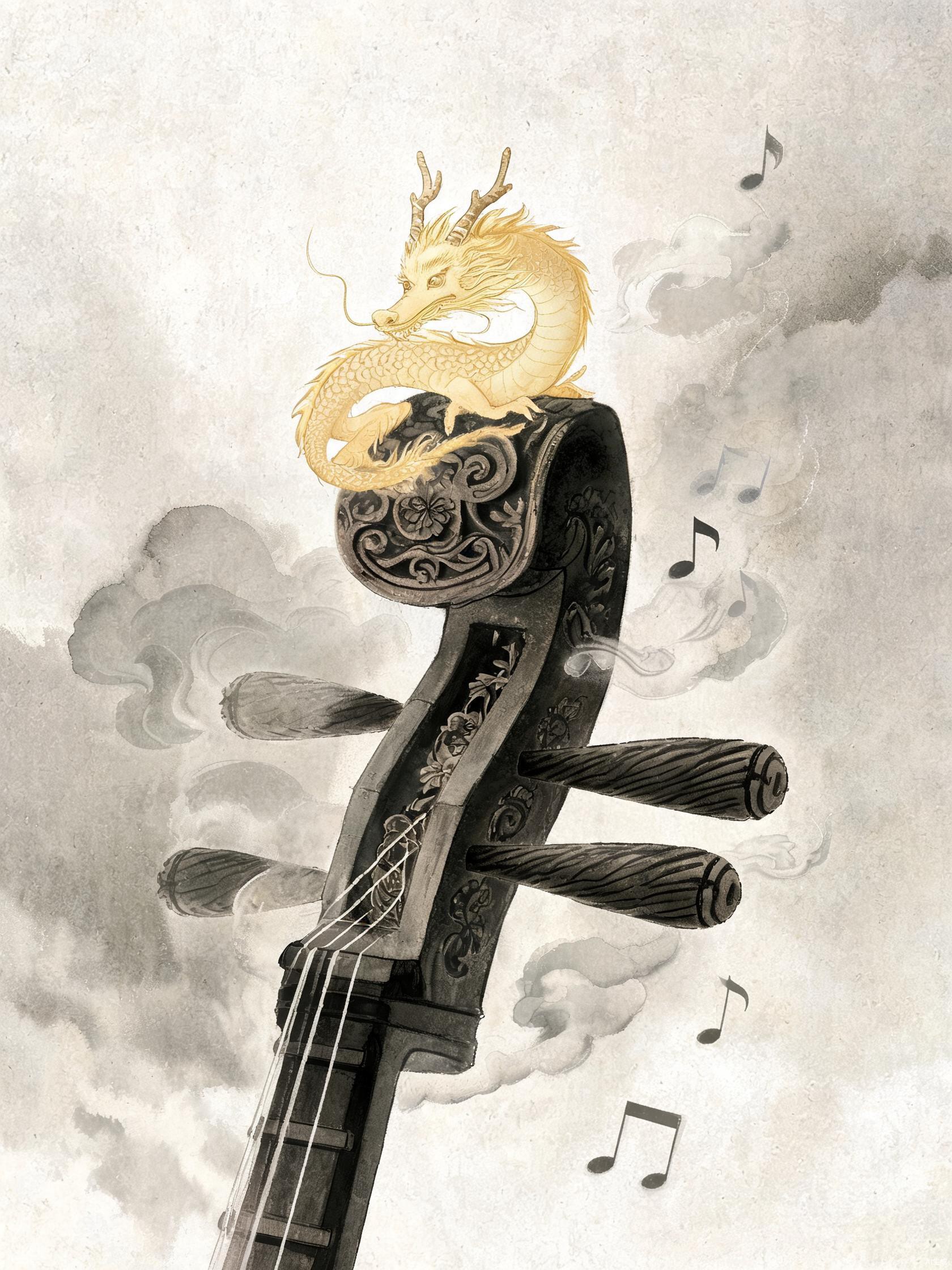
The Nine Sons of the Dragon — each a distinct manifestation of dragon power in Chinese art
According to Chinese tradition, the dragon had nine sons (jiu zi, 九子), each with a distinct personality and an insatiable appetite for a particular thing. Though they are all dragons, none of them grew into full dragon form — instead, each son manifested a different aspect of dragon nature, and each was assigned a specific role in Chinese art and architecture. The phrase 'the dragon has nine sons, and each is different' became a Chinese idiom for the diversity of human nature within a single family.
The nine sons are: Qiuniu (牛), the eldest, who loves music and adorns the heads of stringed instruments; Yazi (眥), the fierce warrior who adorns sword hilts and weapon guards; Chaofeng (風), the bold climber who sits on roof ridges to ward off fire; Pulao (牢), the roarer whose image is cast on bells; Suanni (狻), the tranquil incense-lover who adorns Buddhist censers; Bixi (赑), the mighty bearer who carries stone steles on his back; Bi'an (犴), the just judge who guards prison gates; Fuxi (狴), the scholar who coils on the tops of steles; and Chiwen (吻), the guardian who protects the central ridgepole of roofs.
The Nine Sons are not merely decorative motifs — they represent the Chinese understanding that power must be channeled into specific functions to be useful. A dragon that tries to do everything will do nothing well; but a dragon that devotes itself to music, or justice, or protection, can become essential to civilization. This is why the Nine Sons are found on virtually every traditional Chinese building, instrument, and weapon — they are the distributed fragments of dragon power, each serving a different need of human life. The mythology of the Nine Sons thus transforms the abstract power of the dragon into a practical, functional presence in everyday Chinese material culture.
The Dragon Pearl: Source of Power and Wisdom
The dragon and the flaming pearl — the eternal pursuit of wisdom and the dance of yin and yang
Every Chinese dragon is depicted chasing or holding a flaming pearl (long zhu, 龍珠 or zhu, 珠) — a luminous sphere wreathed in spiraling flames. This dragon pearl is not merely decorative; it is the source of the dragon's power, the distillation of its spiritual essence, and the object of its eternal pursuit. In art, dragons are almost always shown reaching for the pearl, which hovers just ahead of them, always attainable yet never quite grasped.
The dragon pearl has multiple layers of meaning. At the most literal level, it represents the moon — the yin counterpart to the dragon's yang energy. The dragon's pursuit of the pearl thus symbolizes the eternal interplay of yin and yang, the cosmic dance of opposites that generates all life. At a spiritual level, the pearl represents wisdom or enlightenment — the goal of all Taoist and Buddhist cultivation. The dragon, despite its immense power, must continue to strive for the pearl, teaching that no being, however mighty, can afford to stop seeking wisdom.
In folklore, the dragon pearl was sometimes said to grant wishes, heal diseases, or control the weather. Fishermen and sailors who found a 'dragon pearl' (often a luminous pearl or a piece of phosphorescent sea-creature) were considered extremely fortunate. The image of the dragon and pearl is also central to the dragon dance performed during festivals — performers manipulate a pearl on a pole, and the dragon puppet chases it through the streets, bringing rain, prosperity, and good fortune to the community.
The Dragon Dance and the Dragon in Imperial Symbolism
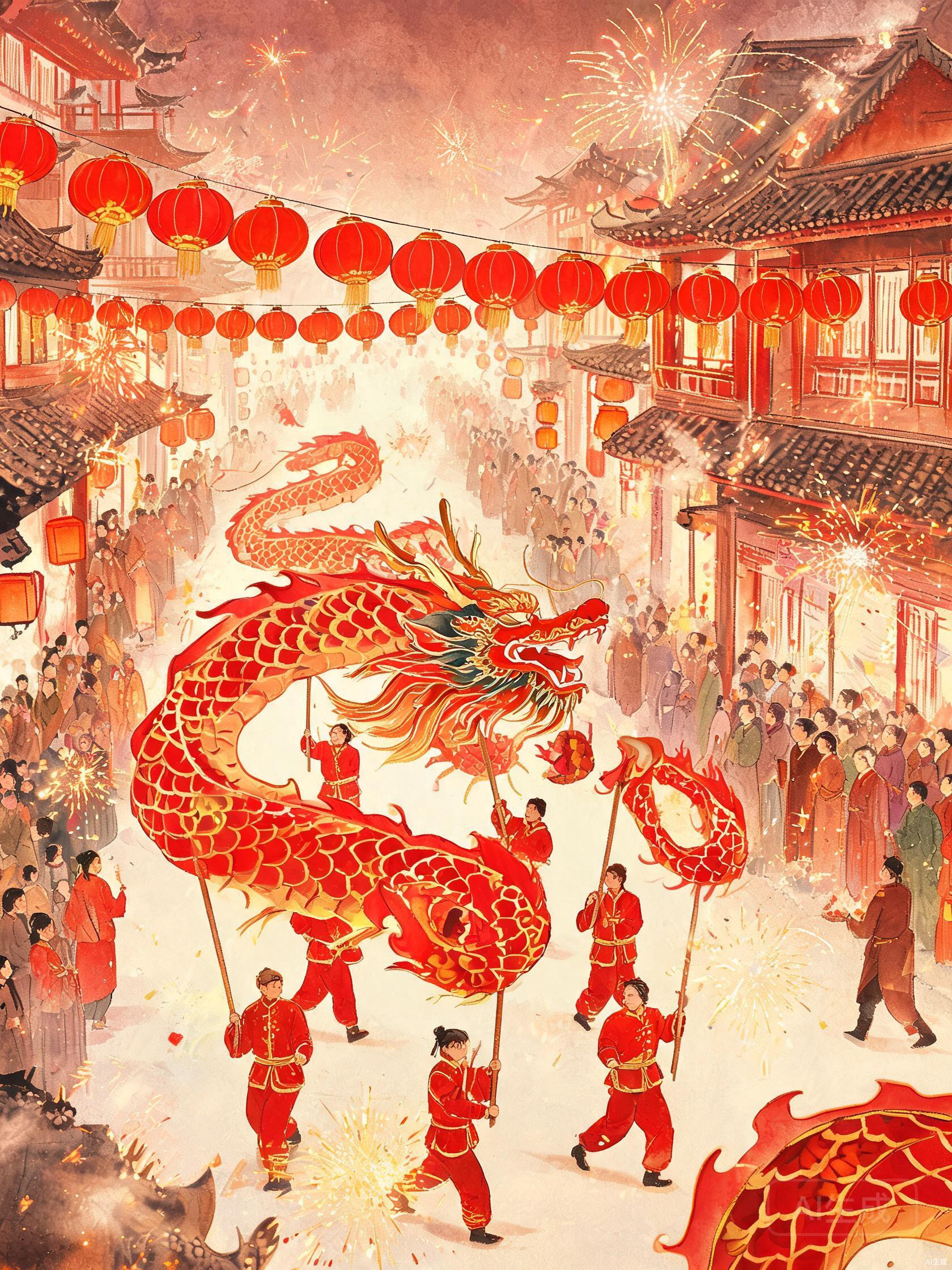
The dragon dance — an ancient rain ritual transformed into a celebration of Chinese cultural identity
The dragon dance (wu long, 舞龍) is one of the most iconic traditions of Chinese culture, performed during the Spring Festival, the Lantern Festival, and other major celebrations. A team of performers manipulates a long, flexible dragon puppet made of silk, bamboo, and paper, chasing a 'pearl' held on a pole by the lead performer. The dance is both a prayer for rain and a celebration of the dragon's power — the longer the dragon (some exceed 100 meters), the greater the fortune it brings.
The dragon dance has ancient roots. According to the Han Dynasty text the Lun Heng, it originated as a rain-invocation ritual — the dragon, as master of water, was entreated through dance to send rain for the crops. Over time, the ritual expanded to become a general celebration of prosperity and good fortune. Different regions developed distinct styles: the fire dragon dance of Guangzhou uses incense sticks to create a dragon that glows with sparks; the grass dragon dance of Zhejiang uses woven straw; and the luminous dragon dance of Hong Kong uses fluorescent paint and ultraviolet light. All share the same core belief: that the dragon's presence, even in symbolic form, brings the blessings of water, harvest, and cosmic harmony.
Beyond folk culture, the dragon was the supreme symbol of imperial power. The emperor was called the 'True Dragon, Son of Heaven' (zhen long tian zi, 真龍天子) — the earthly embodiment of the celestial dragon. His throne was called the Dragon Throne, his robes were embroidered with golden dragons, and his face was called the dragon face. The five-clawed dragon was reserved exclusively for the emperor; princes of the blood used four-clawed dragons, and lesser nobles used three-clawed dragons. This dragon hierarchy encoded the entire imperial system in visual form — to wear a five-clawed dragon robe was to claim the mandate of heaven itself. After the fall of the last dynasty in 1911, the dragon remained the symbol of the Chinese nation — not as a political emblem, but as a cultural one, representing the continuity, resilience, and spiritual ambition of a civilization that has endured for over 5,000 years.