Ruyi Scepter Symbolism
如意
The scepter that grants all wishes — a gift of good fortune, power, and 'as you desire.'
Origin Story
What Is the Ruyi?
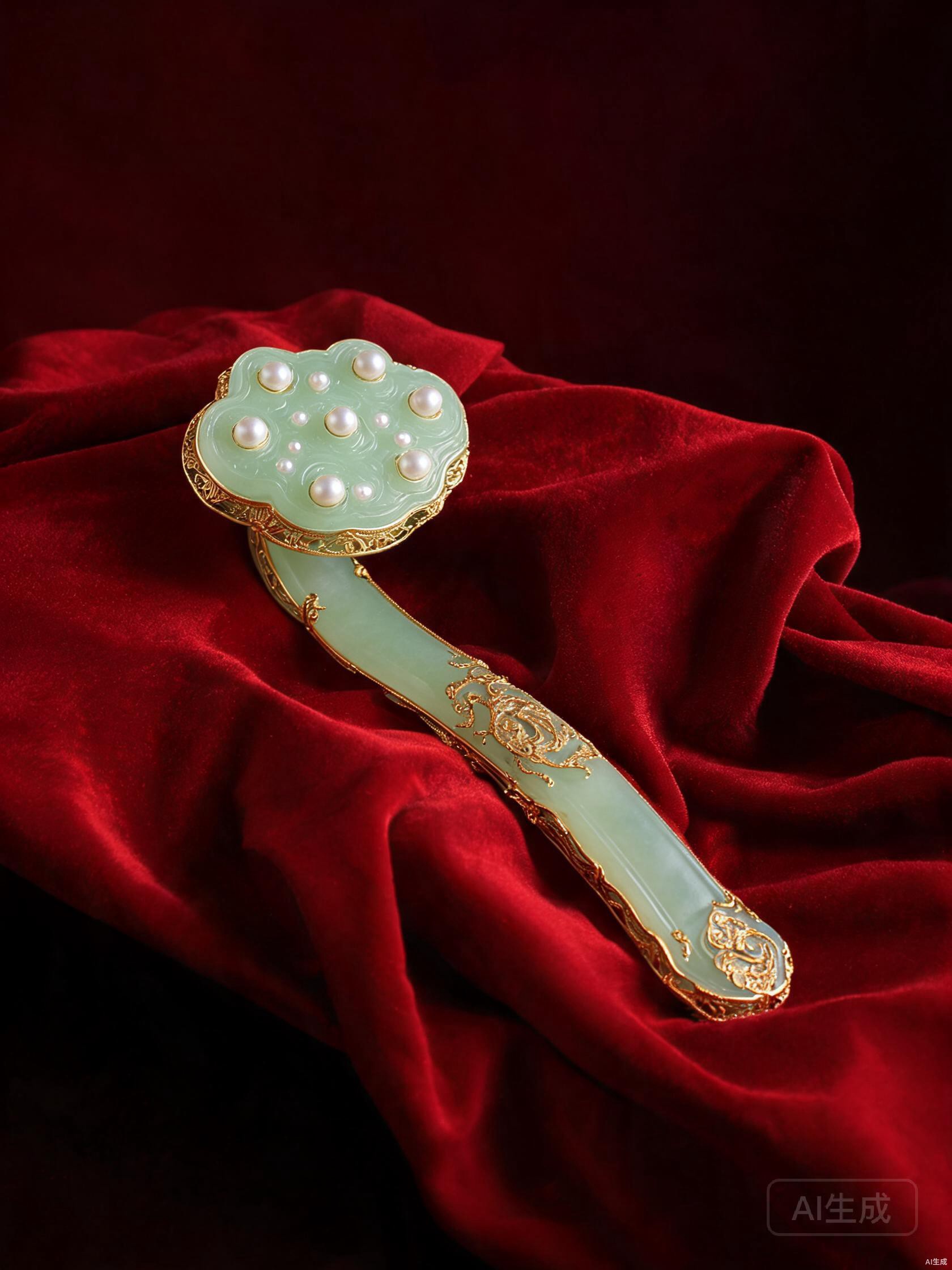
The Ruyi (如意) is a decorative scepter with an elongated, curved body and a head shaped like a cloud, a lingzhi mushroom, or a stylized heart. The name literally translates as 'as you wish' or 'according to your desires.' To hold a Ruyi is to hold the power of wish-fulfillment — the object itself is a physical prayer that everything will go exactly as you want. Few objects in Chinese culture carry such a direct and hopeful message.
The Ruyi is typically made from precious materials: jade, gold, silver, sandalwood, or carved from bamboo, ivory, or bone. The finest examples are studded with pearls, jade cabochons, and gemstones, and may be adorned with auspicious motifs like bats (for happiness), peaches (for longevity), or the shou character (for long life). They range from palm-sized scepters to large ceremonial pieces over a meter long. The most valuable Ruyi scepters were once reserved for the emperor and his closest courtiers, and presenting one to the throne was an act of deep loyalty.
The Ruyi's head shape, the cloud or lingzhi form, is itself auspicious. The lingzhi mushroom is the 'herb of immortality' in Chinese legend, and a Ruyi carved with a lingzhi head thus carries a double blessing — the wish for one's desires to be fulfilled, and the wish for a long and healthy life in which to enjoy them. The scepter is, in a sense, a portable compendium of Chinese good fortune.
The Ruyi is a ceremonial scepter with a curved head shaped like a cloud or lingzhi mushroom. Its name means 'as you wish' or 'according to your desires,' making it one of the most direct symbols of good fortune and wish-fulfillment in Chinese culture. Given as a gift, it conveys the wish that all the recipient's dreams may come true.
Powers & Symbols
Attributes & Artefacts
Click each card to reveal the details behind Ruyi Scepter Symbolism's divine attributes.
Historical & Cultural Meaning
Beyond the Myth
Historical Origins
The origins of the Ruyi are debated, but it is generally believed to have emerged during the Han Dynasty (206 BCE – 220 CE) or earlier. Some scholars trace it to a practical back-scratching tool used by Buddhist monks — a long, curved stick that could reach the itches one could not scratch oneself. Over time, this humble object became ornate and ceremonial, shedding its practical function while keeping its distinctive curve. The transformation from utility to ceremony is itself a symbol of how Chinese culture elevates the ordinary into the meaningful.
Other traditions connect the Ruyi to Buddhist symbolism. The [Buddha](/gods/buddha-shakyamuni) and bodhisattvas are sometimes depicted holding a Ruyi, and the scepter's cloud-shaped head is said to represent the wish-fulfilling jewel (cintamani) of Buddhist legend — a gem that grants all desires to whoever possesses it. In Taoist iconography, the Ruyi is carried by deities such as the god of [wealth](/gods/caishen) and the [Jade Emperor](/gods/jade-emperor), symbolizing their power to grant wishes and the authority to command fortune.
By the Qing Dynasty (1644–1912), the Ruyi had become an essential court gift. Emperors would present Ruyi scepters to favored officials, foreign envoys, and family members on birthdays, weddings, and lunar new year. The Imperial Palace in Beijing still holds a vast collection of these scepters — the Qianlong Emperor alone received hundreds, each more ornate than the last, and he reportedly kept them in dedicated halls. To give a Ruyi was to give the highest secular blessing short of a title, and to receive one was to be marked as someone the emperor wished to succeed.
Symbolism and Meaning
The Ruyi's symbolism is unusually direct — its name is itself a blessing. While most Chinese symbols work through puns or associations, the Ruyi literally means 'may everything go as you wish.' This makes it the ultimate gift: by giving someone a Ruyi, you are giving them a tangible piece of good fortune, a scepter that symbolically commands the universe to fulfill their desires. No interpretation is required; the meaning sits on the surface, which is precisely why it has remained so popular for two thousand years.
The Ruyi is often combined with other auspicious symbols to multiply its power. A Ruyi paired with a persimmon (shì) and an apple (píngguǒ) creates the phrase '万事如意' (wàn shì rú yì), meaning 'may ten thousand things go as you wish.' A Ruyi with a vase (píng) and a ruyi forms '平安如意' (píng'ān rúyì), 'safe and as you wish.' A Ruyi placed with two persimmons and a bamboo ruler (hé) creates '和合如意' (héhé rúyì), 'harmony and as you wish.' These combinations show how the Ruyi functions as a multiplier of fortune — a base blessing that can be stacked with other blessings for compound effect.
In a deeper sense, the Ruyi also represents the ideal of a life lived in harmony with one's desires — not in the sense of selfish greed, but in the sense of alignment between intention and outcome. The person who holds a Ruyi is one whose wishes and reality are in step, whose plans come to fruition, whose path is smooth. This is why the Ruyi is favored by scholars, merchants, and officials alike — it speaks to a universal human hope that our efforts will meet with success.
Ruyi in Daily Life and Culture
Today, the Ruyi remains a popular symbol in Chinese homes and businesses. A small jade or wooden Ruyi placed on a desk is believed to bring career advancement and smooth progress in all endeavors. In Feng Shui, a Ruyi placed in the northwest sector of a home or office is said to attract mentors and benefactors — people who will help you achieve your wishes. A Ruyi in the southwest is believed to improve relationships and marriage luck, while one in the center is said to stabilize and harmonize the whole household.
The [Ruyi](/symbols/ruyi) also appears in modern Chinese gift-giving. A Ruyi is a traditional wedding gift, symbolizing the wish that the couple's marriage will be exactly as they desire. Businessmen give Ruyi to partners to wish them smooth dealings and favorable contracts. During the Chinese New Year, families may display a Ruyi alongside other auspicious objects to ensure that the coming year unfolds according to their wishes. Even in modern corporate settings, a jade Ruyi on the CEO's desk is a statement of confidence and a magnet for good fortune.
The [Ruyi](/symbols/ruyi-symbolism)'s enduring appeal lies in its simplicity: in a world of uncertainty, it is a symbol that says 'may all go well,' and who would not wish for that? It carries no dark side, no double meaning, no cautionary tale — only the pure, hopeful wish that the holder's desires will be met. For this reason, the [Ruyi](/symbols/ruyi) remains one of the most universally beloved objects in Chinese culture, a small curved scepter that holds the weight of a billion wishes.
Sources & References
Primary classical texts: Shanhaijing (山海经, Classic of Mountains and Seas, c. 4th-2nd century BCE) · Fengshen Yanyi (封神演义, Investiture of the Gods, c. 16th century) · Journey to the West (西游记, Xiyouji, c. 16th century) · Records of the Grand Historian (史记, Shiji, by Sima Qian, c. 91 BCE) · Classic of Mountains and Seas commentary (郭璞注 Shanhaijing, c. 4th century) · Bamboo Annals (竹书纪年, c. 4th century BCE onwards)
Classical translations: Legge, James (trans.). The Sacred Books of the East (1879-1910, 50 volumes covering Chinese classics) · Girardot, Norman J. Myth and Meaning in Early Taoism (University of California Press, 1983) · Werner, E.T.C. A Dictionary of Chinese Mythology (Shanghai: Kelly & Walsh, 1932)
Modern academic references: Birrell, Anne. Chinese Mythology: An Introduction (Baltimore: Johns Hopkins University Press, 1993) · Yang, Lihui, and Deming An. Handbook of Chinese Mythology (New York: Oxford University Press, 2005) · Strassberg, Richard E. A Chinese Bestiary: Strange Creatures from the Guideways Through Mountains and Seas (Berkeley: University of California Press, 2002)
Digital encyclopedias and online resources: Wikipedia — Chinese mythology portal (continuously updated, citations to primary sources) · Encyclopedia Britannica — Mythology and Religion section
Mythology Network
Connections & Relationships
Ruyi Scepter Symbolism is woven into a larger web of gods, creatures, and legends. Explore the connections below.
Ruyi Scepter Symbolism
如意


Explore the Topic
Ruyi Scepter Symbolism in the Mythology Network
Go deeper — read the topic guides that gather every symbol like Ruyi Scepter Symbolism.