
Guanyin
观音
The Bodhisattva of Compassion — the most beloved figure in Chinese Buddhism.
Origin Story
Who Is Guanyin?
Guanyin (short for Guanshiyin, 'She Who Hears the Cries of the World') is the Chinese manifestation of the Buddhist bodhisattva [Avalokiteshvara](/gods/avalokiteshvara). She is the embodiment of infinite compassion — a being who has achieved enlightenment but vows to remain in the cycle of rebirth until all beings are freed from suffering.
In one of the most remarkable transformations in religious history, Guanyin [change](/zodiac/change)d from male to female in Chinese culture between the 10th and 12th centuries. This shift reflected the Chinese desire for a nurturing, mother-like figure of mercy — and made Guanyin the most accessible and beloved deity in Chinese religion.
Guanyin is the Bodhisattva of Compassion, the being who hears the cries of the world and responds. Originally the male Indian bodhisattva Avalokiteshvara, Guanyin was transformed in China into a female figure of infinite mercy.
Powers & Symbols
Attributes & Artefacts
Click each card to reveal the details behind Guanyin's divine attributes.
Historical & Cultural Meaning
Beyond the Myth
Guanyin's Powers
Guanyin's defining power is her ability to respond to any cry for help. Call her name with a sincere heart, and she will come — this is the core promise of her worship. She can take any form needed to save a being in danger: a monk, a woman, a child, a king, even an animal.
In her most dramatic form, the Thousand-Armed Guanyin, she has a thousand hands, each with an eye in its palm, symbolizing her ability to see all suffering and reach all who need help. This form is one of the most stunning images in Chinese religious art.
Guanyin in Chinese Culture
Guanyin transcends religious boundaries. She is worshipped in Buddhism, Taoism, and folk religion. Even people who claim no religious affiliation often keep a Guanyin statue in their home for protection and peace.
Her association with the sea — as the protector of sailors — connects her to [Mazu](/gods/mazu), and in some traditions the two are syncretized. [Guanyin](/gods/guanyin)'s presence in [Journey to the West](/myths/journey-to-the-west), where she guides and protects the pilgrims, cemented her image in popular culture as the ultimate figure of mercy and wisdom.
Sources & References
Primary classical texts: Shanhaijing (山海经, Classic of Mountains and Seas, c. 4th-2nd century BCE) · Fengshen Yanyi (封神演义, Investiture of the Gods, c. 16th century) · Journey to the West (西游记, Xiyouji, c. 16th century) · Records of the Grand Historian (史记, Shiji, by Sima Qian, c. 91 BCE) · Classic of Mountains and Seas commentary (郭璞注 Shanhaijing, c. 4th century) · Bamboo Annals (竹书纪年, c. 4th century BCE onwards)
Classical translations: Legge, James (trans.). The Sacred Books of the East (1879-1910, 50 volumes covering Chinese classics) · Girardot, Norman J. Myth and Meaning in Early Taoism (University of California Press, 1983) · Werner, E.T.C. A Dictionary of Chinese Mythology (Shanghai: Kelly & Walsh, 1932)
Modern academic references: Birrell, Anne. Chinese Mythology: An Introduction (Baltimore: Johns Hopkins University Press, 1993) · Yang, Lihui, and Deming An. Handbook of Chinese Mythology (New York: Oxford University Press, 2005) · Strassberg, Richard E. A Chinese Bestiary: Strange Creatures from the Guideways Through Mountains and Seas (Berkeley: University of California Press, 2002)
Digital encyclopedias and online resources: Wikipedia — Chinese mythology portal (continuously updated, citations to primary sources) · Encyclopedia Britannica — Mythology and Religion section
Mythology Network
Connections & Relationships
Guanyin is woven into a larger web of gods, creatures, and legends. Explore the connections below.
Guanyin
观音


📱 Wallpaper · $2.99
Take 观音菩萨 with you
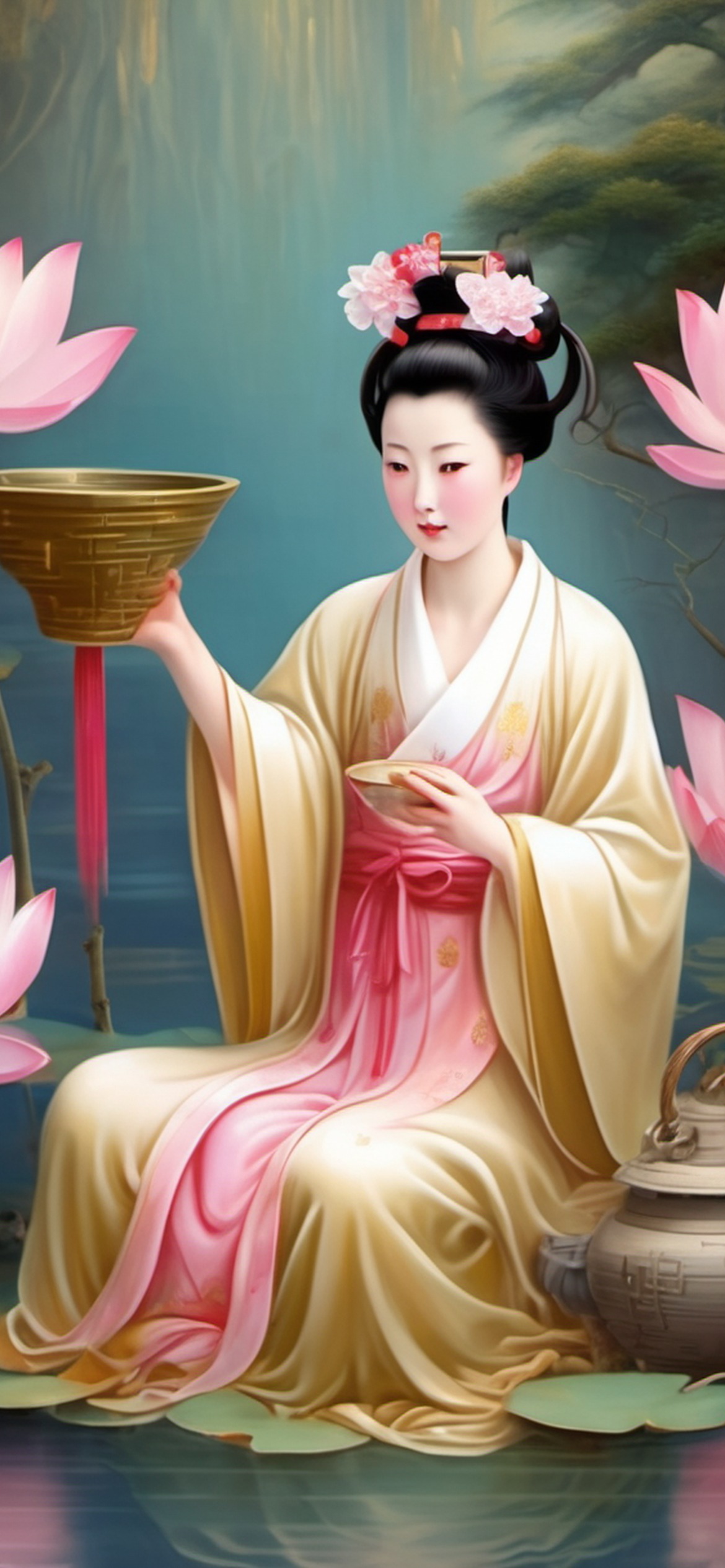
High-resolution phone wallpaper of Goddess Guanyin (观音菩萨) — iconography drawn from classical Chinese sources, painted in traditional style.
📜 Iconography sources
《妙法莲华经·观世音菩萨普门品》 (Lotus Sutra, Chapter on the Universal Gate) describes Avalokiteśvara manifesting in any form to save beings; the 《楞严经》 (Śūraṅgama Sutra) deepens the devotion. Chinese iconography settled on the white-robed Guanyin holding a willow branch and pure-water vase, standing on a lotus — a form popularized in the Tang by the painter Zhou Fang's Water-Moon Guanyin tradition and carried through Song dynasty sculpture.
Buy & download
Explore the Topic
Guanyin in the Mythology Network
Go deeper — read the topic guides that gather every deity like Guanyin.