
White Snake Legend
白蛇传
A snake spirit's love for a mortal — and the monk determined to destroy it.
Origin Story
A Snake Becomes a Woman
Bai Suzhen was a white snake spirit who had cultivated for a thousand years and achieved the ability to take human form. Along with her companion Xiao Qing (a green snake spirit), she traveled to Hangzhou during the [Qingming](/folklore/qingming-festival) Festival. There, she met Xu Xian, a kind and humble pharmacist, and fell in love.
They married and opened a medicine shop. Bai Suzhen used her supernatural knowledge to heal the sick, and the couple lived in happiness. For a time, the story seemed to be a simple fairy tale — a spirit and a mortal, living in love.
The Legend of the White Snake is one of China's Four Folk Legends. It tells the story of Bai Suzhen, a white snake spirit who transforms into a woman to marry the mortal she loves — and the Buddhist monk Fahai who believes such love is unnatural and must be destroyed.
Powers & Symbols
Attributes & Artefacts
Click each card to reveal the details behind White Snake Legend's divine attributes.
Historical & Cultural Meaning
Beyond the Myth
Fahai's Intervention
But the Buddhist monk Fahai saw the marriage as an abomination — a spirit deceiving a mortal, defying the natural order. He told Xu Xian that his wife was a snake demon and urged him to test her with realgar wine during the Duanwu Festival.
When Xu Xian offered the wine, Bai Suzhen drank it — and lost control of her transformation. She reverted to her snake form. Xu Xian, seeing the enormous white snake, died of shock. In one of the myth's most powerful sequences, Bai Suzhen risked everything to steal the herb of [immortal](/gods/buddha-shakyamuni)ity from heaven, revived Xu Xian, and tried to rebuild their life — but Fahai would not relent.
Imprisonment Under Leifeng Pagoda
Bai Suzhen, desperate to protect her family, fought a catastrophic battle with Fahai. She flooded Jinshan Temple with water from the West Lake, endangering innocent lives — an act that turned public sympathy against her. Fahai finally captured her using his alms bowl and imprisoned her beneath Leifeng Pagoda in Hangzhou.
The conditions of her release, as Fahai declared: the pagoda would fall, or the West Lake would dry up, or Leifeng Pagoda would be illuminated — conditions that seemed impossible. Bai Suzhen's son, Xu Mengjiao, eventually grew up, passed the imperial exams, and offered sacrifices to his mother, eventually freeing her.
The Legend's Meaning
The White [Snake](/zodiac/zodiac-snake) legend is one of the most complex stories in Chinese mythology. Is Bai Suzhen a demon who deceived a mortal, or a woman whose love was punished by rigid dogma? Is Fahai a righteous defender of natural law, or a fanatic who destroyed a family out of intolerance?
Over the centuries, the story has shifted — early versions were cautionary tales about snake spirits, but later versions increasingly sympathized with [Bai Suzhen](/gods/bai-suzhen). Today, she is widely seen as the heroine: a being who loved deeply, sacrificed everything, and was punished not for doing wrong, but for being different. The legend continues to inspire films, operas, and TV dramas — most recently in the 2019 animated film [White Snake](/myths/white-snake).
Sources & References
Primary classical texts: Shanhaijing (山海经, Classic of Mountains and Seas, c. 4th-2nd century BCE) · Fengshen Yanyi (封神演义, Investiture of the Gods, c. 16th century) · Journey to the West (西游记, Xiyouji, c. 16th century) · Records of the Grand Historian (史记, Shiji, by Sima Qian, c. 91 BCE) · Classic of Mountains and Seas commentary (郭璞注 Shanhaijing, c. 4th century) · Bamboo Annals (竹书纪年, c. 4th century BCE onwards)
Classical translations: Legge, James (trans.). The Sacred Books of the East (1879-1910, 50 volumes covering Chinese classics) · Girardot, Norman J. Myth and Meaning in Early Taoism (University of California Press, 1983) · Werner, E.T.C. A Dictionary of Chinese Mythology (Shanghai: Kelly & Walsh, 1932)
Modern academic references: Birrell, Anne. Chinese Mythology: An Introduction (Baltimore: Johns Hopkins University Press, 1993) · Yang, Lihui, and Deming An. Handbook of Chinese Mythology (New York: Oxford University Press, 2005) · Strassberg, Richard E. A Chinese Bestiary: Strange Creatures from the Guideways Through Mountains and Seas (Berkeley: University of California Press, 2002)
Digital encyclopedias and online resources: Wikipedia — Chinese mythology portal (continuously updated, citations to primary sources) · Encyclopedia Britannica — Mythology and Religion section
Mythology Network
Connections & Relationships
White Snake Legend is woven into a larger web of gods, creatures, and legends. Explore the connections below.
White Snake Legend
白蛇传


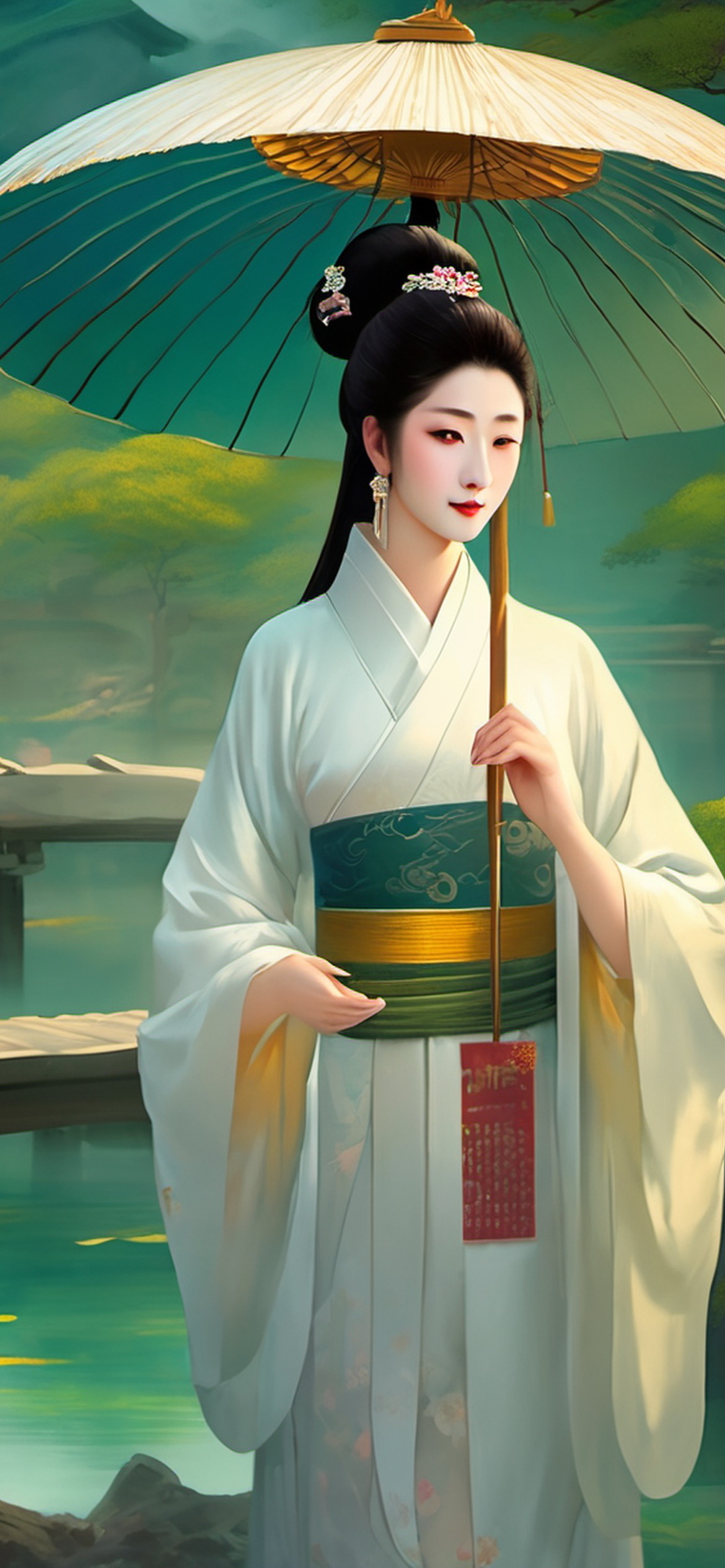
📱 Wallpaper · $2.99
Take 白娘子(白素贞) with you
High-resolution phone wallpaper of Lady White Snake (白娘子(白素贞)) — iconography drawn from classical Chinese sources, painted in traditional style.
📜 Iconography sources
The White Snake's legend grew for a thousand years — from the Tang tale of Li Huang in 《博异志》, through the Song story-poem of the West Lake's three pagodas, to the Qing court opera 《雷峰塔》 that fixed the story we know: Bai Suzhen, the gentle white snake spirit, her paper umbrella on Broken Bridge, West Lake's mist around her love for Xu Xian.
Buy & download
Explore the Topic
White Snake Legend in the Mythology Network
Go deeper — read the topic guides that gather every legend like White Snake Legend.