Topic
Buddhist Deities in Chinese Religion
佛教神明 — The Sinicized Pantheon of the Dharma
When Buddhism arrived from India, it brought a rich pantheon that Chinese religion reshaped, absorbed, and transformed — from Guanyin's boundless compassion to the wisdom of Manjushri, the guardianship of the Four Heavenly Kings, and the vengeful mercy of Ksitigarbha in the depths of hell.
Quick Facts
The Arrival and Transformation of Buddhism in China

Guanyin — the most beloved Buddhist deity in Chinese religion
Buddhism entered China around the 1st century CE, carried along the Silk Road by monks and merchants from Central Asia and India. At first, it was a foreign religion with unfamiliar concepts — karma, rebirth, nirvana, and a vast pantheon of buddhas and bodhisattvas whose names had to be transliterated into Chinese. Early translations of Buddhist texts often used Taoist vocabulary to explain Buddhist ideas, a practice called 'concept-matching' (geyi, 格義), which meant that from the very beginning, Chinese Buddhism was not a copy of Indian Buddhism but a new creation — a hybrid that would eventually develop its own distinct schools, scriptures, and iconography.
The early Chinese encountered Buddhism through texts and miraculous stories before they met Buddhist monks. The White Horse Temple (Baimasi, 白馬寺), traditionally said to be the first Buddhist temple in China, was established in Luoyang in 68 CE during the Eastern Han Dynasty when two Indian monks, Kasyapa Matanga and Dharmaraksha, arrived bearing sutras on white horses. From this small beginning, Buddhism slowly spread through imperial patronage, popular miracle stories, and the establishment of translation centers that would produce the vast Chinese Buddhist canon (the Dazangjing) over the following millennium.
Over centuries, Buddhism underwent a profound process of sinicization. The Indian pantheon was reorganized to fit Chinese sensibilities. Some deities were elevated to supreme importance; others were demoted or absorbed into existing folk religion. The most dramatic transformation was the bodhisattva Avalokitesvara, who in India was depicted as a masculine prince, but in China became Guanyin — the Goddess of Mercy, often depicted as a serene woman in white robes. This gender transformation reflects the Chinese preference for a nurturing, maternal figure of compassion over the Indian warrior-prince archetype.
By the Tang Dynasty (618–907 CE), Buddhism had become one of the Three Teachings (San Jiao, 三教) alongside Confucianism and Taoism, deeply embedded in Chinese society. Buddhist deities were worshipped in the same temples as Taoist gods and folk spirits. Monasteries became centers of learning, art, and political power. The integration was so thorough that many Chinese people today do not distinguish between 'Buddhist' and 'folk' deities — Guanyin, the Jade Emperor, and Mazu may all be worshipped in the same home shrine, as aspects of a single, fluid spiritual landscape where compassion, wisdom, and practical protection are sought from whichever deity seems most capable of providing them.
Buddha Shakyamuni: The Founder of the Dharma

Buddha Shakyamuni — the historical founder of Buddhism in his earth-touching mudra
Buddha Shakyamuni (Shijiamouni Fo, 釋迦牟尼佛), born Siddhartha Gautama in the 5th century BCE, is the historical founder of Buddhism. Born a prince of the Shakya clan in what is now Nepal, he renounced his royal life at age 29 after encountering old age, sickness, and death outside his palace walls. After years of ascetic practice and meditation, he attained enlightenment (bodhi, 菩提) under the Bodhi tree at Bodh Gaya, becoming 'the Awakened One' — a Buddha.
For the next forty-five years, the Buddha traveled across the Ganges plain teaching the dharma — the law of reality as he had come to understand it. His core teachings, the Four Noble Truths (the truth of suffering, the origin of suffering, the cessation of suffering, and the path to that cessation) and the Noble Eightfold Path (right view, intention, speech, action, livelihood, effort, mindfulness, and concentration), form the foundation of all Buddhist traditions. He also taught the doctrine of dependent origination (pratityasamutpada), the law of karma, the nature of impermanence, and the possibility of liberation from suffering through direct insight.
The Buddha's parinirvana (final death) occurred around 483 BCE at Kushinagar, after which his relics were distributed among eight kingdoms and enshrined in stupas. In Chinese Buddhism, the historical Buddha is venerated as one of the 'Three Buddhas' (San Fo, 三佛) of the three time periods: the past Buddha Dipankara (Randeng Fo, 燃燈佛), the present Buddha Shakyamuni, and the future Buddha Maitreya. The Buddha is also central to the 'Three Bodies' (Sanjie, 三界) doctrine: the Dharmakaya (truth-body), the Sambhogakaya (enjoyment-body), and the Nirmanakaya (manifest-body) — with the historical Shakyamuni being the most recent Nirmanakaya, the Buddha as he appeared in human form.
In Chinese Buddhist iconography, the Buddha is depicted with specific physical marks (lakshanas, 八十種好) that signify his awakened state: the ushnisha (cranial bump) on top of his head, the urna (tuft of hair) between his eyebrows, long earlobes, and a golden complexion. He is usually shown in three principal mudras (hand gestures): the bhumisparsha mudra (earth-touching, calling the earth to witness his enlightenment), the dharmachakra mudra (teaching, turning the wheel of dharma), and the abhaya mudra (reassurance, fearlessness). These three gestures mark the three principal moments of his teaching life and remain the standard iconography in every Chinese Buddhist temple hall.
Guanyin: The Bodhisattva of Compassion
Guanyin — 'She Who Hears the Cries of the World,' the embodiment of boundless compassion
Guanyin (觀音, 'She Who Hears the Cries of the World') is the Chinese form of Avalokitesvara, the bodhisattva of compassion in Mahayana Buddhism. In the Buddhist sutras, Avalokitesvara is described as a being of infinite compassion who has postponed his own final enlightenment to remain in the world until all suffering beings are saved. This selfless vow resonated deeply with Chinese values, and Guanyin became — and remains — the most widely worshipped deity in Chinese Buddhism.
The most important scriptural basis for Guanyin's worship is the 25th chapter of the Lotus Sutra (Miaofa Lianhua Jing, 妙法蓮華經), known as the 'Universal Gateway' chapter (Pumen Pin, 普門品). It describes Guanyin as a being who will appear in whatever form is needed to save a suffering person — as a monk, a king, a woman, a child, or any other form. This doctrinal flexibility allowed Guanyin to be depicted in countless ways, and it ultimately enabled her transformation into a female deity in Chinese art and devotion, particularly from the Tang Dynasty onward, when the 'White-Robed Guanyin' (Baiyi Guanyin, 白衣觀音) became a standard iconographic type.
Guanyin's cultural impact extends far beyond formal Buddhism. She is syncretized with the folk goddess Mazu (the goddess of the sea), with the Taoist deity Tara, and even with the Virgin Mary in some syncretic communities. In Journey to the West, Guanyin is the spiritual guide who tames Sun Wukong and sets him on the path of redemption. In the White [Snake](/myths/white-snake) legend, she intervenes to resolve the conflict between the snake spirit Bai Suzhen and the monk Fahai. Guanyin represents the Chinese ideal of compassion — not passive pity, but active, transformative mercy that meets suffering wherever it is found.
Guanyin's iconography in China includes over thirty distinct forms. The most famous are the White-Robed Guanyin (Baiyi Guanyin, 白衣觀音), serene in white robes representing purity; the Thousand-Armed Guanyin (Qianshou Guanyin, 千手觀音), symbolizing her ability to save countless beings simultaneously; the Eleven-Headed Guanyin (Shitou Guanyin, 十一頭觀音), representing her ability to perceive all directions of suffering; the Fish-Basket Guanyin (Yulan Guanyin, 魚籃觀音), holding a basket containing the fish that is actually a seductress test for the monk Maquin; and the Water-Moon Guanyin (Shuiyue Guanyin, 水月觀音), depicted in graceful contemplation by the sea under moonlight — the form that influenced Korean and Japanese Avalokitesvara iconography.
Manjushri: The Bodhisattva of Wisdom
Manjushri (Manshushi Pusa, 文殊師利菩薩), the Bodhisattva of Wisdom (or Transcendent Wisdom), is one of the most important figures in Mahayana Buddhism. In the Avatamsaka Sutra (Huayan Jing, 華嚴經), Manjushri appears as the spiritual interlocutor of the Buddha himself, the one whose questioning elicits the sutra's profound teachings on the interpenetration of all phenomena. He is also prominent in the Vimalakirti Sutra and the Lotus Sutra, where he represents the wisdom that cuts through illusion.
In Chinese Buddhism, Manjushri is venerated as one of the four principal bodhisattvas, alongside Guanyin (compassion), Samantabhadra (practice), and Kshitigarbha (rescue of hell-beings). His iconography is distinctive and consistent: he is usually depicted riding a lion (the fearless vehicle of wisdom), holding a flaming sword of discriminating insight that cuts through ignorance and illusion, and often carrying a sutra basket or a lotus supporting the Prajnaparamita (Perfection of Wisdom) sutra.
Manjushri's sacred domain in China is Mount Wutai (Wutaishan, 五台山) in Shanxi Province, one of the Four Sacred Buddhist Mountains (Si Da Mingshan, 四大名山) of China. According to tradition, Manjushri manifested himself on Mount Wutai, where the mountain's central peak is said to resemble his sacred lion vehicle. The mountain hosts over fifty monasteries and is the primary pilgrimage site for devotion to Manjushri. The bodhisattva is particularly venerated by scholars, students, and those seeking wisdom or clarity of mind.
In Chinese Buddhist art, Manjushri is often shown as a youthful prince — sometimes seated, sometimes riding — holding the flaming sword that represents the analytical power of prajna (transcendent wisdom) to cut through the bonds of conceptual thought. In some depictions, he appears with five top-knots representing the five wisdoms; in others, he is shown with three faces and six arms, each hand holding a different symbolic object. In Chinese folk belief, he is invoked by those preparing for the imperial examinations (a tradition that has been revived in modern times by students facing important tests), and he is considered the patron of scholars, philosophers, and all who seek understanding.
Samantabhadra: The Bodhisattva of Practice
Samantabhadra (Puxian Pusa, 普賢菩薩), the Bodhisattva of Practice (or Universal Practice), is the embodiment of meditative action and the actualization of wisdom in the world. Where Manjushri represents the wisdom that knows the truth, Samantabhadra represents the practice that embodies it. Together, they form a pair — Manjushri riding the lion of insight, Samantabhadra riding the elephant of patient endurance — who flank the Buddha in countless depictions, particularly in the Avatamsaka Sutra, where they are the principal attendants of Shakyamuni in the celestial assembly at Vulture Peak.
The 'Samantabhadra Ten Great Vows' (Puxian Shi Dayuan, 普賢十大願), recited in Chinese Buddhist liturgies, articulate the bodhisattva's path of universal practice: to worship all buddhas, to praise the Tathagatas, to make extensive offerings, to repent all evil deeds, to rejoice in others' merits, to request the turning of the dharma wheel, to request the buddhas to remain in the world, to always follow the buddhas' teachings, to benefit all sentient beings, and to dedicate all merits to the welfare of all beings. These ten vows are the practical expression of the Mahayana bodhisattva ideal — wisdom translated into compassionate action.
Samantabhadra's sacred domain in China is Mount Emei (Emeishan, 峨眉山) in Sichuan Province, the second of the Four Sacred Buddhist Mountains. Mount Emei is one of the most beautiful sacred sites in China, famous for its misty forests, the Golden Summit (Jinding, 金頂) where one can see the 'sea of clouds' at sunrise, and the giant statue of Samantabhadra erected at the peak in recent decades. The bodhisattva's mount, the six-tusked white elephant, is said to have carried him to China across the western seas.
In Chinese folk belief, Samantabhadra is the patron of meditation, virtue, and practical Buddhist practice. Unlike Guanyin (who is invoked for rescue) or Manjushri (who is invoked for wisdom), Samjushri is invoked for the strength to carry out one's spiritual practice consistently and without discouragement. He represents the bodhisattva's perseverance, the ability to embody wisdom through sustained effort over many lifetimes — a virtue particularly valued in Chinese spirituality, where steady cultivation is prized over sudden mystical experience.
Maitreya: The Future Buddha Who Will Save the World
Maitreya (Mile Fo, 彌勒佛) is the Buddha of the future, who currently resides in Tushita Heaven (Doushuai Tian, 兜率天) awaiting his descent to earth. According to Buddhist eschatology, the current cosmic age is presided over by Buddha Shakyamuni; when the dharma he taught is finally forgotten and the world is filled with suffering, Maitreya will descend to become the next Buddha, inaugurating a new age of awakening. This promise of future salvation gave hope to millions of Chinese Buddhists across the centuries.
In China, Maitreya has two principal iconographic forms. The first is the 'Bodhisattva Maitreya' (Pusa Mile, 菩薩彌勒), depicted as a slender, princely figure with one foot on the ground and one raised on a lotus — poised to descend from Tushita Heaven. The second, far more famous in popular culture, is the 'Laughing Buddha' (Xiaofo, 笑佛), based on the Chinese monk Budai (布袋, literally 'cloth sack'), who lived during the Later Liang Dynasty (907–923 CE). Budai was a wandering monk with a big belly, a sunny disposition, and a bag of treasures he shared with children. After his death, he was venerated as an incarnation of Maitreya, and his laughing, fat image became the standard iconography in Chinese temples, restaurants, and homes.
The Budai form of Maitreya carries the symbolism of generosity, contentment, and the unburdened joy of enlightenment. His big belly represents the boundless capacity of the awakened mind to contain all things; his laughing expression represents the joy of one who has realized that the world is fundamentally good; and his cloth bag (budai, which puns on his name) represents the treasures of the dharma freely given to all who approach. In Fengshui and folk belief, a laughing Buddha statue placed in the home is said to bring prosperity, harmony, and the protection of future salvation.
Maitreya is also a significant figure in Chinese millennial movements. Several historical movements — notably the White Lotus Society (Bailian She, 白蓮社) — proclaimed that Maitreya's descent was imminent, sometimes leading to uprisings against imperial authority. In the Journey to the West, Maitreya appears as the keeper of the magical fan that can extinguish the Flaming Mountain. His festival in Chinese folk religion is celebrated on the first day of the Chinese New Year, when his descent is awaited — making Maitreya one of the few Buddhist deities whose annual celebration falls on a date aligned with the traditional lunar calendar's most important festival.
Ksitigarbha: The Bodhisattva of Hell's Vow
Ksitigarbha (Dizang Pusa, 地藏菩薩) is the bodhisattva of hell-beings and the underworld — perhaps the most emotionally powerful figure in Chinese Buddhist devotion. His name means 'Earth Storehouse' or 'Earth Womb,' referring to his vow to remain in the world as the hidden source of spiritual sustenance. According to the Ksitigarbha Sutra (Dizang Pusa Benyuan Jing, 地藏菩薩本願經), Ksitigarbha was once a Brahmin maiden whose mother had fallen into hell. The maiden sold everything she had to save her mother, and the Buddha told her that this act of filial compassion was the seed of her bodhisattva vow.
Ksitigarbha made a famous vow: 'If hell is not empty, I will not become a Buddha; only when all the hells are emptied of suffering beings will I attain Buddhahood.' This vow of unending compassion toward the most desperate — those suffering in hell — made Ksitigarbha uniquely powerful in the Chinese religious imagination, where ancestor veneration and concern for the dead are central. He became the patron of deceased children (especially those who died young), travelers to the underworld, and all those whose relatives had died and might be suffering in hell.
Ksitigarbha's sacred domain is Mount Jiuhua (Jiuhuashan, 九華山) in Anhui Province, the third of the Four Sacred Buddhist Mountains. According to legend, the Korean monk Kim Qiaojue (Jin Qiaojue, 金喬覺) arrived at Mount Jiuhua in the Tang era and lived for seventy-five years in a cave, finally achieving nirvana seated in meditation. He was identified as an incarnation of Ksitigarbha, and the mountain became the principal pilgrimage site for devotion to him. Today Mount Jiuhua hosts over seventy monasteries and is famous for the incorruptible body of Kim Qiaojue enshrined there, one of the few examples in Chinese Buddhism of a still-present 'living Buddha' body.
Ksitigarbha's iconography is distinctive: he is usually shown as a monk with a shaved head, holding a staff (the tin-staff, xizhang, 錫杖, with nine or twelve rings that announce the dharma in hell) in his right hand and a wish-fulfilling jewel (ruyi baozhu, 如意寶珠) in his left. He is accompanied by a white dog, whose appearance at the mountain legendarily preceded Kim Qiaojue's arrival. In Chinese folk religion, Ksitigarbha is invoked for the dead, for deceased children (who are believed to have committed sins in past lives), and for protection during the dangerous period after one's death — when the soul is most vulnerable to being consigned to one of the eighteen hells of the Chinese underworld (Diyu).
The Four Heavenly Kings: Guardians of the Four Directions
The Four Heavenly Kings (Si Da Tian Wang, 四大天王) are the guardians of the four cardinal directions in Buddhist cosmology. They reside on the slopes of Mount Sumeru (Xumi Shan, 須彌山), the cosmic mountain at the center of the Buddhist universe, and each is responsible for protecting one quarter of the world. In Chinese Buddhist temples, their fierce, towering statues flank the entrance hall (the Hall of Heavenly Kings, Tianwang Dian, 天王殿), serving as both spiritual guardians and dramatic reminders of the power of the dharma.
Each king is associated with a direction, a color, and a domain. Virupaksha (Guangmu Tianwang, 廣目天王) of the West wields a dragon and represents far-seeing vision. Virudhaka (Zengzhang Tianwang, 增長天王) of the South carries a sword and represents growth and improvement. Dhritarashtra (Chiguo Tianwang, 持國天王) of the East holds a pipa (Chinese lute) and represents harmony and music. Vaisravana (Duowen Tianwang, 多聞天王) of the North carries an umbrella and represents wealth and protection. Together, they symbolize that the dharma is defended from all directions and that spiritual protection is total.
In Chinese folk culture, the Four Heavenly Kings were further localized and absorbed into popular belief. They are sometimes equated with the 'Four Guardian Spirits' of folk religion, and their attributes were given folk meanings: the sword (jian, 劍) sounds like 'wind' (feng, 風), the pipa 'tunes' like 'rain' (yu, 雨), the umbrella symbolizes 'shelter' and by extension 'harmony' (he, 順), and the dragon-serpent relates to 'smoothness' (shun, 順). Thus the Four Kings came to represent 'Feng Tiao Yu Shun' — favorable winds and timely rains — making them agricultural protectors as well as spiritual guardians. This folk reinterpretation is a perfect example of how Indian Buddhist cosmology was recast to serve Chinese practical concerns.
Among the Four Heavenly Kings, the Northern King Vaisravana holds special prominence in Chinese folk religion. He is identified with the legendary general Duowen, and is venerated independently as the 'King of the North' (Bei Duowen Tianwang) and as a wealth deity. In Hong Kong, Taiwan, and Fujian, Vaisravana's temples are particularly common, and his name — 'Duowen' meaning 'much-hearing' — is taken as a homophone for 'much wealth' (多聞 sounds like 多賺, 'much earning'). The Hong Kong film 'Kung Fu Hustle' famously featured the axe-wielding Landlords as parodies of these celestial kings — showing how thoroughly the Four Kings had entered popular culture.
Arhats: The Enlightened Disciples
Arhats (Luohan, 羅漢) are beings who have achieved the highest level of enlightenment short of full Buddhahood. In early Buddhism, an arhat was a disciple of the historical Buddha who had attained nirvana through rigorous practice. As Buddhism developed in China, the arhats became a major focus of devotion and art — they were seen as ideal practitioners, humans who had transcended suffering through their own effort, and who remained in the world to protect the dharma.
The most famous group of arhats in Chinese Buddhism are the Sixteen Arhats, later expanded to Eighteen Arhats (Shiba Luohan, 十八羅漢) in Chinese tradition. The expansion from sixteen to eighteen is itself a sign of sinicization — the Chinese added two figures to create a more aesthetically pleasing and doctrinally complete set. Among the most beloved arhats are Pindola (Bin Tou Lu, 賓頭盧), the arhat who was told by the Buddha to remain in the world and not enter nirvana until the coming of the future Buddha Maitreya — a figure sometimes equated with the laughing, fat 'Buddha' (the Budai monk) seen in Chinese restaurants worldwide.
In addition to the Eighteen Arhats, Chinese temples often feature the Five Hundred Arhats (Wubai Luohan, 五百羅漢), a vast assembly depicted in large halls with hundreds of individual statues. Each arhat has a distinct expression, posture, and personality — some are serene, some are fierce, some are laughing, some are meditating. This gallery of enlightened beings reflects the Buddhist teaching that enlightenment is possible for all types of people, and that the path to liberation is not one-size-fits-all. The arhats are also invoked as miracle-workers, and pilgrims to arhat halls often seek specific arhats for help with specific problems — health, wealth, fertility, or protection during travel.
The artistic tradition of the arhats reached its peak during the Tang and Song dynasties, with master painters like Guan Xiu (貫休, 832–912 CE) creating famous series of 'Strange Luohan' (Qiekan Luohan, 揃衲羅漢) — wild, almost demonic figures that emphasized the transcendent strangeness of those who have passed beyond ordinary human concerns. These images, often reproduced as woodblock prints, influenced the visualization of enlightened beings across East Asia. In modern times, the Five Hundred Arhats halls of temples like Qiongzhou in Hainan (with its five hundred differently-expressed arhat statues) remain popular pilgrimage destinations where visitors can count the arhats to determine their karmic affinity — a uniquely Chinese devotional practice that combines Buddhist numerology with folk superstition.
The Ten Kings of Hell and the Buddhist Underworld
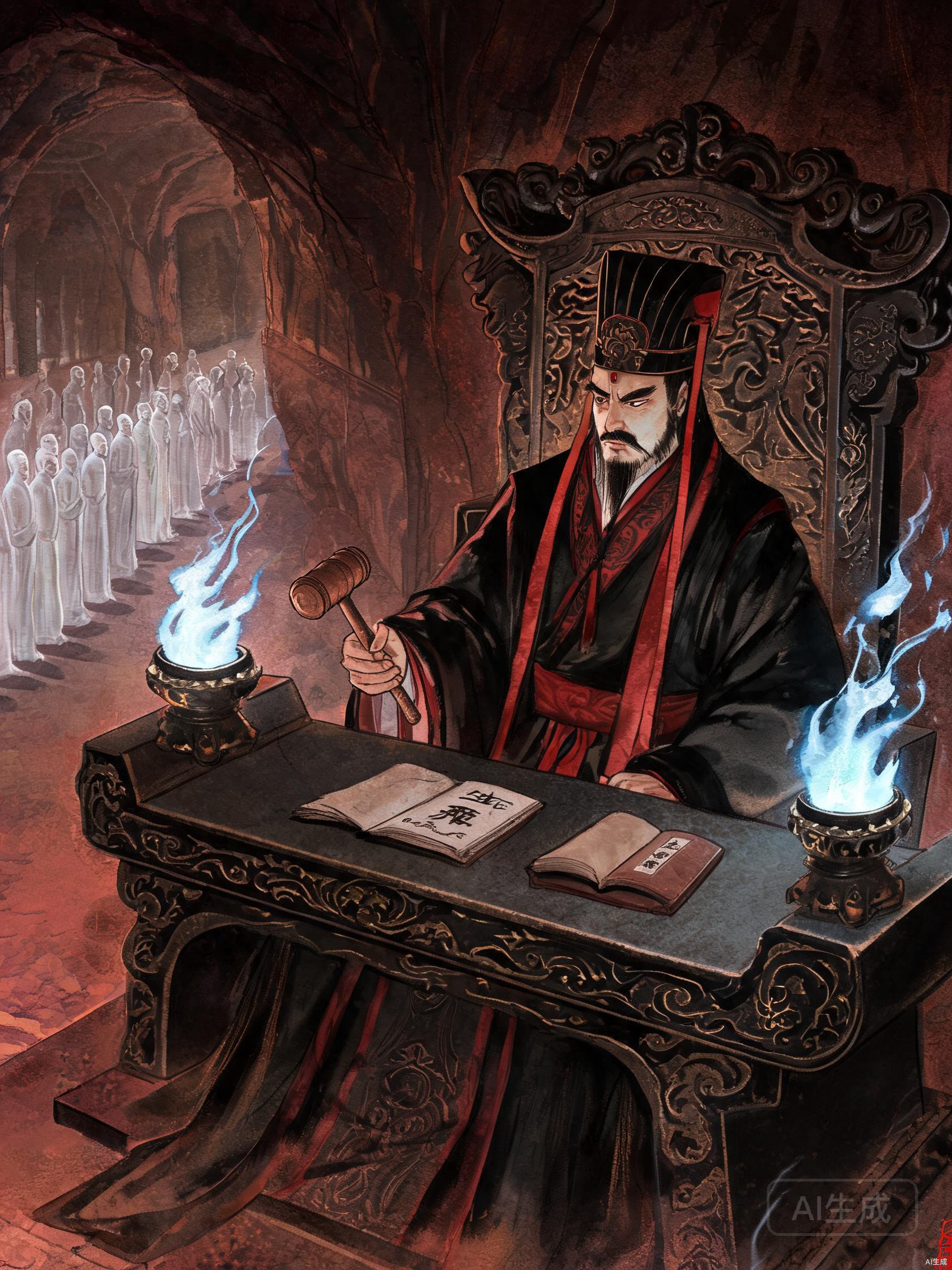
Yanluo Wang — the syncretic King of Hell, where Buddhist cosmology meets Chinese bureaucracy
The Buddhist underworld in China is a uniquely syncretic creation. Indian Buddhism brought the idea of multiple hells where beings suffer according to their karma, but Chinese Buddhism transformed this into a vast bureaucratic underworld where the dead are judged by ten kings, each presiding over one of the ten courts of hell. This vision, codified in the 'Sutra of the Ten Kings' (Shiwang Jing, 十王經) during the Tang Dynasty, combined Buddhist cosmology with the Chinese imperial court system — the dead pass from court to court, just as a criminal would pass through the imperial bureaucracy.
The Ten Kings of Hell (Shiwang, 十王) are: King Qinguang (秦廣王), who rules the first court; King Chujiang (楚江王), the second; King Songdi (宋帝王), the third; King Wuguan (五官王), the fourth; King Yama (閻羅王, Yanluo Wang), the fifth; King Biancheng (卞城王), the sixth; King Taizang (太山王), the seventh; King Pingdeng (平等王), the eighth; King Dushi (都市王), the ninth; and King Zhuanlun (轉輪王), the tenth. The first court judges initial offenses; the fifth court, presided by Yama himself, makes final determination; the tenth court determines reincarnation.
Crucially, the Buddhist underworld is not eternal — Chinese Buddhist theology teaches that hell sentences, like criminal sentences, have a finite term, after which the soul is reborn. However, the suffering endured in hell is commensurate with the sins committed, and the most wicked may suffer for thousands of years before release. The living can help the dead through merit transfer — performing good deeds on behalf of deceased relatives, sponsoring Buddhist rituals, copying sutras, or commissioning temple artwork. This practical theology gave Buddhism a central place in Chinese ancestor veneration.
The 'Ox-Head and Horse-Face' attendants (Niutou Mamian, 牛頭馬面) and the Black and White Impermanence (Heibai Wuchang, 黑白無常) — folk deities who escort the dead to the underworld — are uniquely Chinese additions that combine Buddhist karma theology with folk spirit belief. The Ox-Head and Horse-Face were originally the guards of Yama's court in Indian Buddhism, but in China they became folk-deity enforcers of karmic law. The Black and White Impermanence, originally minor underworld officials, were elevated in Chinese folk belief to become the most recognizable emissaries of death — masked figures who come for the soul at the appointed moment.
The Four Sacred Buddhist Mountains of China
China has four mountains sacred to Buddhism (Si Da Mingshan, 四大名山), each presided over by one of the four principal bodhisattvas. These mountains are not merely pilgrimage destinations but are themselves considered embodiments of the bodhisattvas they honor. Pilgrims climb them in circuits that can take weeks or months, and each mountain has its own distinct atmosphere, climate, and devotional tradition. Together, the Four Sacred Mountains represent the geographical heart of Chinese Buddhism.
Mount Wutai (Wutaishan, 五台山) in Shanxi Province, the sacred mountain of Manjushri, is the highest of the four (its five peaks rise above 2,500 meters) and is the northernmost. Its climate is harsh, and pilgrims often face snow even in summer. The mountain hosts over fifty monasteries, including the magnificent Foguang Temple (one of the oldest surviving wooden structures in China) and the Tayuan Temple, which contains a marvelously expressive Manjushri statue. The mountain's name, 'Five Terraces,' refers to its five flat-topped peaks, each said to be one of Manjushri's residences.
Mount Emei (Emeishan, 峨眉山) in Sichuan Province, the sacred mountain of Samantabhadra, is famous for its extraordinary biodiversity (it is a UNESCO World Heritage site), its sea of clouds at the Golden Summit, and its population of Tibetan macaques that inhabit the forested slopes. The mountain's most spectacular sight is the Golden Summit (Jinding, 金頂), where the giant Samantabhadra statue stands amid swirling clouds, and where one can see the 'Buddha's light' (Foguang, 佛光) — a halo phenomenon created by sunlight refracted through mist, considered a sign of the bodhisattva's presence.
Mount Jiuhua (Jiuhuashan, 九華山) in Anhui Province, the sacred mountain of Ksitigarbha, is the southernmost of the four. It is famous for its serene Buddhist atmosphere, the legendary presence of the still-incarnate Kim Qiaojue, and the immense natural beauty of its forested valleys. Mount Jiuhua's monastic tradition is particularly strong in the Tiantai school of Buddhism, and many of its monasteries host monks dedicated to the study and recitation of the Ksitigarbha Sutra — a meditation that is said to relieve the suffering of deceased relatives in hell.
Mount Putuo (Putuoshan, 普陀山) on the Zhejiang coast, the sacred mountain of Guanyin, is an island in the East China Sea. It is the smallest of the four but among the most visited, accessible only by ferry. According to tradition, Guanyin chose to dwell on Putuoshan, where she manifests as the sea-breeze, the sunlight on the water, and the compassion of fishermen. The island hosts over thirty monasteries and is famous for its Guanyin statues, the most spectacular being the thirty-three-meter Nanhai Guanyin (South Sea Guanyin) statue erected in 1997 — the largest Guanyin statue in the world, facing the sea in the form that Guanyin assumes as the protector of sailors and seafarers.
Buddhist Schools and the Spread of Sectarian Buddhism
Chinese Buddhism developed several major schools, each with its own doctrinal emphasis and patron bodhisattva. The Tiantai school (Tiantai Zong, 天台宗), founded in the 6th century by Zhiyi, is based on the Lotus Sutra and teaches that all phenomena are manifestations of the one Buddha-nature. The Huayan school (Huayan Zong, 華嚴宗), based on the Avatamsaka Sutra (the sutra of Manjushri and Samantabhadra), teaches the interpenetration of all phenomena. The Chan school (Chan Zong, 禪宗) — known in Japan as Zen — teaches direct transmission of the Buddha-mind through meditation; its legendary first patriarch in China was Bodhidharma (Damoyu, 達摩).
The Pure Land school (Jingtu Zong, 淨土宗), founded by Huiyuan in the 4th century and systematized by Shandao in the 7th, is the most popular school of Buddhism in Chinese history. It teaches that practitioners can be reborn in the 'Western Pure Land' of Amitabha Buddha (Emituo Fo, 阿彌陀佛) by invoking his name — typically through the nianfo (nembutsu) practice of reciting 'Namo Amitabha Buddha' (Namo Emituo Fo, 南無阿彌陀佛). Pure Land Buddhism gave hope of salvation to ordinary people who could not pursue the long monastic life, and it eventually merged with Chan Buddhism in most Chinese monasteries.
By the Song and Ming dynasties, the Chan school itself had fragmented into 'Five Houses' (Wujia, 五家): Linji (Rinzai in Japanese), Caodong (Soto in Japanese), Yunmen, Fayan, and Huanglong. Each developed different meditation techniques, koan (gongan, 公案) practices, and rhetorical styles. The Linji school's sudden-awakening teaching (using shouts and slaps) eventually reached Japan as Rinzai Zen, and the Caodong school's silent-illumination meditation (mokusho, 默照) reached Japan as Soto Zen — both becoming world-famous through their Japanese descendants.
Esoteric Buddhism (Mizong, 密宗), also called Tantric Buddhism or Vajrayana, entered China during the Tang Dynasty through masters like Vajrabodhi, Amoghavajra, and Huiguo (who taught the Japanese monk Kukai). Esoteric Buddhism emphasizes ritual, mantra (zhenyan, 真言), mudra, and mandala, and it had considerable influence on court Buddhism during the Tang. Although Esoteric Buddhism did not survive as an independent school in China, its ritual elements — the use of dharani (incantations), the bodhisattva vows, the elaborate visualization practices — were absorbed into the mainstream Chinese Buddhist tradition and persist today in Chinese temple rituals, especially funerals.
How Buddhism Integrated with Chinese Folk Religion
The integration of Buddhism with Chinese folk religion is one of the most remarkable case studies in religious syncretism. Rather than replacing existing beliefs, Buddhism added to them, creating a layered spiritual ecosystem where Buddhist, Taoist, and folk deities coexist, collaborate, and sometimes merge. A Chinese family might pray to Guanyin for mercy, to Guan Yu for protection, and to the Kitchen God for prosperity — all without sensing any contradiction, because in the Chinese religious imagination, these are simply different faces of a single, vast spiritual order.
This integration is visible in the architecture of Chinese temples. Many temples have a Buddhist hall alongside Taoist and folk altars. The City God temples, dedicated to the local protector deity, often include a shrine to Guanyin. Buddhist monasteries host Taoist-style fortune-telling and folk-style ancestor veneration. Even the Chinese underworld (Diyu) is a syncretic creation — it combines the Buddhist cosmology of hell-realms with Chinese bureaucratic imagery, so that Yanluo Wang, the King of Hell, functions like an imperial magistrate in a cosmic court system where karma and bureaucracy intertwine.
Perhaps the clearest example of syncretism is the goddess Mazu. Originally a folk heroine from Fujian province, Mazu was deified as a sea-protector goddess by the imperial court. Some traditions identify her as an incarnation of Guanyin — a bodhisattva who chose to manifest as a mortal woman to protect fishermen. This identification is accepted by both Buddhist and folk worshippers, and Mazu temples often contain Buddhist imagery. The result is a religious culture in which boundaries between traditions are not walls but membranes — permeable, flexible, and shaped by the practical needs of the worshippers rather than by theological dogma.
The same syncretism is visible in the figures of Guan Yu and the City God. Guan Yu, the historical general from the Three Kingdoms, was deified as a god of war and loyalty. In Buddhism, he became Sangharama (Qielan, 伽藍), the protector of Buddhist monasteries — a doctrine that emerged in the Tang Dynasty. In Taoism, he became a guardian deity with full Taoist priestly status. As Sangharama, his statue stands in every Buddhist monastery's grounds, an armed warrior in green robes protecting the dharma with his sword. The Three Teachings (San Jiao, 三教) — Confucianism, Taoism, and Buddhism — thus share their deities freely, and the result is the unique multi-layered spiritual landscape that defines Chinese religion to this day.