
Mazu
妈祖
The goddess of the sea who protects sailors and fishermen.
Origin Story
Who Is Mazu?
Mazu is unique among Chinese deities because she was a real historical person. Born Lin Mo[nian](/symbols/nian)g on Meizhou Island in Fujian province in 960 CE, she was said to have supernatural abilities from childhood — she could predict the weather, swim extraordinary distances, and rescue drowning sailors in her dreams.
After her death at age 28, sailors and fishermen along the Chinese coast began reporting that a woman in red appeared to guide them safely through storms. She was deified as Mazu, meaning 'Mother Ancestor,' and her cult spread rapidly across the maritime world.
Mazu is the most widely worshipped sea goddess in Chinese folk religion. A real woman who became a deity, she protects all who travel on water and is revered across coastal China, Taiwan, and Southeast Asia.
Powers & Symbols
Attributes & Artefacts
Click each card to reveal the details behind Mazu's divine attributes.
Historical & Cultural Meaning
Beyond the Myth
From Woman to Goddess
Mazu's transformation from mortal to deity happened organically. Fishermen built shrines to her; local officials reported her miracles to the imperial court. Over centuries, successive emperors bestowed ever-grander titles on her: Lady, Consort, Empress of Heaven (Tianhou).
By the Qing Dynasty, Mazu was the most important deity for Chinese maritime communities. Her temples dotted the coast from Shandong to Hainan, and her worship traveled with Chinese emigrants to Taiwan, Southeast Asia, and beyond.
Mazu in Chinese Culture
Today, Mazu has over 1,500 temples and 100 million devotees worldwide. The most important is the [Meizhou](/folklore/meizhou) Ancestral Temple on [Meizhou Island](/folklore/meizhou-island), which draws millions of pilgrims annually. In Taiwan, where Mazu is the most popular folk deity, the annual [Daji](/gods/daji)a Mazu Pilgrimage covers 340 kilometers over nine days.
Mazu represents the Chinese value of compassion in action. Unlike remote sky gods, she was a woman who used her gifts to save lives, and her worshippers honor her by helping others — especially those in danger on the sea.
In 2009, [Mazu](/gods/mazu) belief and customs were inscribed on UNESCO's Representative List of the Intangible Cultural Heritage of Humanity.
Sources & References
Primary classical texts: Shanhaijing (山海经, Classic of Mountains and Seas, c. 4th-2nd century BCE) · Fengshen Yanyi (封神演义, Investiture of the Gods, c. 16th century) · Journey to the West (西游记, Xiyouji, c. 16th century) · Records of the Grand Historian (史记, Shiji, by Sima Qian, c. 91 BCE) · Classic of Mountains and Seas commentary (郭璞注 Shanhaijing, c. 4th century) · Bamboo Annals (竹书纪年, c. 4th century BCE onwards)
Classical translations: Legge, James (trans.). The Sacred Books of the East (1879-1910, 50 volumes covering Chinese classics) · Girardot, Norman J. Myth and Meaning in Early Taoism (University of California Press, 1983) · Werner, E.T.C. A Dictionary of Chinese Mythology (Shanghai: Kelly & Walsh, 1932)
Modern academic references: Birrell, Anne. Chinese Mythology: An Introduction (Baltimore: Johns Hopkins University Press, 1993) · Yang, Lihui, and Deming An. Handbook of Chinese Mythology (New York: Oxford University Press, 2005) · Strassberg, Richard E. A Chinese Bestiary: Strange Creatures from the Guideways Through Mountains and Seas (Berkeley: University of California Press, 2002)
Digital encyclopedias and online resources: Wikipedia — Chinese mythology portal (continuously updated, citations to primary sources) · Encyclopedia Britannica — Mythology and Religion section
Mythology Network
Connections & Relationships
Mazu is woven into a larger web of gods, creatures, and legends. Explore the connections below.
Mazu
妈祖


📱 Wallpaper · $2.99
Take 妈祖(天上圣母) with you
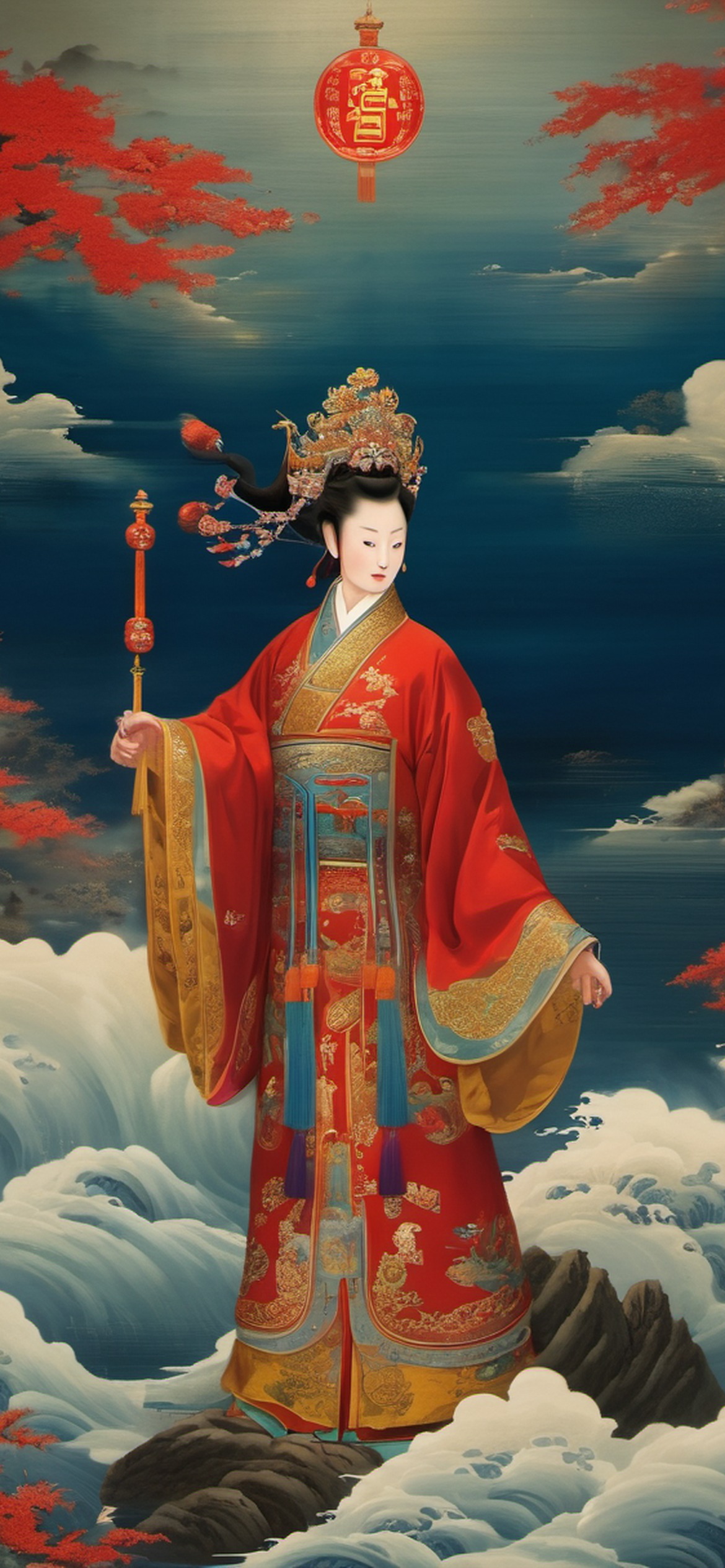
High-resolution phone wallpaper of Goddess Mazu (妈祖(天上圣母)) — iconography drawn from classical Chinese sources, painted in traditional style.
📜 Iconography sources
Mazu began as Lin Moniang (林默娘, 960–987), a Fujian shamaness who rescued sailors from typhoons; dynastic chronicles record her posthumous promotions — from Lady to Consort to Heavenly Consort to Heavenly Queen Mother (天后), the sea goddess of the entire Chinese coast. Iconography shows her in vermillion robes and phoenix crown, standing on storm waves with a guiding lantern, flanked by her two demon generals Qianliyan and Shunfeng'er.
Buy & download
Explore the Topic
Mazu in the Mythology Network
Go deeper — read the topic guides that gather every deity like Mazu.