Black and White Impermanence
黑白无常
The two underworld officers who escort the souls of the dead to the afterlife.
Origin Story
The Two Guards of Death
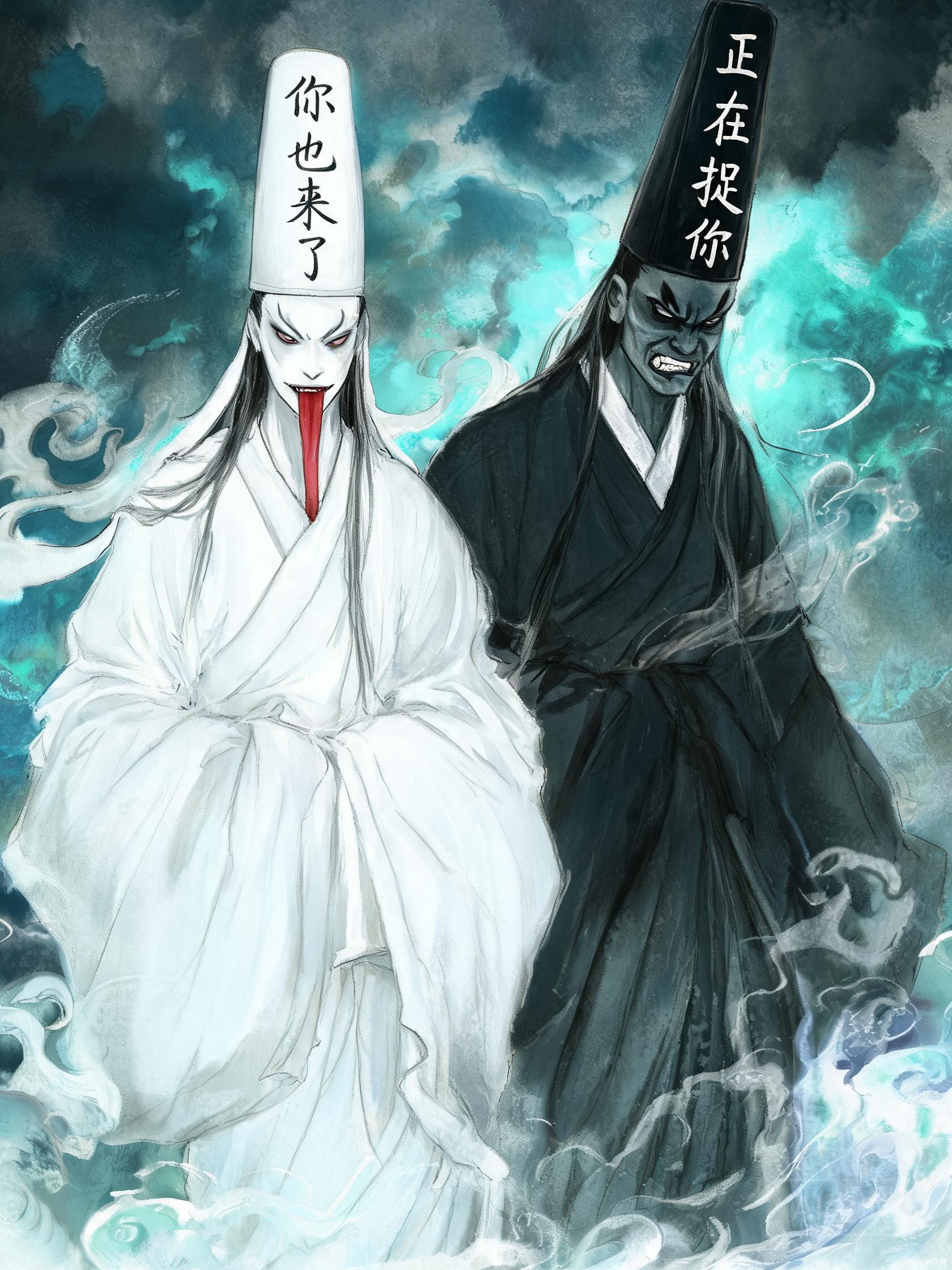
The White Impermanence (Bai Wuchang) is depicted as a tall, thin figure in white robes, with a pale face and a permanent, slightly eerie smile. He wears a tall white hat inscribed with the words 'Seeing me, you will be [wealth](/gods/caishen)y' (or in darker versions, 'Seeing me, you will catch your breath'). His demeanor is outwardly friendly, but his arrival always means death.
The Black Impermanence (Hei Wuchang) is shorter and stockier, dressed in black, with a dark, fierce face and a stern expression. His hat bears the words 'One look and all is well' — a sardonic greeting for the [soul](/gods/yama) about to be taken. He carries chains and a placard bearing the name and address of the person whose time has come.
Together, they represent the dual nature of death: the white guard's smile is the mercy of release, the black guard's sternness is the inescapability of fate. Neither is malicious — they are simply doing their duty, enforcing the natural order of life and death. In Chinese folk temples, their statues often stand at the entrances of city god temples, reminding the living that death comes for all.
Black and White Impermanence (Hei Bai Wuchang) are a pair of underworld figures in Chinese folk religion who serve as psychopomps — guides of the dead. They appear at the moment of death to escort the newly deceased [soul](/folklore/hungry-ghosts) to the underworld for judgment. One wears black, the other white, and together they represent the inescapable nature of mortality.
Powers & Symbols
Attributes & Artefacts
Click each card to reveal the details behind Black and White Impermanence's divine attributes.
Historical & Cultural Meaning
Beyond the Myth
The Legend of Two Brothers
According to one popular origin story, the Black and White Impermanence were once two sworn brothers named Xie Bi'an and Fan Wujiu. One day, while walking together, they were caught in a sudden rainstorm. Xie told Fan to wait while he went home to fetch an umbrella. But before he could return, the river flooded, and Fan, refusing to abandon the meeting place, drowned rather than break his promise.
When Xie returned and found his brother dead, he was overcome with grief and hanged himself. Moved by their extraordinary loyalty and brotherhood, the King of Hell appointed them as his officers, giving them the duty of guiding [souls to ](/folklore/hungry-ghosts)the underworld. Their names — Xie [Bi](/gods/bi-deng)'an and Fan Wujiu — are still used in temple worship.
In another tradition, they are called 'Seventh Master' (Qi Ye) and 'Eighth Master' (Ba Ye), based on their heights. They are among the most beloved figures in Chinese folk religion, and their statues — the tall smiling white figure and the short fierce black figure — are instantly recognizable in temples throughout the Chinese world.
Cultural Significance
The Black and White Impermanence serve an important psychological function in Chinese folk belief. Death is terrifying in part because it is unknown — the appearance of these two figures at the moment of death transforms the unknown into something familiar. The dead are not abandoned to wander alone; they are met by guides who know the way.
Their presence in city god temples (chenghuang miao) is particularly significant. The [City God](/folklore/city-god) is the bureaucratic administrator of the local spirit world, and the Black and White Impermanence are his enforcers — the police officers of the spirit realm. Their statues, often life-sized and fearsomely realistic, remind temple visitors that the spirit world operates with the same bureaucratic structure as the human government.
In popular culture, they appear in countless ghost stories, films, and television dramas. They are sometimes portrayed humorously — bickering like an old married couple or dealing with difficult [souls — ](/gods/jade-emperor)but their fundamental role remains solemn: they are the border guards between life and death, the first beings a soul meets on its journey to judgment.
Sources & References
Primary classical texts: Shanhaijing (山海经, Classic of Mountains and Seas, c. 4th-2nd century BCE) · Fengshen Yanyi (封神演义, Investiture of the Gods, c. 16th century) · Journey to the West (西游记, Xiyouji, c. 16th century) · Records of the Grand Historian (史记, Shiji, by Sima Qian, c. 91 BCE) · Classic of Mountains and Seas commentary (郭璞注 Shanhaijing, c. 4th century) · Bamboo Annals (竹书纪年, c. 4th century BCE onwards)
Classical translations: Legge, James (trans.). The Sacred Books of the East (1879-1910, 50 volumes covering Chinese classics) · Girardot, Norman J. Myth and Meaning in Early Taoism (University of California Press, 1983) · Werner, E.T.C. A Dictionary of Chinese Mythology (Shanghai: Kelly & Walsh, 1932)
Modern academic references: Birrell, Anne. Chinese Mythology: An Introduction (Baltimore: Johns Hopkins University Press, 1993) · Yang, Lihui, and Deming An. Handbook of Chinese Mythology (New York: Oxford University Press, 2005) · Strassberg, Richard E. A Chinese Bestiary: Strange Creatures from the Guideways Through Mountains and Seas (Berkeley: University of California Press, 2002)
Digital encyclopedias and online resources: Wikipedia — Chinese mythology portal (continuously updated, citations to primary sources) · Encyclopedia Britannica — Mythology and Religion section
Mythology Network
Connections & Relationships
Black and White Impermanence is woven into a larger web of gods, creatures, and legends. Explore the connections below.
Black and White Impermanence
黑白无常
Explore the Topic
Black and White Impermanence in the Mythology Network
Go deeper — read the topic guides that gather every folk tradition like Black and White Impermanence.