Lantern Festival
元宵节
The festival of lights that marks the grand finale of the Lunar New Year celebrations.
Origin Story
Origins and History
The Lantern Festival dates back over 2,000 years to the Han Dynasty. Emperor Wen designated the 15th night of the first lunar month as a day of celebration to commemorate the suppression of the Lü clan rebellion. Later, Emperor Ming, a devout Buddhist, ordered lanterns to be lit in the palace on this night to honor [Buddha](/gods/buddha-shakyamuni), giving the festival its luminous character.
During the Tang Dynasty, the [Lantern](/symbols/lantern) Festival became a grand public celebration lasting three nights. The Song Dynasty extended it to five nights, and the Ming Dynasty to a full ten days. Lantern displays grew increasingly elaborate, with artisans competing to create the most magnificent designs.
The festival was also one of the few nights when traditional restrictions on women's movements were relaxed. Young women could venture out to view the lanterns, making the festival a romantic occasion celebrated in countless poems and love stories.
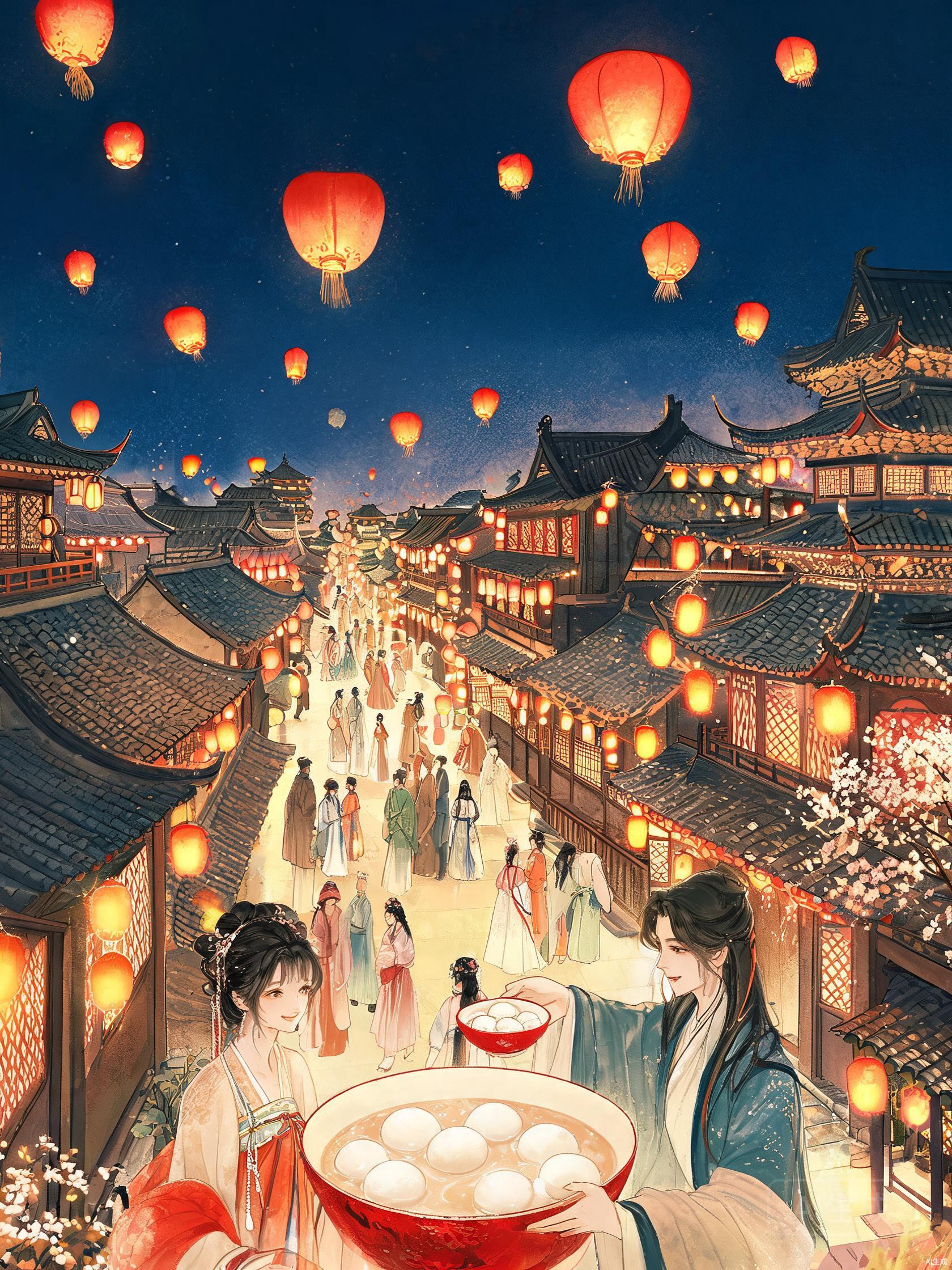
The Lantern Festival, celebrated on the 15th day of the first lunar month, is one of China's most enchanting festivals. It marks the first full moon of the lunar year and the official end of the [Spring Festival](/folklore/spring-festival). On this night, streets and homes are adorned with colorful lanterns, riddles are solved, and sweet rice balls are shared.
Powers & Symbols
Attributes & Artefacts
Click each card to reveal the details behind Lantern Festival's divine attributes.
Historical & Cultural Meaning
Beyond the Myth
Lantern Traditions
On the night of the [Lantern](/symbols/lantern) Festival, streets, temples, and homes are filled with lanterns of every conceivable shape and design. Traditional lanterns include palace lanterns, flower lanterns, animal-shaped lanterns, and the magnificent revolving horse lantern (zouma deng) with its shadow-play mechanism.
One of the most beloved customs is solving lantern riddles (cai deng mi). Riddles are written on slips of paper attached to the lanterns, and viewers attempt to solve them. The tradition, dating to the Song Dynasty, adds an intellectual element to the visual feast.
In some regions, people release sky lanterns (similar to hot air balloons) into the night sky, carrying written wishes. In others, rivers are lit with floating water lanterns to guide lost spirits home — a practice that bridges the festive and the sacred.
Tangyuan: The Taste of Reunion
The signature food of the [Lantern](/symbols/lantern-symbolism) Festival is tangyuan — sweet glutinous rice balls filled with sesame paste, red bean paste, or peanut butter. Their round shape symbolizes completeness, unity, and family togetherness. The name 'tangyuan' sounds like 'tuanyuan,' meaning reunion.
In northern China, a similar food called yuanxiao is prepared differently — the filling is rolled in glutinous rice flour rather than wrapped — but the meaning is the same. Eating these sweet balls on the night of the first full moon is a wish for a year of harmony and wholeness.
The tradition of eating tangyuan dates back to the Song Dynasty and has remained essentially un[change](/zodiac/change)d for a thousand years — a testament to the enduring power of food to carry cultural meaning across generations.
Sources & References
Primary classical texts: Shanhaijing (山海经, Classic of Mountains and Seas, c. 4th-2nd century BCE) · Fengshen Yanyi (封神演义, Investiture of the Gods, c. 16th century) · Journey to the West (西游记, Xiyouji, c. 16th century) · Records of the Grand Historian (史记, Shiji, by Sima Qian, c. 91 BCE) · Classic of Mountains and Seas commentary (郭璞注 Shanhaijing, c. 4th century) · Bamboo Annals (竹书纪年, c. 4th century BCE onwards)
Classical translations: Legge, James (trans.). The Sacred Books of the East (1879-1910, 50 volumes covering Chinese classics) · Girardot, Norman J. Myth and Meaning in Early Taoism (University of California Press, 1983) · Werner, E.T.C. A Dictionary of Chinese Mythology (Shanghai: Kelly & Walsh, 1932)
Modern academic references: Birrell, Anne. Chinese Mythology: An Introduction (Baltimore: Johns Hopkins University Press, 1993) · Yang, Lihui, and Deming An. Handbook of Chinese Mythology (New York: Oxford University Press, 2005) · Strassberg, Richard E. A Chinese Bestiary: Strange Creatures from the Guideways Through Mountains and Seas (Berkeley: University of California Press, 2002)
Digital encyclopedias and online resources: Wikipedia — Chinese mythology portal (continuously updated, citations to primary sources) · Encyclopedia Britannica — Mythology and Religion section
Mythology Network
Connections & Relationships
Lantern Festival is woven into a larger web of gods, creatures, and legends. Explore the connections below.
Lantern Festival
元宵节

Explore the Topic
Lantern Festival in the Mythology Network
Go deeper — read the topic guides that gather every folk tradition like Lantern Festival.