Qiuniu
囚牛
The eldest dragon son who loves music and rests upon the instruments of the immortals.
Origin Story
What Is Qiuniu?
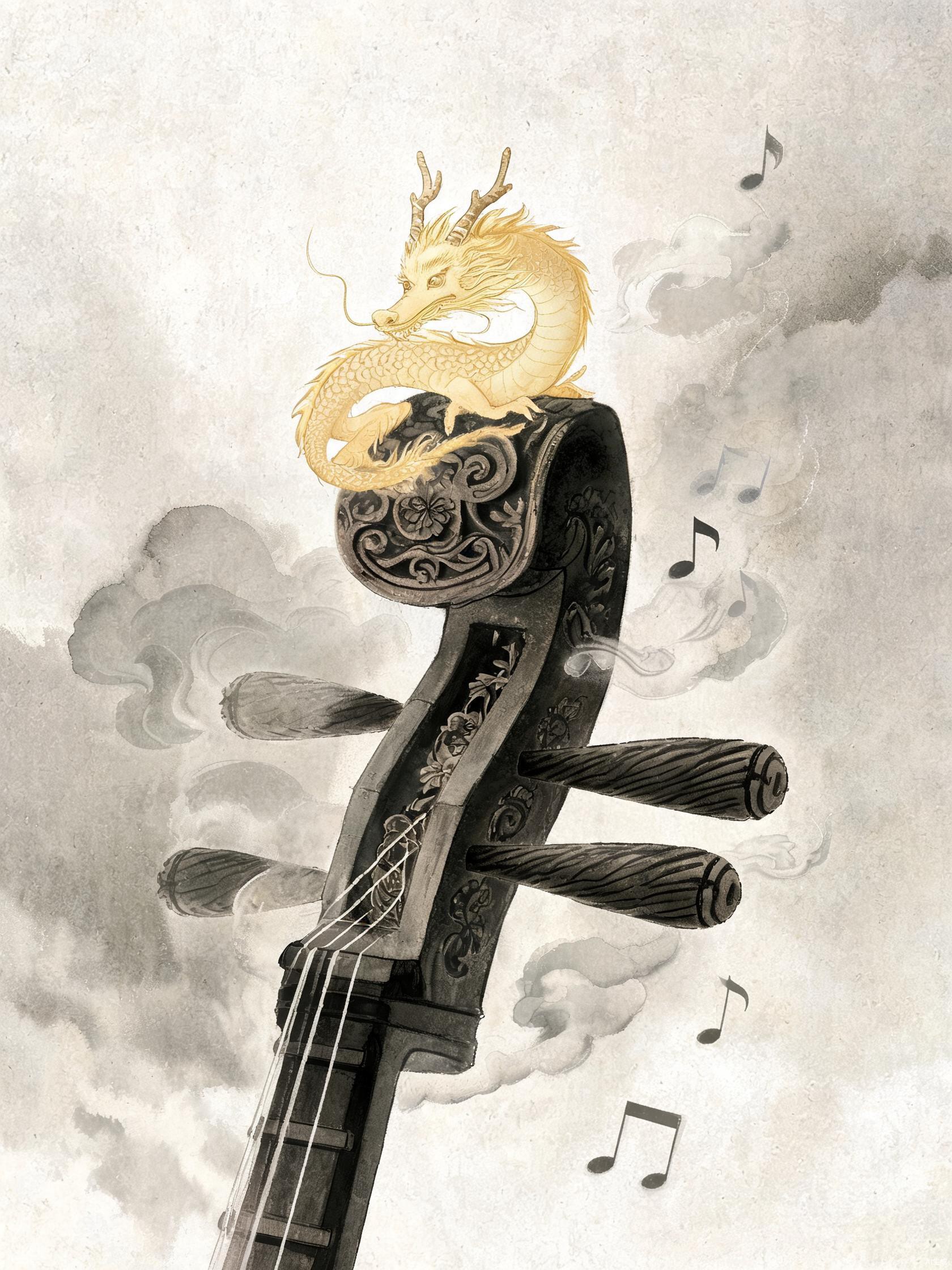
Qiuniu is the eldest of the Nine Sons of the [Dragon](/creatures/chinese-dragon) in Chinese mythology. Where most of his brothers are fierce, predatory, or imposing, Qiuniu is defined by his love of music. He is said to be a [yellow dragon](/creatures/chinese-dragon) of small stature, gentle temperament, and refined sensibility, who spends his time listening to the finest melodies of heaven and earth.
Because of this musical devotion, craftsmen carve Qiuniu's image onto the heads of traditional Chinese stringed instruments, most notably the huqin family of bowed lutes. The creature sits where the [strings](/symbols/seven) meet the neck, his carved head gazing out as though listening to every note. Players believed his presence gave their instruments a sweeter, more resonant voice.
Qiuniu is the first of the [Dragon](/symbols/dragon-symbolism)'s Nine Sons, a gentle creature with a deep love of music. Unlike his fiercer brothers, he is serene and artistic, and his image is carved onto the heads of traditional stringed instruments so that every melody might carry his blessing.
Powers & Symbols
Attributes & Artefacts
Click each card to reveal the details behind Qiuniu's divine attributes.
Historical & Cultural Meaning
Beyond the Myth
Qiuniu in Architecture and Art
Unlike his brothers, who appear on weapons, bells, and roof ridges, Qiuniu is most at home in the world of music. His carved figure decorates the scroll heads of erhus, jinghus, and other huqin instruments used in Chinese [opera](/folklore/beijing-opera) and [folk music](/folklore/lunar-new-year). Some temple instruments and ceremonial zithers also feature his likeness.
The placement is intimate rather than monumental — Qiuniu does not guard gates or palaces but dwells close to the [musician](/gods/[huang](/creatures/fenghuang)di)'s hands. This reflects his character as the most cultured and gentle of the dragon sons, a being who would rather listen to a song than fight a battle.
Symbolism and Cultural Meaning
Qiuniu represents the belief that even the mightiest lineage contains gentleness. As the firstborn son of the dragon — the most powerful symbol in Chinese culture — Qiuniu could have been a warrior or ruler, yet his gift is an ear for beauty. He embodies the Confucian ideal that refinement and self-cultivation are as worthy as strength.
Musicians and artisans historically invoked Qiuniu as a patron of their craft, believing his spirit could elevate ordinary sound into something divine. In a culture that reveres both dragons and [music](/creatures/fenghuang), the union of the two in Qiuniu made him a quietly beloved figure among performers and instrument makers.
The Nine Sons of the Dragon
Qiuniu is the first of the celebrated Nine Sons of the [Dragon](/zodiac/zodiac-dragon) (龙生九子), a group of mythical creatures each with a distinct appearance and temperament. The saying 'the dragon has nine sons, and each is different' (龙生九子,各有不同) became a Chinese idiom for how siblings can be utterly unlike one another.
Though called 'nine,' the list varies across historical sources, with Ming dynasty scholars such as Li Dongyang recording the most widely cited versions. [Qiuniu](/creatures/qiuniu) consistently appears as the eldest, the musical soul of a famously fierce family — proof that even dragons value a beautiful song.
Sources & References
Primary classical texts: Shanhaijing (山海经, Classic of Mountains and Seas, c. 4th-2nd century BCE) · Fengshen Yanyi (封神演义, Investiture of the Gods, c. 16th century) · Journey to the West (西游记, Xiyouji, c. 16th century) · Records of the Grand Historian (史记, Shiji, by Sima Qian, c. 91 BCE) · Classic of Mountains and Seas commentary (郭璞注 Shanhaijing, c. 4th century) · Bamboo Annals (竹书纪年, c. 4th century BCE onwards)
Classical translations: Legge, James (trans.). The Sacred Books of the East (1879-1910, 50 volumes covering Chinese classics) · Girardot, Norman J. Myth and Meaning in Early Taoism (University of California Press, 1983) · Werner, E.T.C. A Dictionary of Chinese Mythology (Shanghai: Kelly & Walsh, 1932)
Modern academic references: Birrell, Anne. Chinese Mythology: An Introduction (Baltimore: Johns Hopkins University Press, 1993) · Yang, Lihui, and Deming An. Handbook of Chinese Mythology (New York: Oxford University Press, 2005) · Strassberg, Richard E. A Chinese Bestiary: Strange Creatures from the Guideways Through Mountains and Seas (Berkeley: University of California Press, 2002)
Digital encyclopedias and online resources: Wikipedia — Chinese mythology portal (continuously updated, citations to primary sources) · Encyclopedia Britannica — Mythology and Religion section
Mythology Network
Connections & Relationships
Qiuniu is woven into a larger web of gods, creatures, and legends. Explore the connections below.
Qiuniu
囚牛

Explore the Topic
Qiuniu in the Mythology Network
Go deeper — read the topic guides that gather every creature like Qiuniu.