Suanni
狻猊
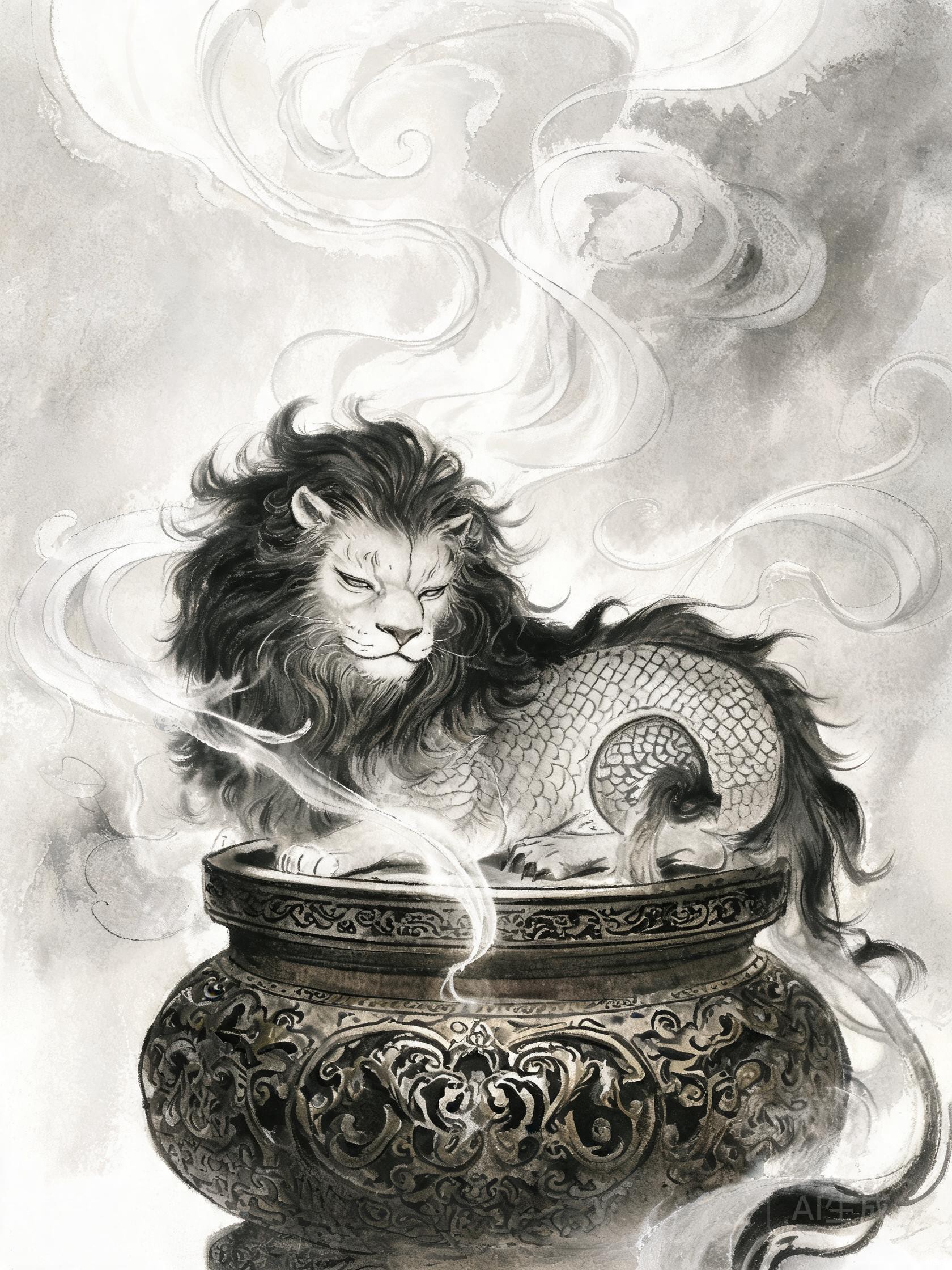
The lion-like dragon son who reclines among incense smoke and the seats of the wise.
Origin Story
What Is Suanni?
Suanni is the fifth son of the [Dragon](/symbols/dragon-symbolism), and he resembles a lion rather than a serpent. Majestic, broad-chested, and thick-maned, he is the most composed of the nine sons — a creature that loves stillness, introspection, and the curling smoke of burning incense. He is often described as fond of fire and smoke, which is why he dwells where incense burns.
His leonine form links him to the lion, an animal revered in Chinese Buddhism as the mount of [Manjushri](/gods/manjushri), the bodhisattva of wisdom. Because of this association, Suanni carries a strong Buddhist significance, representing the dignified calm of enlightenment and the contemplative life.
Suanni is the fifth of the Dragon's Nine Sons, a lion-like creature of calm and dignity. He loves stillness, fire, and fragrant smoke, and his image is cast onto incense burners and throne bases, where he sits in serene contemplation amid rising incense.
Powers & Symbols
Attributes & Artefacts
Click each card to reveal the details behind Suanni's divine attributes.
Historical & Cultural Meaning
Beyond the Myth
Suanni in Architecture and Art
Suanni's image is most commonly found on incense burners (香炉), where his lion-like form crouches or sits among the rising smoke. He also appears on the feet of thrones, incense stands, and temple furniture — anywhere that fire, smoke, and stillness converge.
In Buddhist temples, lions flanking entrances and supporting seats are sometimes identified with Suanni, blending the dragon son's mythology with the broader reverence for lions as guardians of the dharma. His placement amid incense is both symbolic and practical: he watches over the smoke that carries prayers to the heavens.
Symbolism and Cultural Meaning
Suanni symbolizes tranquility, wisdom, and spiritual dignity. Unlike his fiercer brothers, he does not fight or roar — he sits, watches, and breathes in the smoke of devotion. This made him the patron of contemplation, meditation, and the quiet authority of those who rule through wisdom rather than force.
His lion form also tied him to the broader symbolism of the lion in Chinese culture as a guardian and symbol of power. But where ordinary guardian lions are fierce, Suanni's lion is serene — a reminder that true strength is often still, and that the most powerful presence in a room may be the one that never raises its voice.
The Nine Sons of the Dragon
Suanni is the fifth of the Nine Sons of the [Dragon](/zodiac/zodiac-dragon) (龙生九子), the celebrated brood of the [Chinese dragon](/creatures/chinese-dragon), each with a distinct form and disposition. The proverb 'the dragon has nine sons, and each is different' (龙生九子,各有不同) expresses how a single parent can produce remarkably varied offspring.
Among the nine, [Suanni](/creatures/suanni) is the contemplative — the son who found his place not in war or music but in the quiet smoke of temples. Ming dynasty sources record his leonine form and his love of sitting, cementing his role as the spiritual, Buddhist-leaning member of the dragon's family.
Sources & References
Primary classical texts: Shanhaijing (山海经, Classic of Mountains and Seas, c. 4th-2nd century BCE) · Fengshen Yanyi (封神演义, Investiture of the Gods, c. 16th century) · Journey to the West (西游记, Xiyouji, c. 16th century) · Records of the Grand Historian (史记, Shiji, by Sima Qian, c. 91 BCE) · Classic of Mountains and Seas commentary (郭璞注 Shanhaijing, c. 4th century) · Bamboo Annals (竹书纪年, c. 4th century BCE onwards)
Classical translations: Legge, James (trans.). The Sacred Books of the East (1879-1910, 50 volumes covering Chinese classics) · Girardot, Norman J. Myth and Meaning in Early Taoism (University of California Press, 1983) · Werner, E.T.C. A Dictionary of Chinese Mythology (Shanghai: Kelly & Walsh, 1932)
Modern academic references: Birrell, Anne. Chinese Mythology: An Introduction (Baltimore: Johns Hopkins University Press, 1993) · Yang, Lihui, and Deming An. Handbook of Chinese Mythology (New York: Oxford University Press, 2005) · Strassberg, Richard E. A Chinese Bestiary: Strange Creatures from the Guideways Through Mountains and Seas (Berkeley: University of California Press, 2002)
Digital encyclopedias and online resources: Wikipedia — Chinese mythology portal (continuously updated, citations to primary sources) · Encyclopedia Britannica — Mythology and Religion section
Mythology Network
Connections & Relationships
Suanni is woven into a larger web of gods, creatures, and legends. Explore the connections below.
Suanni
狻猊


Explore the Topic
Suanni in the Mythology Network
Go deeper — read the topic guides that gather every creature like Suanni.