Qixi Festival
七夕节
The Chinese Valentine's Day — the night when the Cowherd and the Weaver Girl meet across a bridge of magpies.
Origin Story
What Is the Qixi Festival?
The Qixi Festival (七夕节, Qīxī Jié, 'Night of Sevens') is celebrated on the seventh day of the seventh month of the lunar calendar. Its name refers to the date — the double seven — and its story is the legend of the Cowherd (牛郎, Niúláng) and the Weaver Girl (织女, Zhīnǚ), the most beloved love story in Chinese mythology. The two stars, Altair and Vega, represent the lovers, separated by the Milky Way (the Silver River, 银河) for most of the year, but permitted to meet on this one night across a bridge formed by magpies (鹊桥, quèqiáo).
The festival's roots go back over two thousand years. References to the star-crossed lovers appear in the Book of Songs (诗经, Shījīng), the oldest collection of Chinese poetry, dating from the Zhou Dynasty. Over centuries, the astronomical myth — two stars separated by the Milky Way — evolved into a full narrative: a cowherd and a celestial weaver who fell in love, married, and had children, but were separated by the Queen Mother of the West (西王母) when the weaver neglected her heavenly duties. The Queen Mother drew the Milky Way across the sky with her hairpin, creating a river of stars that the lovers could not cross. Moved by their devotion, the magpies of the world volunteered to form a bridge across the Silver River — a single night of reunion, once a year, for all eternity.
Qixi is thus a festival of paradox: it celebrates love and laments separation, it honors devotion and acknowledges loss. The lovers meet, but they must part again by morning. The bridge is formed by living creatures who choose to help, not by divine decree. The story is not a triumph but a bittersweet compromise — the lovers are not permanently reunited but are granted a single night, year after year, a reminder that some separations cannot be overcome by love alone, but that love persists even across the greatest distances.

The Cowherd and Weaver Girl — the lovers whose annual reunion is celebrated at Qixi
The Qixi Festival (七夕节, 'Night of Sevens') falls on the seventh day of the seventh lunar month and is based on the legend of the Cowherd and the Weaver Girl — the star-crossed lovers separated by the Milky Way who are permitted to meet only once a year, on this night, across a bridge formed by magpies. Qixi is the Chinese festival of love and craftsmanship, a celebration of romantic longing, devoted love, and the skills of weaving and needlework. In recent decades, it has been revived as 'Chinese Valentine's Day.'
Powers & Symbols
Attributes & Artefacts
Click each card to reveal the details behind Qixi Festival's divine attributes.
Historical & Cultural Meaning
Beyond the Myth
Traditions and Activities
In traditional Chinese culture, Qixi was primarily a festival for women and girls. On this night, unmarried women would set up tables in courtyards, offering tea, fruits, and flowers to the Weaver Girl, praying for skill in needlework and weaving. The Weaver Girl was the celestial seamstress — the being who wove the clouds and the robes of heaven — and women who wished to become skilled in the domestic arts sought her blessing on her festival night.
The most characteristic Qixi activity was the thread-needle competition (穿针乞巧, chuānzhēn qǐqiǎo, 'threading the needle to beg for skill'). Under the moonlight, young women would compete to thread needles — the one who could thread the most needles in the moonlight was considered the most skilled, blessed by the Weaver Girl. Another tradition involved floating a needle on a bowl of water: the pattern the needle cast on the water's surface was read as a divination of the woman's future — her marriage prospects, her domestic skills, her fortune. These competitions were both practical (testing real needlework skill) and ritual (seeking the blessing of a deity), blending domestic craft with cosmic petition.
In some regions, Qixi was also associated with the tradition of washing hair with water left overnight under the stars — the water, having absorbed the starlight, was believed to give the hair a special shine and to bring beauty and good fortune. Children would pick wild flowers and offer them to the stars, and families would eat special Qixi foods: qiaoguo (巧果, 'skill fruits'), a fried pastry shaped like the Weaver Girl's loom, and longan, peanuts, and melon seeds, each carrying a wish for cleverness, fertility, and the birth of children.
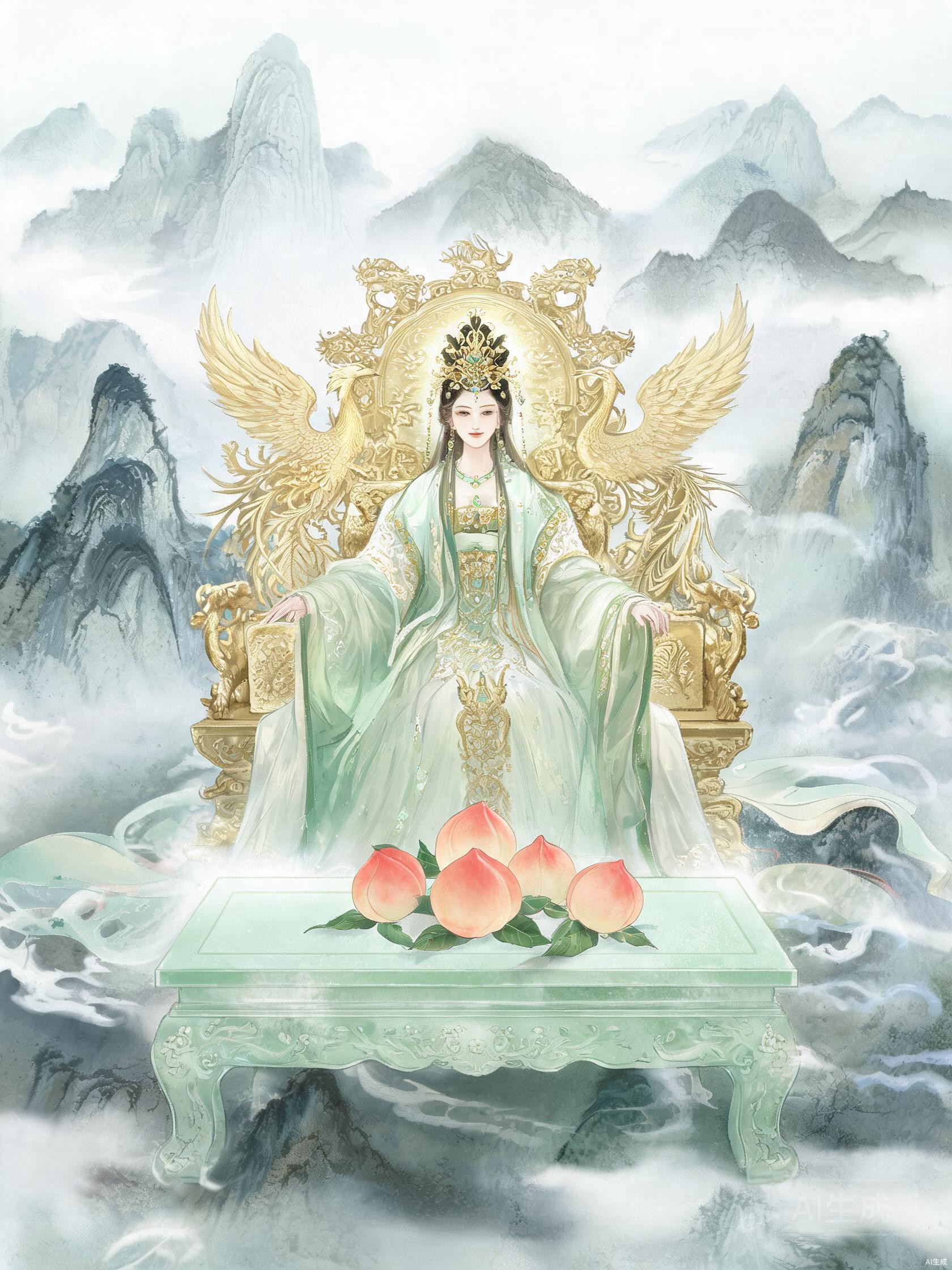
The Queen Mother of the West — the deity who separated the Cowherd and Weaver Girl
Qixi in Modern China
In the mid-20th century, as China modernized and urbanized, many Qixi traditions faded. The thread-needle competitions and star-gazing rituals of the old courtyard culture lost their relevance in a world of electric light and factory-made clothing. But in recent decades, Qixi has experienced a dramatic revival — not as a festival of needlework, but as 'Chinese Valentine's Day' (中国情人节). Commercial forces, cultural nationalism, and the desire for a Chinese alternative to the Western Valentine's Day (February 14th) have combined to make Qixi one of the biggest shopping and dating holidays in modern China.
This revival raises interesting questions about cultural authenticity. The modern Qixi — with its romantic dinners, flower deliveries, and social media posts — bears little resemblance to the traditional festival of needlework and star-gazing. But the underlying theme — romantic love across separation — is deeply faithful to the original myth. The Cowherd and Weaver Girl are the original star-crossed lovers, and their story, at its core, is about love that persists despite distance, time, and divine opposition. The modern Qixi, for all its commercialization, still celebrates this core value: that love is worth waiting for, worth crossing any distance for, and worth celebrating even if the reunion is only for a single night.
The festival also retains its astronomical dimension. On the night of Qixi, if the sky is clear, one can still see Altair and Vega — the two brightest stars in the summer sky — separated by the pale band of the Milky Way. For over two thousand years, Chinese lovers have looked up at these stars on the seventh night of the seventh month and seen in them a reflection of their own longing. The stars have not changed, and neither has the human need to believe that love, once separated, can be reunited — if only for a night, if only across a bridge of birds.
Mythology Network
Connections & Relationships
Qixi Festival is woven into a larger web of gods, creatures, and legends. Explore the connections below.
Qixi Festival
七夕节