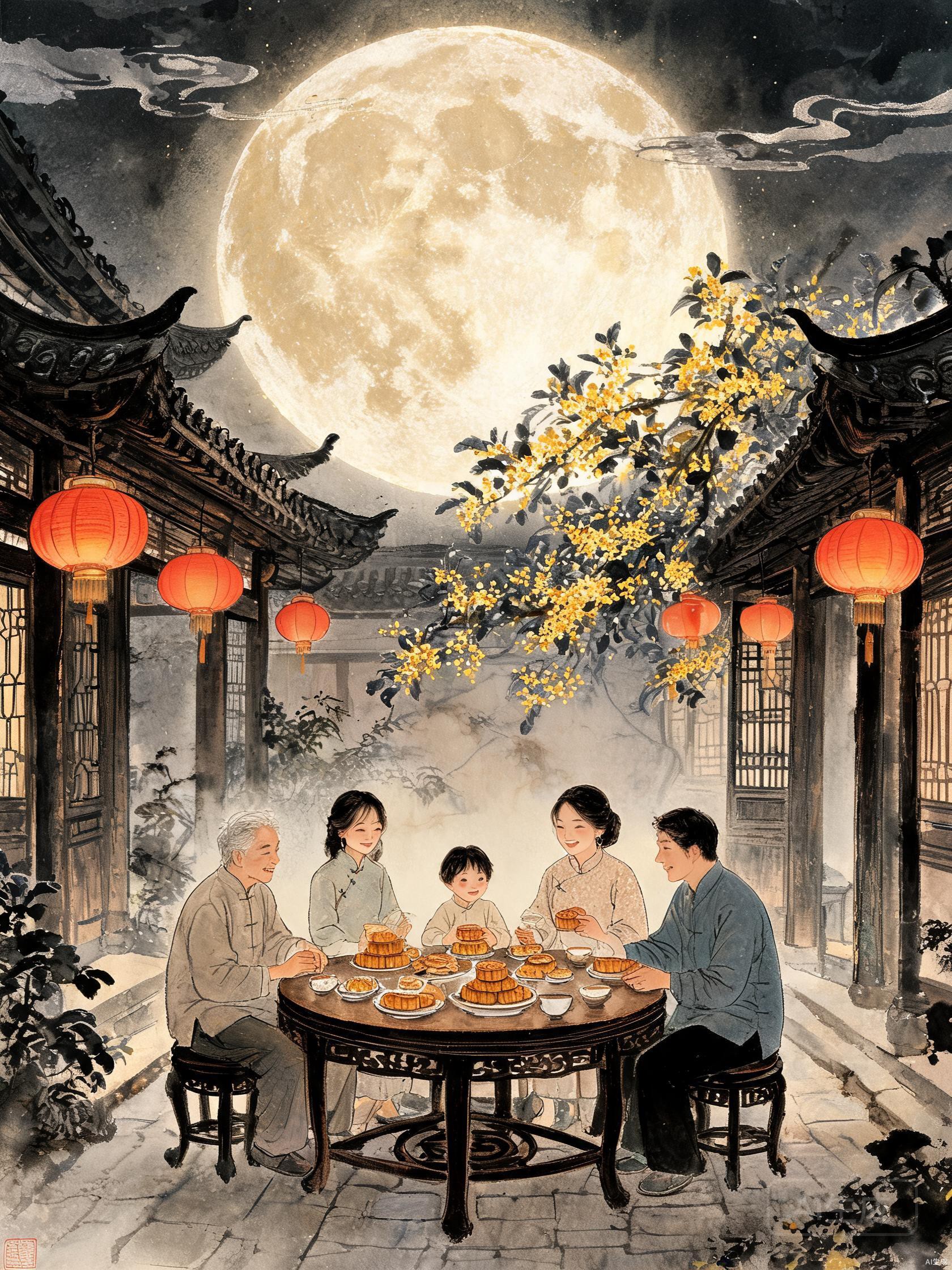
Mid-Autumn Festival
中秋节
The festival of the harvest moon, family reunion, and mooncakes.
Origin Story
The Brightest Moon of the Year
The Mid-Autumn Festival falls on the night when the moon is at its fullest and brightest — the 15th day of the 8th lunar month, when the autumn air is clear and crisp, making the moon appear especially luminous. This astronomical perfection made it a natural occasion for celebration in ancient China.
The festival's core symbolism is the circle — the full moon represents completeness, unity, and family togetherness. The Chinese word for reunion, 'tuanyuan,' contains 'yuan,' meaning round. When families cannot gather, they share the same moon, knowing that loved ones far away are looking at the same luminous disk.
The tradition of moon viewing (shang yue) dates back to the Tang Dynasty, when it became fashionable for literati to gather on this night to drink wine, compose poetry, and admire the moon's beauty. The festival was officially established in the Song Dynasty and has been celebrated continuously for over a thousand years.
Mid-Autumn Festival — when families reunite under the fullest moon
The Mid-Autumn Festival, celebrated on the 15th day of the 8th lunar month, is the second most important festival in Chinese culture after the [Spring Festival](/folklore/spring-festival). It is a time for family reunion under the year's brightest and roundest moon, sharing mooncakes, and recalling the legend of Chang'e, the Moon Goddess.
Powers & Symbols
Attributes & Artefacts
Click each card to reveal the details behind Mid-Autumn Festival's divine attributes.
Historical & Cultural Meaning
Beyond the Myth
The Legend of Chang'e
The Mid-Autumn Festival is inseparable from the story of Chang'e, the woman who became the Moon Goddess. According to the most popular version, Chang'e's husband [Hou Yi](/gods/hou-yi), the legendary archer who shot down nine of the ten suns, obtained an elixir of immortality. When a thief tried to steal it, Chang'e swallowed the elixir herself to protect it and floated up to the moon.
On the night of the Mid-Autumn Festival, families look up at the moon and say they can see the silhouette of Chang'e in its patterns, accompanied by the Jade [Rabbit](/zodiac/zodiac-rabbit) who pounds medicine, and occasionally the woodcutter [Wu Gang](/gods/wu-gang), condemned to eternally cut down a self-healing cassia tree on the moon.
The story of Chang'e is both a love story and a meditation on separation. She gained [immortal](/gods/buddha-shakyamuni)ity but lost her husband — a bittersweet reflection of the festival's dual nature, celebrating reunion while acknowledging those who are far from home.
Mooncakes: A Gift of Meaning
Mooncakes are the iconic food of the Mid-Autumn Festival — round pastries filled with lotus seed paste, red bean paste, or salted egg yolk, with intricate patterns pressed into their golden crusts. The round shape symbolizes completeness and family unity, and sharing a mooncake among family members is a ritual of togetherness.
A famous legend holds that mooncakes were used as secret communication during the Yuan Dynasty. Chinese rebels hid messages inside mooncakes calling for an uprising against Mongol rule on the night of the [Mid-Autumn](/folklore/mid-autumn-festival) Festival. Whether true or not, the story adds a layer of patriotic significance to this festive treat.
Today, mooncakes have evolved into an art form and a social currency. Luxury hotels and bakeries compete to create the most elaborate mooncake gift boxes, with flavors ranging from traditional lotus paste to modern innovations like ice cream, truffle, and even durian. Despite these innovations, the simple act of sharing a mooncake under the full moon remains the heart of the festival.
Sources & References
Primary classical texts: Shanhaijing (山海经, Classic of Mountains and Seas, c. 4th-2nd century BCE) · Fengshen Yanyi (封神演义, Investiture of the Gods, c. 16th century) · Journey to the West (西游记, Xiyouji, c. 16th century) · Records of the Grand Historian (史记, Shiji, by Sima Qian, c. 91 BCE) · Classic of Mountains and Seas commentary (郭璞注 Shanhaijing, c. 4th century) · Bamboo Annals (竹书纪年, c. 4th century BCE onwards)
Classical translations: Legge, James (trans.). The Sacred Books of the East (1879-1910, 50 volumes covering Chinese classics) · Girardot, Norman J. Myth and Meaning in Early Taoism (University of California Press, 1983) · Werner, E.T.C. A Dictionary of Chinese Mythology (Shanghai: Kelly & Walsh, 1932)
Modern academic references: Birrell, Anne. Chinese Mythology: An Introduction (Baltimore: Johns Hopkins University Press, 1993) · Yang, Lihui, and Deming An. Handbook of Chinese Mythology (New York: Oxford University Press, 2005) · Strassberg, Richard E. A Chinese Bestiary: Strange Creatures from the Guideways Through Mountains and Seas (Berkeley: University of California Press, 2002)
Digital encyclopedias and online resources: Wikipedia — Chinese mythology portal (continuously updated, citations to primary sources) · Encyclopedia Britannica — Mythology and Religion section
Mythology Network
Connections & Relationships
Mid-Autumn Festival is woven into a larger web of gods, creatures, and legends. Explore the connections below.
Mid-Autumn Festival
中秋节



Explore the Topic
Mid-Autumn Festival in the Mythology Network
Go deeper — read the topic guides that gather every folk tradition like Mid-Autumn Festival.