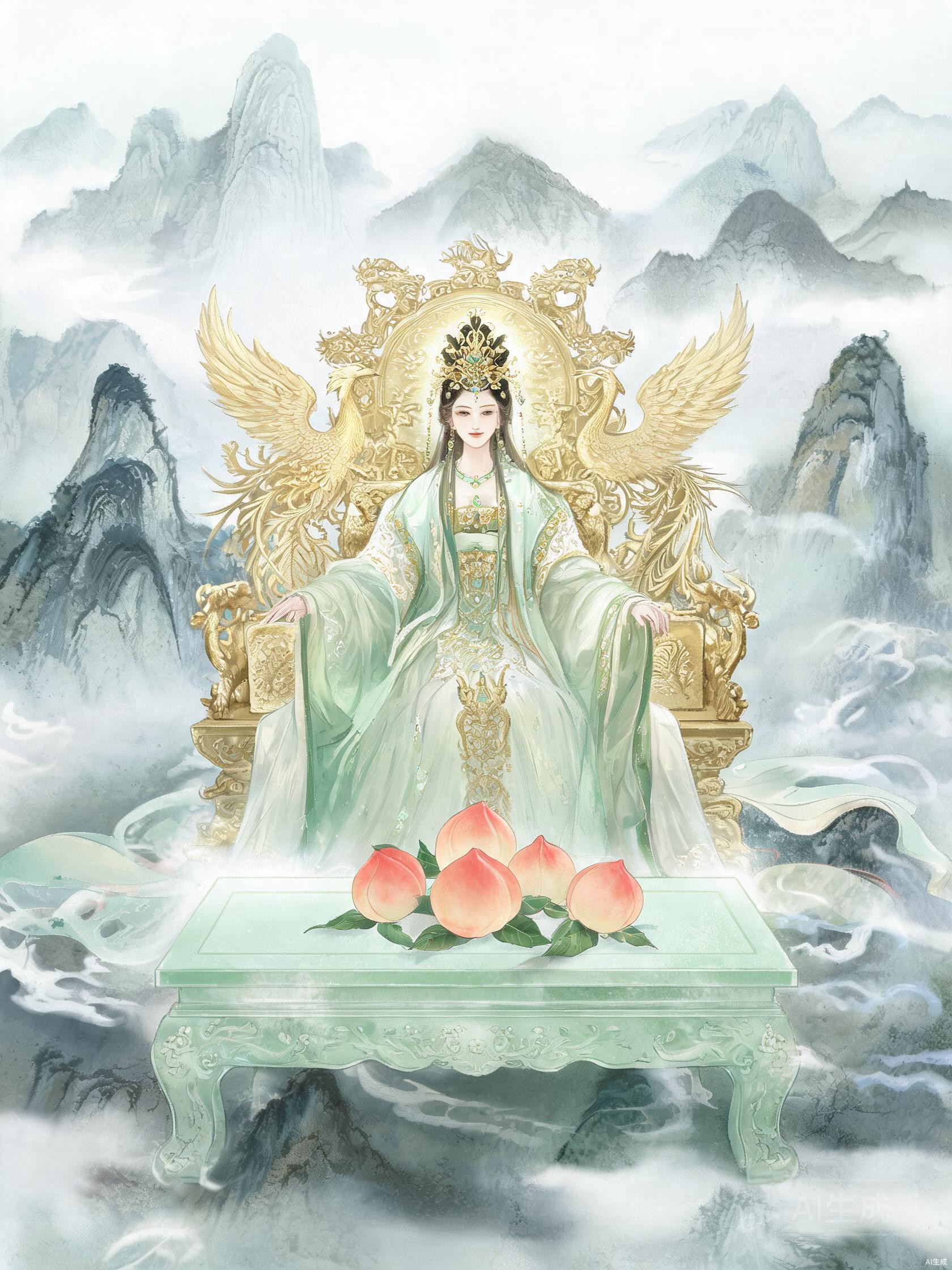
Queen Mother of the West
王母娘娘
The goddess of immortality who tends the Peaches of Paradise on Mount Kunlun.
Origin Story
Who Is the Queen Mother of the West?
The Queen Mother of the West, known in Chinese as Xiwangmu and later as Wangmu [Nian](/creatures/nian)gniang, is one of the oldest deities in the Chinese mythological tradition. She first appears in oracle bone inscriptions from the Shang Dynasty (c. 1600–1046 BCE), making her over three thousand years old as an object of worship.
She rules from Mount Kunlun, the cosmic mountain at the center of the world, where she presides over the Jade Pool (Yaochi). In her garden grow the Peaches of Immortality, which take three thousand years to blossom and another three thousand to ripen. Whoever eats them gains eternal life.
As the head of all female immortals and a supreme figure in the Taoist pantheon, she stands parallel to the [Jade Emperor](/gods/jade-emperor) himself. In some traditions, she is his consort; in others, she is an independent power of equal or greater antiquity.
The Queen Mother of the West (Xiwangmu) is one of the most ancient and powerful deities in Chinese mythology. Ruler of Mount Kunlun and guardian of the Peaches of Immortality, she commands all female immortals and dispenses the gift of eternal life.
Powers & Symbols
Attributes & Artefacts
Click each card to reveal the details behind Queen Mother of the West's divine attributes.
Magical Artifacts & Weapons
Queen Mother of the West's Divine Arsenal
The legendary weapons and treasures wielded by Queen Mother of the West — each with its own origin story, powers, and mythological significance.
Historical & Cultural Meaning
Beyond the Myth
The Peaches of Immortality
The Peaches of Immortality are the Queen Mother's most famous treasure. In Journey to the West, Sun Wukong crashes her Peach Banquet — held on the third day of the third lunar month — and devours the finest peaches, enraging the heavens and precipitating his war on the celestial realm.
The peaches also feature in the story of Chang'e. The archer [Hou Yi](/gods/hou-yi) received the elixir of immortality from the Queen Mother as a reward for shooting down nine of the ten suns. When Chang'e drank it, she floated to the moon, forever separating the Queen Mother's gift from its intended recipient.
These stories illustrate a recurring theme in Chinese mythology: immortality is not something one seizes by force, but a gift dispensed by divine judgment. The Queen Mother is the gatekeeper of that gift, and those who take it without her permission — like [Sun Wukong](/gods/sun-wukong) or Chang'e — face consequences.
Worship and Cultural Significance
The Queen Mother's worship predates organized Taoism. In the earliest texts, she was a fierce figure — a goddess with tiger's teeth, a jade ornament, and a disheveled appearance, who ruled over plague, punishment, and the wild forces of nature. Over centuries, she was gradually refined into the image of a beautiful, dignified queen attended by the three-legged blue crow and the nine-tailed fox.
Today, she is revered across Taoist temples, folk shrines, and domestic altars. Her Mount Kunlun is the spiritual center of the world in Taoist cosmology, and the Peach Banquet is a metaphor for divine favor and the rare gift of transcendence.
The Queen Mother also holds a unique role as the patron of women. In Taoist tradition, a woman who achieves immortality is welcomed into her court — making her the aspiration of female practitioners for over two thousand years.
The Queen Mother in Popular Culture
The Queen Mother of the West appears throughout Chinese literature, from the Shanhaijing (Classic of Mountains and Seas) to [Journey to the West](/myths/journey-to-the-west). In modern film and television adaptations of these classics, she is typically portrayed as a stately, remote figure whose peach banquet is the most exclusive event in heaven.
Her image as a dispenser of immortality has also made her a popular figure in xianxia and xuanhuan web fiction, where she often appears as an ancient, peerlessly powerful female immortal who tests and guides the heroine.
Sources & References
Primary classical texts: Shanhaijing (山海经, Classic of Mountains and Seas, c. 4th-2nd century BCE) · Fengshen Yanyi (封神演义, Investiture of the Gods, c. 16th century) · Journey to the West (西游记, Xiyouji, c. 16th century) · Records of the Grand Historian (史记, Shiji, by Sima Qian, c. 91 BCE) · Classic of Mountains and Seas commentary (郭璞注 Shanhaijing, c. 4th century) · Bamboo Annals (竹书纪年, c. 4th century BCE onwards)
Classical translations: Legge, James (trans.). The Sacred Books of the East (1879-1910, 50 volumes covering Chinese classics) · Girardot, Norman J. Myth and Meaning in Early Taoism (University of California Press, 1983) · Werner, E.T.C. A Dictionary of Chinese Mythology (Shanghai: Kelly & Walsh, 1932)
Modern academic references: Birrell, Anne. Chinese Mythology: An Introduction (Baltimore: Johns Hopkins University Press, 1993) · Yang, Lihui, and Deming An. Handbook of Chinese Mythology (New York: Oxford University Press, 2005) · Strassberg, Richard E. A Chinese Bestiary: Strange Creatures from the Guideways Through Mountains and Seas (Berkeley: University of California Press, 2002)
Digital encyclopedias and online resources: Wikipedia — Chinese mythology portal (continuously updated, citations to primary sources) · Encyclopedia Britannica — Mythology and Religion section
Mythology Network
Connections & Relationships
Queen Mother of the West is woven into a larger web of gods, creatures, and legends. Explore the connections below.
Queen Mother of the West
王母娘娘


📱 Wallpaper · $2.99
Take 西王母 with you
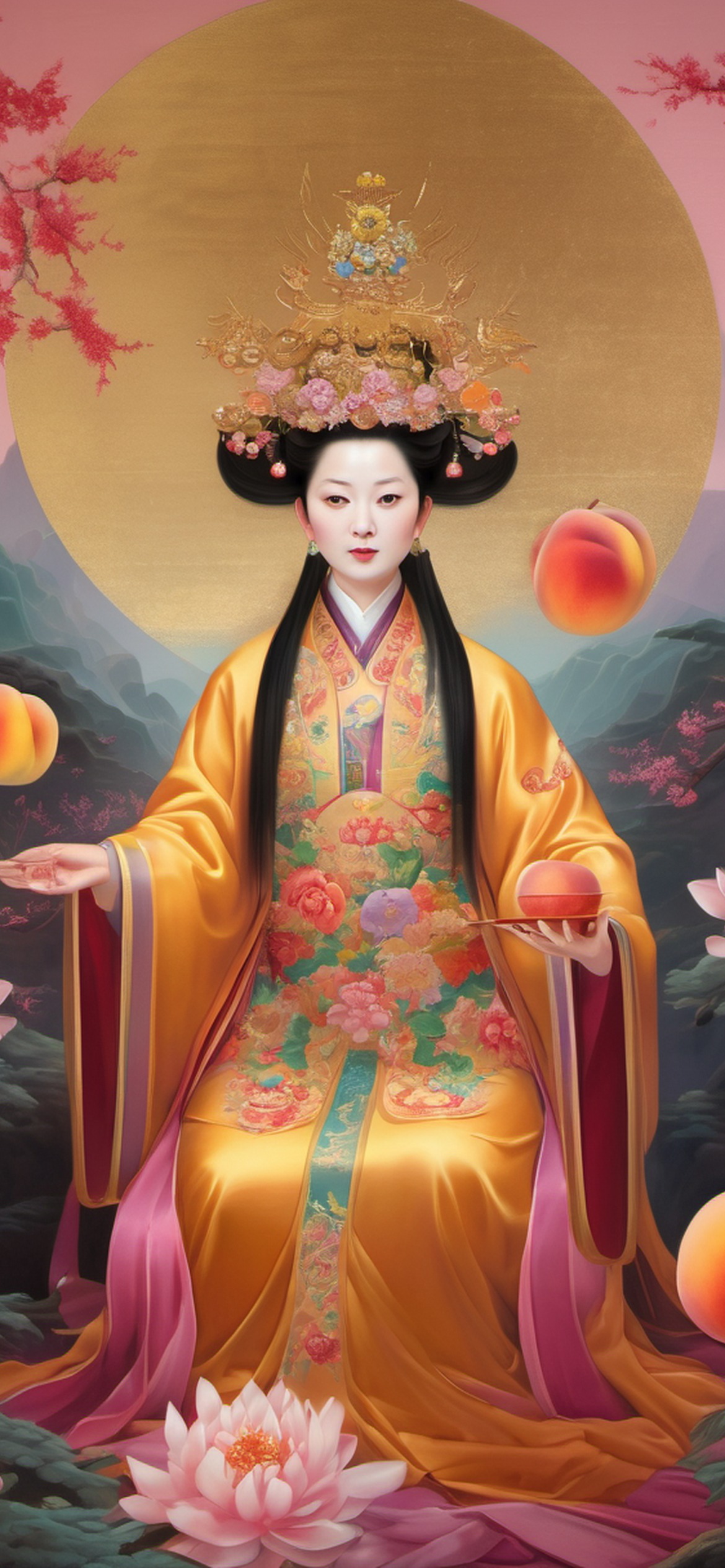
High-resolution phone wallpaper of Queen Mother of the West (西王母) — iconography drawn from classical Chinese sources, painted in traditional style.
📜 Iconography sources
《山海经·西山经》 (Classic of Mountains and Seas) gives her earliest, fearsome form: '豹尾虎齿' — leopard's tail, tiger's teeth, a deity of plagues who dwells on Jade Mountain. 《穆天子传》 (Tale of King Mu) recasts her as the gracious hostess of the 瑶池 (Jasper Pool) banquet, and Han–Tang Daoist texts complete her as sovereign of the immortals. Later art softens her into the phoenix-crowned queen holding peaches of immortality.
Buy & download
Explore the Topic
Queen Mother of the West in the Mythology Network
Go deeper — read the topic guides that gather every deity like Queen Mother of the West.