
Peach of Immortality
蟠桃
The heavenly fruit that grants eternal life — stolen by the Monkey King.
Origin Story
The Heavenly Orchard
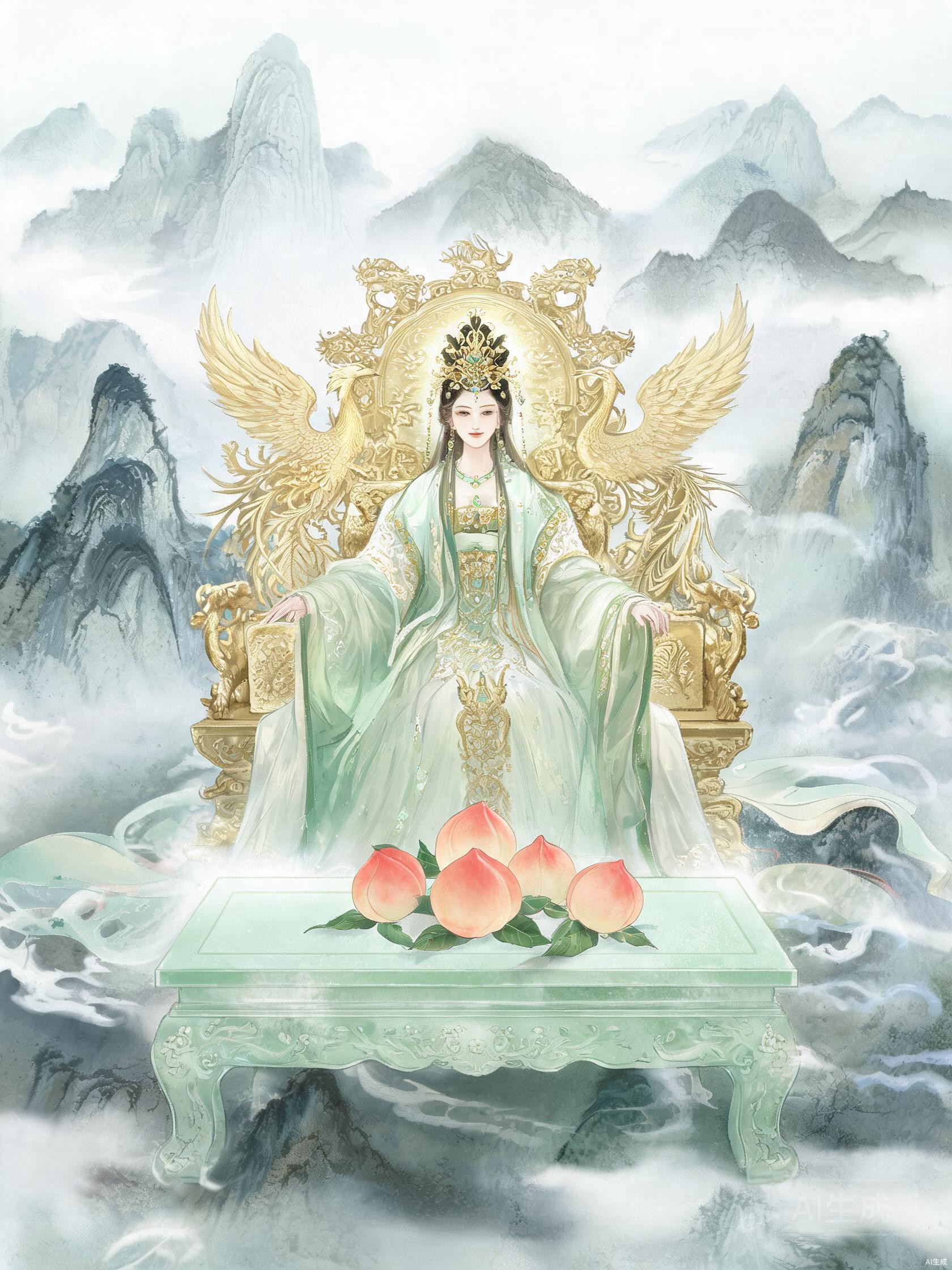
In the Jade Emperor's heaven, the [Queen Mother of the West](/gods/queen-mother-west) (Xiwangmu) tends an orchard of immortal peach trees. These are no ordinary trees — they bloom once every 3,000 years and bear fruit once every 9,000 years. The peaches are said to be the size of a fist, glowing pink and gold, and eating even one grants thousands of years of life.
The orchard is divided into three sections: trees that bear fruit every 3,000 years (eating the fruit grants 1,000 years of life), trees that bear every 6,000 years (grants immortality), and trees that bear every 9,000 years (grants eternal youth). The Peach Banquet (蟠桃会), held when the peaches ripen, is one of the most exclusive events in heaven.
The Peach of Immortality — one bite grants 3,000 years of life
The Peach of Immortality is a sacred fruit from Chinese mythology that grows in the Jade Emperor's heavenly orchard. Eating it grants immortality — a power so great that [Sun Wukong](/gods/sun-wukong) stole and ate them all, sparking his war with heaven.
Powers & Symbols
Attributes & Artefacts
Click each card to reveal the details behind Peach of Immortality's divine attributes.
Historical & Cultural Meaning
Beyond the Myth
Sun Wukong's Theft
When [Sun Wukong](/symbols/sun-wukong) was appointed Keeper of the Heavenly Orchard — a post he considered insulting — he discovered the immortal peaches. Enraged at not being invited to the [Peach](/symbols/peach-of-immortality) Banquet, he ate his way through the entire orchard, consuming the most precious peaches just before they were to be harvested.
This theft was not merely gluttony — it was an act of cosmic defiance. By eating the peaches, [Sun Wukong](/gods/sun-wukong) seized immortality for himself, outside the authority of heaven. The [Jade Emperor](/gods/jade-emperor)'s inability to control who became immortal was a direct challenge to his sovereignty, sparking the war that would eventually require the [Buddha](/gods/buddha-shakyamuni) himself to resolve.
The Peach in Chinese Culture
The peach remains the foremost symbol of longevity in Chinese culture. At birthday celebrations for elders, peach-shaped pastries (寿桃包) are served. Paintings of peaches are given as birthday gifts. The god of longevity, Shouxing, is often depicted holding a peach.
In Feng Shui, a bowl of peaches (or peach imagery) in the east sector of the home is believed to promote health and long life. The peach tree itself is considered sacred — its wood is used to make amulets against evil, and peach blossoms symbolize romance and new beginnings.
Sources & References
Primary classical texts: Shanhaijing (山海经, Classic of Mountains and Seas, c. 4th-2nd century BCE) · Fengshen Yanyi (封神演义, Investiture of the Gods, c. 16th century) · Journey to the West (西游记, Xiyouji, c. 16th century) · Records of the Grand Historian (史记, Shiji, by Sima Qian, c. 91 BCE) · Classic of Mountains and Seas commentary (郭璞注 Shanhaijing, c. 4th century) · Bamboo Annals (竹书纪年, c. 4th century BCE onwards)
Classical translations: Legge, James (trans.). The Sacred Books of the East (1879-1910, 50 volumes covering Chinese classics) · Girardot, Norman J. Myth and Meaning in Early Taoism (University of California Press, 1983) · Werner, E.T.C. A Dictionary of Chinese Mythology (Shanghai: Kelly & Walsh, 1932)
Modern academic references: Birrell, Anne. Chinese Mythology: An Introduction (Baltimore: Johns Hopkins University Press, 1993) · Yang, Lihui, and Deming An. Handbook of Chinese Mythology (New York: Oxford University Press, 2005) · Strassberg, Richard E. A Chinese Bestiary: Strange Creatures from the Guideways Through Mountains and Seas (Berkeley: University of California Press, 2002)
Digital encyclopedias and online resources: Wikipedia — Chinese mythology portal (continuously updated, citations to primary sources) · Encyclopedia Britannica — Mythology and Religion section
Mythology Network
Connections & Relationships
Peach of Immortality is woven into a larger web of gods, creatures, and legends. Explore the connections below.
Peach of Immortality
蟠桃


Explore the Topic
Peach of Immortality in the Mythology Network
Go deeper — read the topic guides that gather every symbol like Peach of Immortality.