Dragon Boat Festival
端午节
A festival of dragon boats, zongzi, and the memory of the poet Qu Yuan.
Origin Story
The Story of Qu Yuan
[Qu Yuan](/folklore/qu-yuan) was a minister and poet of the Chu state during the Warring States Period. A loyal patriot, he advocated for political reform and alliance against the powerful Qin state. But corrupt officials slandered him, and he was exiled. When Qin troops captured the Chu capital in 278 BCE, Qu Yuan, in despair, threw himself into the Miluo River.
According to legend, the local people raced out in boats to save him, beating drums and splashing their paddles to scare away fish and water dragons from his body. When they could not find him, they threw balls of sticky rice wrapped in leaves into the river, hoping the fish would eat the rice instead of [Qu Yuan](/folklore/qu-yuan)'s body.
These two acts — the boat race and the rice dumplings — became the central traditions of the [Dragon Boat](/folklore/dragon-boat-festival) Festival, practiced for over 2,000 years in his memory. [Qu Yuan](/folklore/qu-yuan)'s poetry, including 'Li Sao' (The Lament), remains foundational to Chinese literature.
Dragon Boat Festival — commemorating the poet Qu Yuan with races
The [Dragon](/symbols/dragon-symbolism) Boat Festival, celebrated on the 5th day of the 5th lunar month, commemorates the patriotic poet Qu Yuan who drowned himself in the Miluo River. It features dragon boat races, zongzi (sticky rice dumplings), and rituals to ward off disease and evil spirits during the height of summer.
Powers & Symbols
Attributes & Artefacts
Click each card to reveal the details behind Dragon Boat Festival's divine attributes.
Historical & Cultural Meaning
Beyond the Myth
Dragon Boat Racing
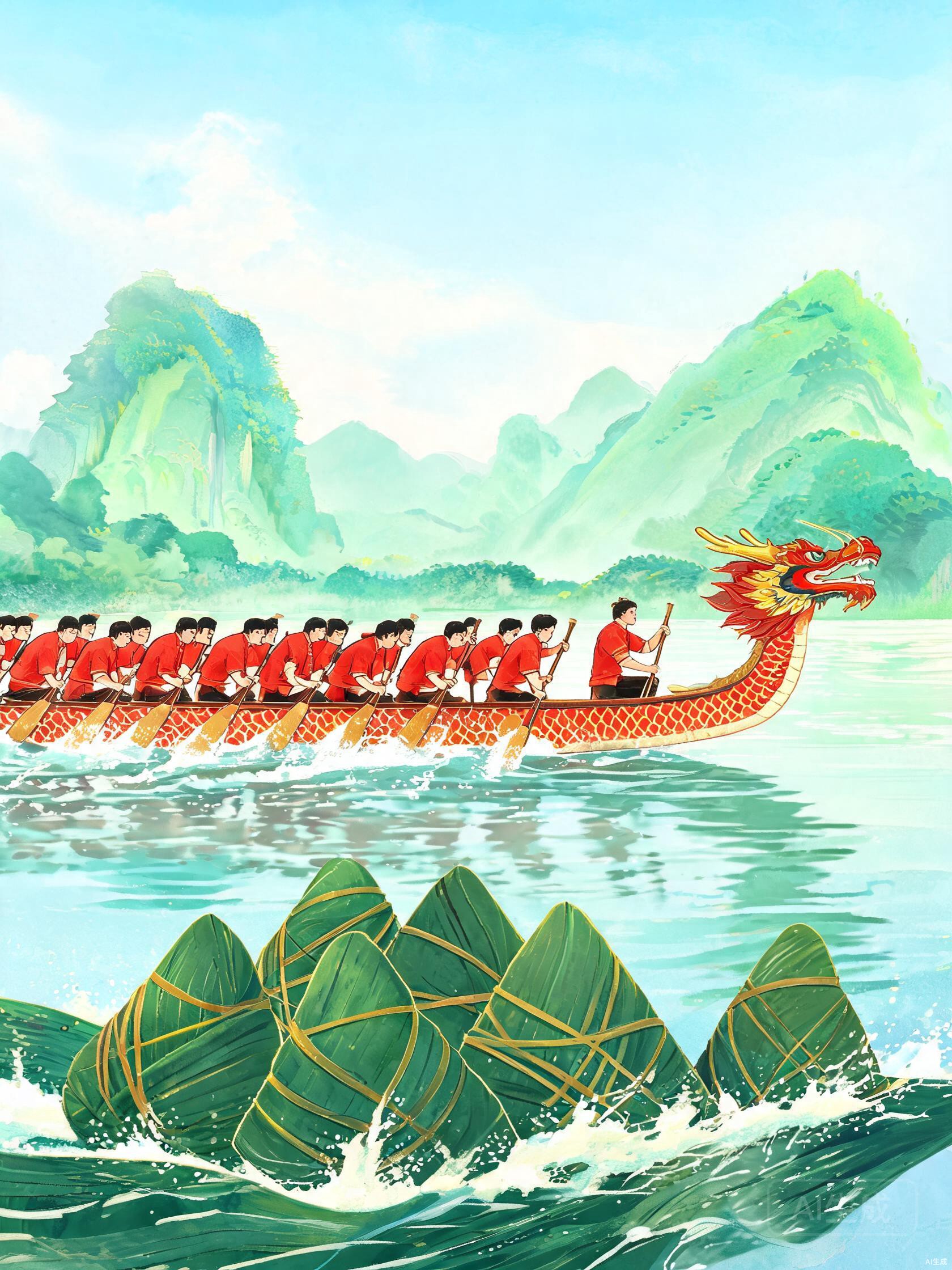
[Dragon](/zodiac/zodiac-dragon) boat racing is the most spectacular tradition of the festival. [Long](/creatures/chinese-dragon), narrow boats — often 12-22 meters in length — are decorated with carved dragon heads at the prow and dragon tails at the stern. A crew of 20-80 paddlers races in unison to the rhythm of a drum beaten by a drummer seated at the front.
The boats themselves are sacred objects. Before the race, a ceremony called 'awakening the dragon' is performed: the dragon's eyes are dotted with red paint to bring the boat to life. In traditional communities, the boats are stored in temples and treated with the reverence of living beings.
Today, dragon boat racing has spread worldwide as a competitive sport, with international races held on five continents. But its heart remains in China, where the thundering drums and cheering crowds echo the ancient cry to save a beloved poet.
Zongzi and Summer Protection
Zongzi — pyramid-shaped sticky rice dumplings wrapped in bamboo or reed leaves — are the essential food of the festival. The fillings vary by region: in the north, they are typically sweet with red bean paste or dates; in the south, they are savory with pork, salted egg yolk, and mushrooms.
The fifth lunar month was traditionally considered the most dangerous time of year, when the 'five poisonous creatures' (snakes, scorpions, centipedes, toads, and lizards) became active and diseases spread. To ward off evil and illness, families hang mugwort (ai cao) and calamus on doors, wear sachets of fragrant herbs, and in some regions drink realgar wine — a practice with roots in ancient medicine.
These customs reflect the practical wisdom of traditional Chinese life: the festival marked the transition from spring to the hot, disease-prone summer, and its rituals combined mythological meaning with genuine health precautions.
Sources & References
Primary classical texts: Shanhaijing (山海经, Classic of Mountains and Seas, c. 4th-2nd century BCE) · Fengshen Yanyi (封神演义, Investiture of the Gods, c. 16th century) · Journey to the West (西游记, Xiyouji, c. 16th century) · Records of the Grand Historian (史记, Shiji, by Sima Qian, c. 91 BCE) · Classic of Mountains and Seas commentary (郭璞注 Shanhaijing, c. 4th century) · Bamboo Annals (竹书纪年, c. 4th century BCE onwards)
Classical translations: Legge, James (trans.). The Sacred Books of the East (1879-1910, 50 volumes covering Chinese classics) · Girardot, Norman J. Myth and Meaning in Early Taoism (University of California Press, 1983) · Werner, E.T.C. A Dictionary of Chinese Mythology (Shanghai: Kelly & Walsh, 1932)
Modern academic references: Birrell, Anne. Chinese Mythology: An Introduction (Baltimore: Johns Hopkins University Press, 1993) · Yang, Lihui, and Deming An. Handbook of Chinese Mythology (New York: Oxford University Press, 2005) · Strassberg, Richard E. A Chinese Bestiary: Strange Creatures from the Guideways Through Mountains and Seas (Berkeley: University of California Press, 2002)
Digital encyclopedias and online resources: Wikipedia — Chinese mythology portal (continuously updated, citations to primary sources) · Encyclopedia Britannica — Mythology and Religion section
Mythology Network
Connections & Relationships
Dragon Boat Festival is woven into a larger web of gods, creatures, and legends. Explore the connections below.
Dragon Boat Festival
端午节

Explore the Topic
Dragon Boat Festival in the Mythology Network
Go deeper — read the topic guides that gather every folk tradition like Dragon Boat Festival.