
Zhong Kui
钟馗
The demon-quelling god — ugly in life, terrifying to demons in death.
Origin Story
Who Is Zhong Kui?
Zhong Kui is the most fearsome protector deity in Chinese folk religion. His story begins in the Tang Dynasty: a brilliant scholar named Zhong Kui traveled to the capital for the [imperial examination](/gods/wen-chang) and placed first. But when the emperor saw his grotesquely ugly face, he revoked Zhong Kui's title. In despair and rage, Zhong Kui smashed his head against the palace steps and died.
The [Jade Emperor](/gods/jade-emperor), moved by the injustice, deified Zhong Kui as the King of Ghosts — giving him authority over all spirits and [demon](/creatures/gui)s. From that moment, Zhong Kui became the ultimate demon-queller, hunting evil spirits with his sword and a legion of [ghost](/creatures/gui)ly soldiers at his command.
Zhong Kui — the fearsome demon-queller of Chinese mythology
Zhong Kui is the Chinese god of exorcism and demon-quelling. A brilliant scholar who was denied his rightful position because of his ugly appearance, he committed suicide and was deified by the emperor as the King of Ghosts. His fierce image — a grotesque face, a broken sword, and a legion of captured demons — adorns doorways and homes across China to ward off evil.
Powers & Symbols
Attributes & Artefacts
Click each card to reveal the details behind Zhong Kui's divine attributes.
Magical Artifacts & Weapons
Zhong Kui's Divine Arsenal
The legendary weapons and treasures wielded by Zhong Kui — each with its own origin story, powers, and mythological significance.
Historical & Cultural Meaning
Beyond the Myth
The Legend of Zhong Kui
According to legend, during the Tang Dynasty, [Emperor Xuanzong](/gods/jade-emperor) fell ill with a fever and dreamed that a small demon was stealing his belongings. Suddenly, a fierce, ugly man in a [red robe](/symbols/red-envelopes) appeared, grabbed the demon, and ate it. When the emperor asked who he was, the man said: 'I am Zhong Kui, a scholar who failed to obtain his rightful position because of my ugliness. I have sworn to rid the world of demons.'
The emperor woke up cured and ordered the painter [Wu Daozi](/gods/wu-daozi) to paint the image he had seen. This painting became the prototype for all Zhong Kui images — a fierce, bearded man in a [red ](/symbols/jade)robe, holding a sword, surrounded by subdued demons. From that moment, Zhong Kui's image was hung in homes across China to ward off evil spirits.
Zhong Kui in Chinese Culture
Zhong Kui is invoked especially during the [Dragon Boat](/folklore/dragon-boat-festival) Festival (Duanwu), when evil spirits are said to be most active. His image is painted on doors, printed on paper charms, and carried as amulets. In art, he is often depicted drinking wine, playing with demons, or leading a procession of captured spirits — a figure of terror to demons and comfort to humans.
[Zhong Kui](/gods/zhong-kui)'s story also carries a deep social message: a brilliant mind denied recognition because of appearance. His deification is a form of cosmic justice — the system that rejected him in life is overruled by heaven itself. In this way, [Zhong Kui](/creatures/zhong-kui) is not just a demon-queller but a patron of the wronged and the overlooked.
Sources & References
Primary classical texts: Shanhaijing (山海经, Classic of Mountains and Seas, c. 4th-2nd century BCE) · Fengshen Yanyi (封神演义, Investiture of the Gods, c. 16th century) · Journey to the West (西游记, Xiyouji, c. 16th century) · Records of the Grand Historian (史记, Shiji, by Sima Qian, c. 91 BCE) · Classic of Mountains and Seas commentary (郭璞注 Shanhaijing, c. 4th century) · Bamboo Annals (竹书纪年, c. 4th century BCE onwards)
Classical translations: Legge, James (trans.). The Sacred Books of the East (1879-1910, 50 volumes covering Chinese classics) · Girardot, Norman J. Myth and Meaning in Early Taoism (University of California Press, 1983) · Werner, E.T.C. A Dictionary of Chinese Mythology (Shanghai: Kelly & Walsh, 1932)
Modern academic references: Birrell, Anne. Chinese Mythology: An Introduction (Baltimore: Johns Hopkins University Press, 1993) · Yang, Lihui, and Deming An. Handbook of Chinese Mythology (New York: Oxford University Press, 2005) · Strassberg, Richard E. A Chinese Bestiary: Strange Creatures from the Guideways Through Mountains and Seas (Berkeley: University of California Press, 2002)
Digital encyclopedias and online resources: Wikipedia — Chinese mythology portal (continuously updated, citations to primary sources) · Encyclopedia Britannica — Mythology and Religion section
Mythology Network
Connections & Relationships
Zhong Kui is woven into a larger web of gods, creatures, and legends. Explore the connections below.
Zhong Kui
钟馗


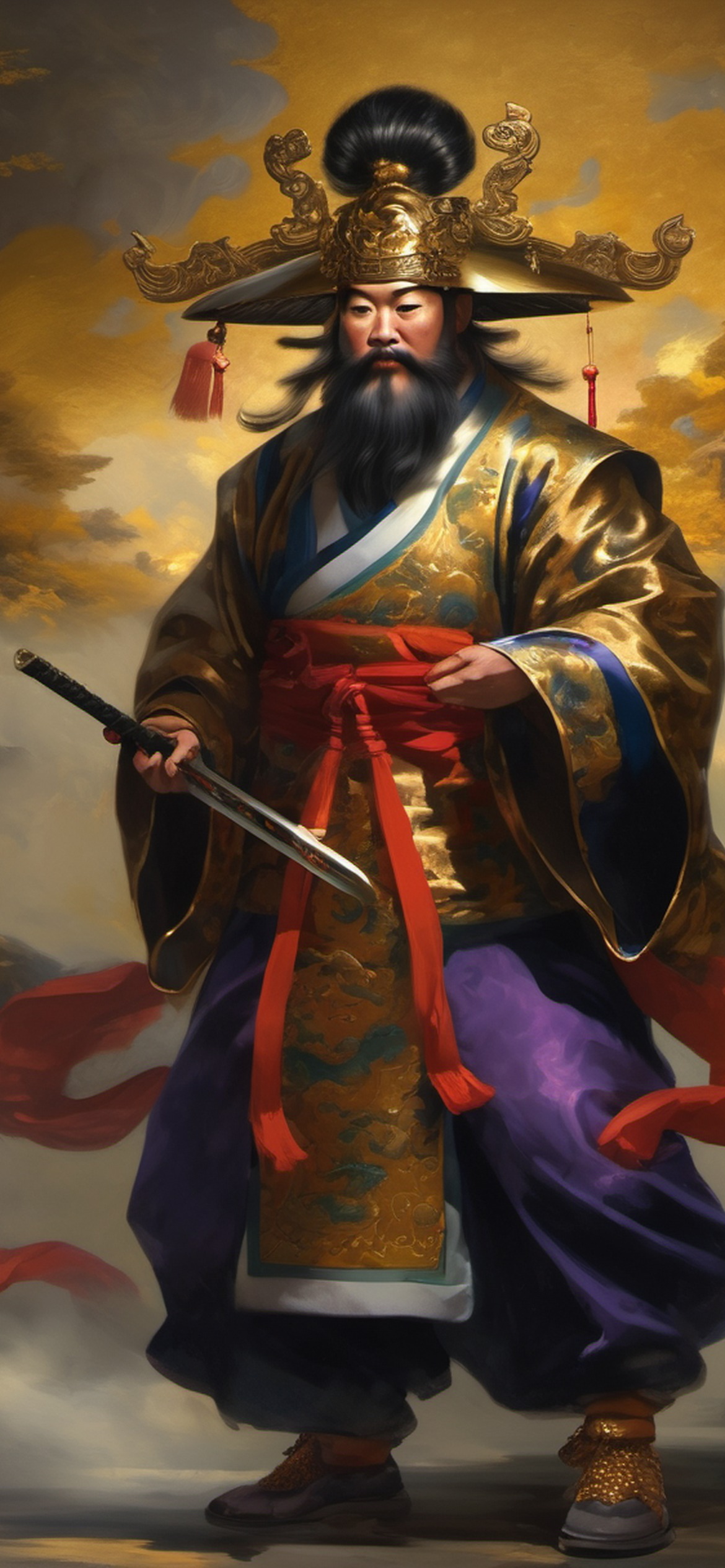
📱 Wallpaper · $2.99
Take 钟馗 with you
High-resolution phone wallpaper of Demon Queller Zhong Kui (钟馗) — iconography drawn from classical Chinese sources, painted in traditional style.
📜 Iconography sources
The demon queller was born in a Tang tale (《唐逸史》): the scholar Zhong Kui, ugly and rejected, killed himself; years later Emperor Xuanzong dreamed of a great bearded ghost who caught and devoured the small demon plaguing him — '臣钟馗也' — and the court painter Wu Daozi immortalized the face. That imperial portrait set the type forever: bulging leopard eyes, wild black beard, torn scholar's hat, blue robe, sword raised against demons.
Buy & download
Explore the Topic
Zhong Kui in the Mythology Network
Go deeper — read the topic guides that gather every deity like Zhong Kui.