Jiaotu
椒图
The shell-bound dragon son who shuts the door against all who would intrude.
Origin Story
What Is Jiaotu?
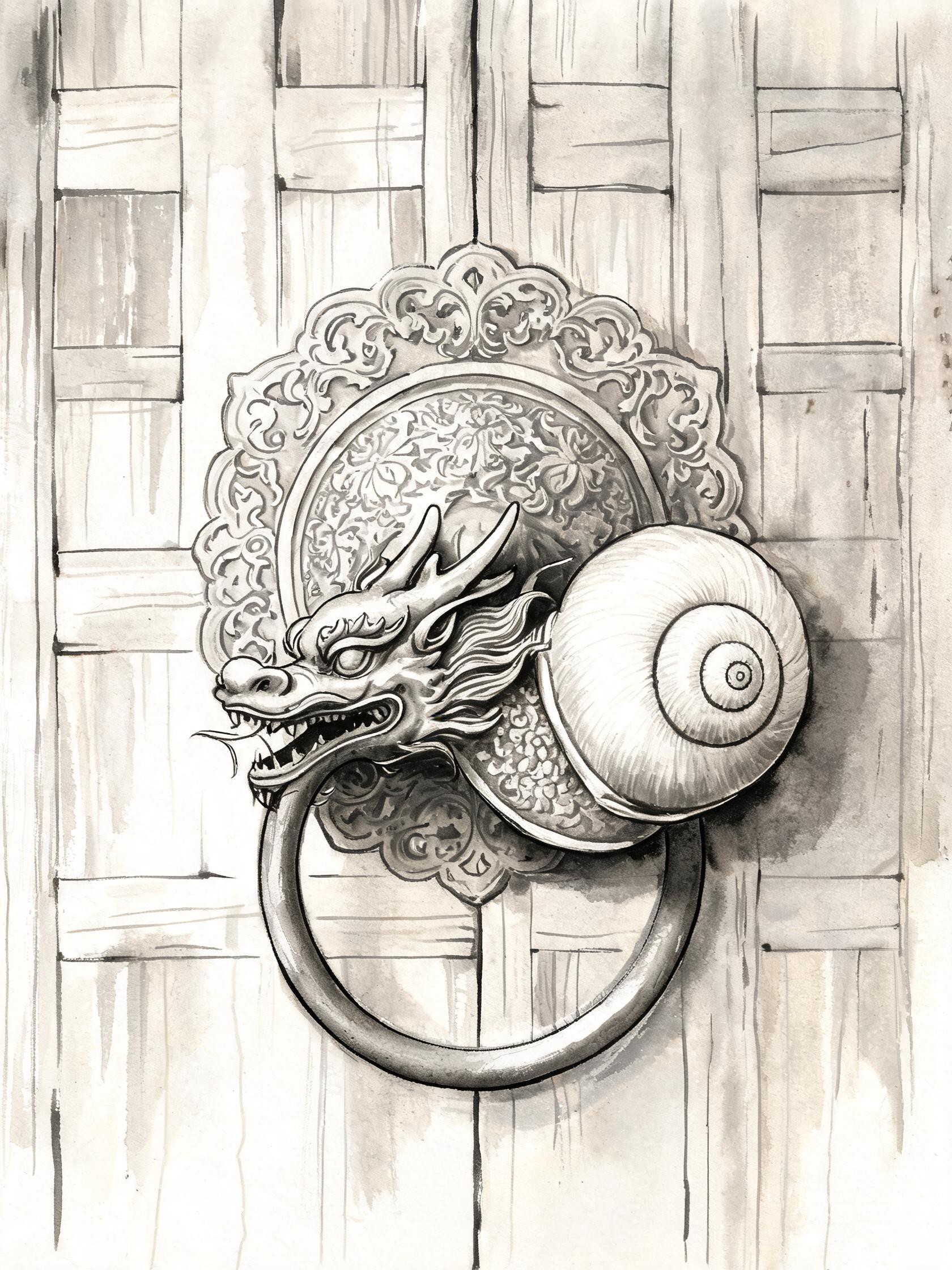
Jiaotu is counted among the Dragon's sons in several versions of the legend, and his form is among the most unusual: he resembles a clam or snail, a creature that lives inside a shell and closes it tightly at the first sign of danger. His defining trait is his love of shutting — of sealing himself away from the world and refusing to let anything in.
According to tradition, Jiaotu is shy and dislikes visitors. When anything approaches, he withdraws into his shell and clamps it shut, immovable and impenetrable. This reclusive nature made him the perfect guardian of doorways — a creature whose instinct to close and seal could protect the threshold of every home.
Jiaotu is one of the Dragon's sons, a creature shaped like a clam or snail that loves to close and seal itself away. His image is carved onto door knockers, where his tight-shut shell guards the threshold and keeps the dangers of the outside world from crossing into the home.
Powers & Symbols
Attributes & Artefacts
Click each card to reveal the details behind Jiaotu's divine attributes.
Historical & Cultural Meaning
Beyond the Myth
Jiaotu in Architecture and Art
Jiaotu's image is carved onto door knockers and door-grip plates (铺首, pushou) — the ornamental metal fittings found on the doors of traditional Chinese homes, palaces, and temples. His shell-like face stares outward from the door, with a ring hanging from his mouth that serves as the knocker.
The placement is precise: Jiaotu sits exactly at the threshold, the boundary between inside and outside, private and public. His presence there was believed to seal the door against intruders, evil spirits, and misfortune — anything unwelcome that tried to cross into the home would be stopped by the dragon son who loved nothing more than to close.
Symbolism and Cultural Meaning
Jiaotu symbolizes the protection of the home, the sanctity of privacy, and the security of the threshold. In Chinese culture, the door is the most important boundary in a dwelling — the point where the family meets the outside world — and placing Jiaotu there asserted that the home was guarded by a divine being who would never let harm enter.
His shell-bound form also carries a quieter meaning: the value of retreat and self-protection. Not every dragon son seeks battle or display; some, like Jiaotu, find strength in closing the door and guarding what is within. In a culture that valued both hospitality and the safety of the family, Jiaotu stood for the latter — the right to shut the world out when one needed peace.
The Nine Sons of the Dragon
Jiaotu is counted among the [Dragon](/zodiac/zodiac-dragon)'s sons in several versions of the Nine Sons of the Dragon (龙生九子) legend. While the core nine are often listed as Qiuniu, [Yazi](/creatures/yazi), Chaofeng, [Pulao](/creatures/pulao), [Suanni](/creatures/suanni), [Bixi](/creatures/bixi), Bi'an, [Fuxi](/gods/fuxi), and [Chiwen](/creatures/chiwen), later sources — including the Ming dynasty scholar [Yang](/symbols/yin-yang) Shen — added Jiaotu and others to reflect the wider tradition.
The proverb 'the dragon has nine sons, and each is different' (龙生九子,各有不同) captures the spirit of the legend: the dragon's offspring are so varied that no two share a form or a passion. Jiaotu, with his shell and his love of closing, is among the most distinctive — a dragon son whose power lies not in opening but in shutting.
Sources & References
Primary classical texts: Shanhaijing (山海经, Classic of Mountains and Seas, c. 4th-2nd century BCE) · Fengshen Yanyi (封神演义, Investiture of the Gods, c. 16th century) · Journey to the West (西游记, Xiyouji, c. 16th century) · Records of the Grand Historian (史记, Shiji, by Sima Qian, c. 91 BCE) · Classic of Mountains and Seas commentary (郭璞注 Shanhaijing, c. 4th century) · Bamboo Annals (竹书纪年, c. 4th century BCE onwards)
Classical translations: Legge, James (trans.). The Sacred Books of the East (1879-1910, 50 volumes covering Chinese classics) · Girardot, Norman J. Myth and Meaning in Early Taoism (University of California Press, 1983) · Werner, E.T.C. A Dictionary of Chinese Mythology (Shanghai: Kelly & Walsh, 1932)
Modern academic references: Birrell, Anne. Chinese Mythology: An Introduction (Baltimore: Johns Hopkins University Press, 1993) · Yang, Lihui, and Deming An. Handbook of Chinese Mythology (New York: Oxford University Press, 2005) · Strassberg, Richard E. A Chinese Bestiary: Strange Creatures from the Guideways Through Mountains and Seas (Berkeley: University of California Press, 2002)
Digital encyclopedias and online resources: Wikipedia — Chinese mythology portal (continuously updated, citations to primary sources) · Encyclopedia Britannica — Mythology and Religion section
Mythology Network
Connections & Relationships
Jiaotu is woven into a larger web of gods, creatures, and legends. Explore the connections below.
Jiaotu
椒图


Explore the Topic
Jiaotu in the Mythology Network
Go deeper — read the topic guides that gather every creature like Jiaotu.