
Pangu
盘古
The cosmic giant whose body became the world.
Origin Story
Who Is Pangu?
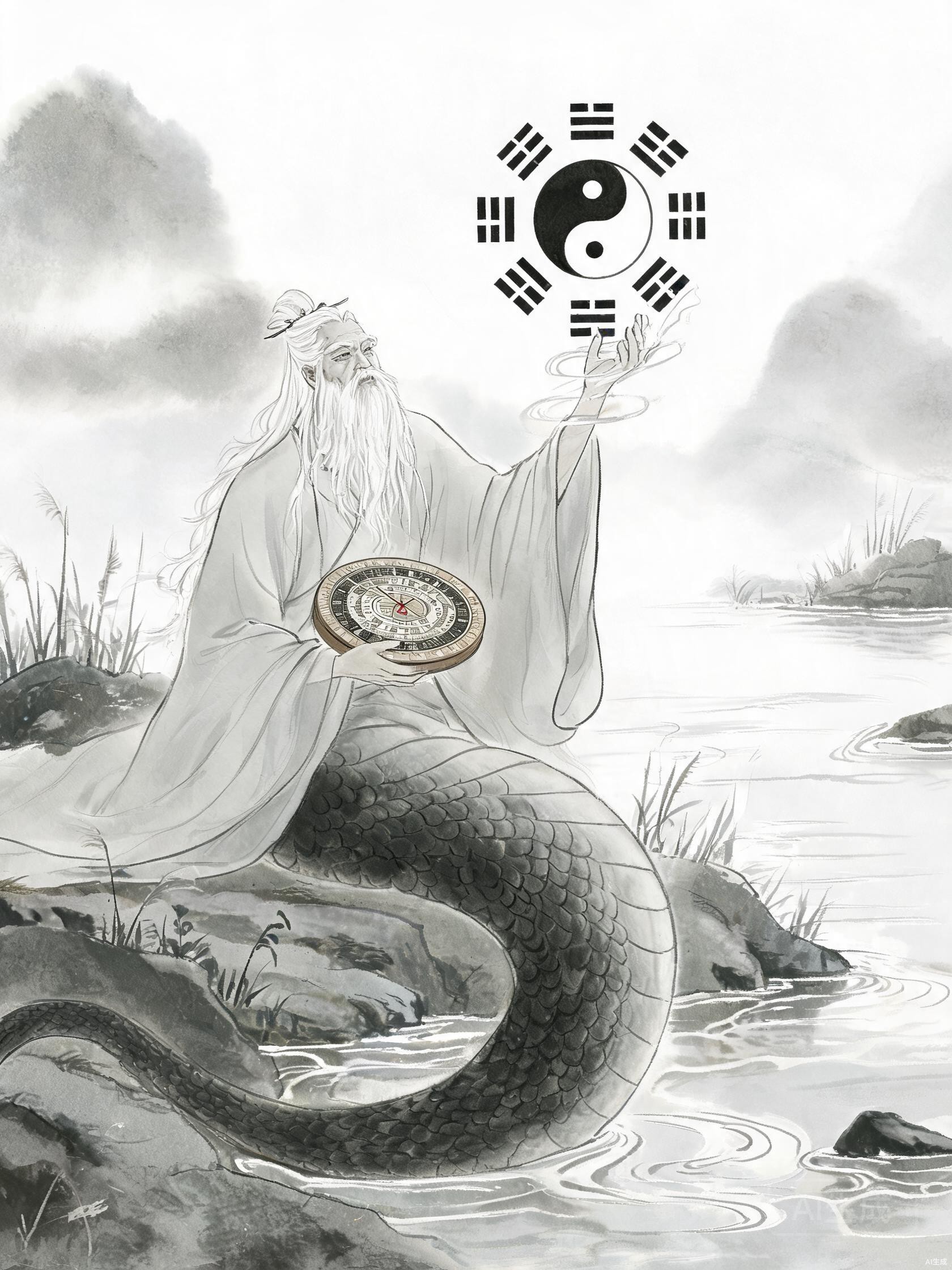
Pangu is the first being in Chinese creation mythology. Before Pangu, the universe was a formless mass — a [cosmic egg](/myths/cosmic-egg) of chaos, with the heavy [yin](/symbols/yin-yang) sinking down and the light yang floating up, all mixed together in darkness.
Inside this egg, Pangu grew for 18,000 years. When he finally awoke, he swung his giant axe and cracked the egg open, separating the pure yang (which became the sky) from the murky [yin ](/symbols/yin-yang)(which became the earth).
Pangu is the primordial being in Chinese mythology who separated heaven from earth and whose body became the mountains, rivers, and stars of the world after his death.
Powers & Symbols
Attributes & Artefacts
Click each card to reveal the details behind Pangu's divine attributes.
Historical & Cultural Meaning
Beyond the Myth
Pangu Separates Heaven and Earth
After cracking the [cosm](/gods/nuwa)ic egg, Pangu stood between heaven and earth, pushing the sky up with his hands and pressing the earth down with his feet. Each day, the sky rose ten feet higher, the earth sank ten feet lower, and Pangu grew ten feet taller.
For another 18,000 years, Pangu held the sky and earth apart, preventing them from merging back into chaos. When the gap was finally vast enough to be stable, Pangu collapsed from exhaustion and died.
Pangu's Body Becomes the World
In one of mythology's most poetic transformations, [Pangu](/gods/pangu)'s death gave birth to the natural world. His breath became the wind and clouds. His voice became thunder. His left eye became the sun, his right eye the moon.
His blood became rivers. His muscles became fertile soil. His bones became minerals and [jade](/symbols/jade). His hair became the stars. His sweat became rain. And the fleas on his body (or, in some versions, the wind-spirited remnants of his body) became the first humans.
This myth embodies a distinctly Chinese view of the relationship between humanity and nature: the world itself is the body of a divine being, and humans are its most humble creation.
Sources & References
Primary classical texts: Birrell, Anne. "The Pangu Myth" in Chinese Mythology: An Introduction (Johns Hopkins University Press, 1993) · Shanhaijing (山海经, Classic of Mountains and Seas, c. 4th-2nd century BCE) · Fengshen Yanyi (封神演义, Investiture of the Gods, c. 16th century) · Journey to the West (西游记, Xiyouji, c. 16th century) · Records of the Grand Historian (史记, Shiji, by Sima Qian, c. 91 BCE) · Classic of Mountains and Seas commentary (郭璞注 Shanhaijing, c. 4th century)
Classical translations: Legge, James (trans.). The Sacred Books of the East (1879-1910, 50 volumes covering Chinese classics) · Girardot, Norman J. Myth and Meaning in Early Taoism (University of California Press, 1983) · Werner, E.T.C. A Dictionary of Chinese Mythology (Shanghai: Kelly & Walsh, 1932)
Modern academic references: Birrell, Anne. Chinese Mythology: An Introduction (Baltimore: Johns Hopkins University Press, 1993) · Yang, Lihui, and Deming An. Handbook of Chinese Mythology (New York: Oxford University Press, 2005) · Strassberg, Richard E. A Chinese Bestiary: Strange Creatures from the Guideways Through Mountains and Seas (Berkeley: University of California Press, 2002)
Digital encyclopedias and online resources: Wikipedia — Chinese mythology portal (continuously updated, citations to primary sources) · Encyclopedia Britannica — Mythology and Religion section
Mythology Network
Connections & Relationships
Pangu is woven into a larger web of gods, creatures, and legends. Explore the connections below.
Pangu
盘古




Explore the Topic
Pangu in the Mythology Network
Go deeper — read the topic guides that gather every deity like Pangu.