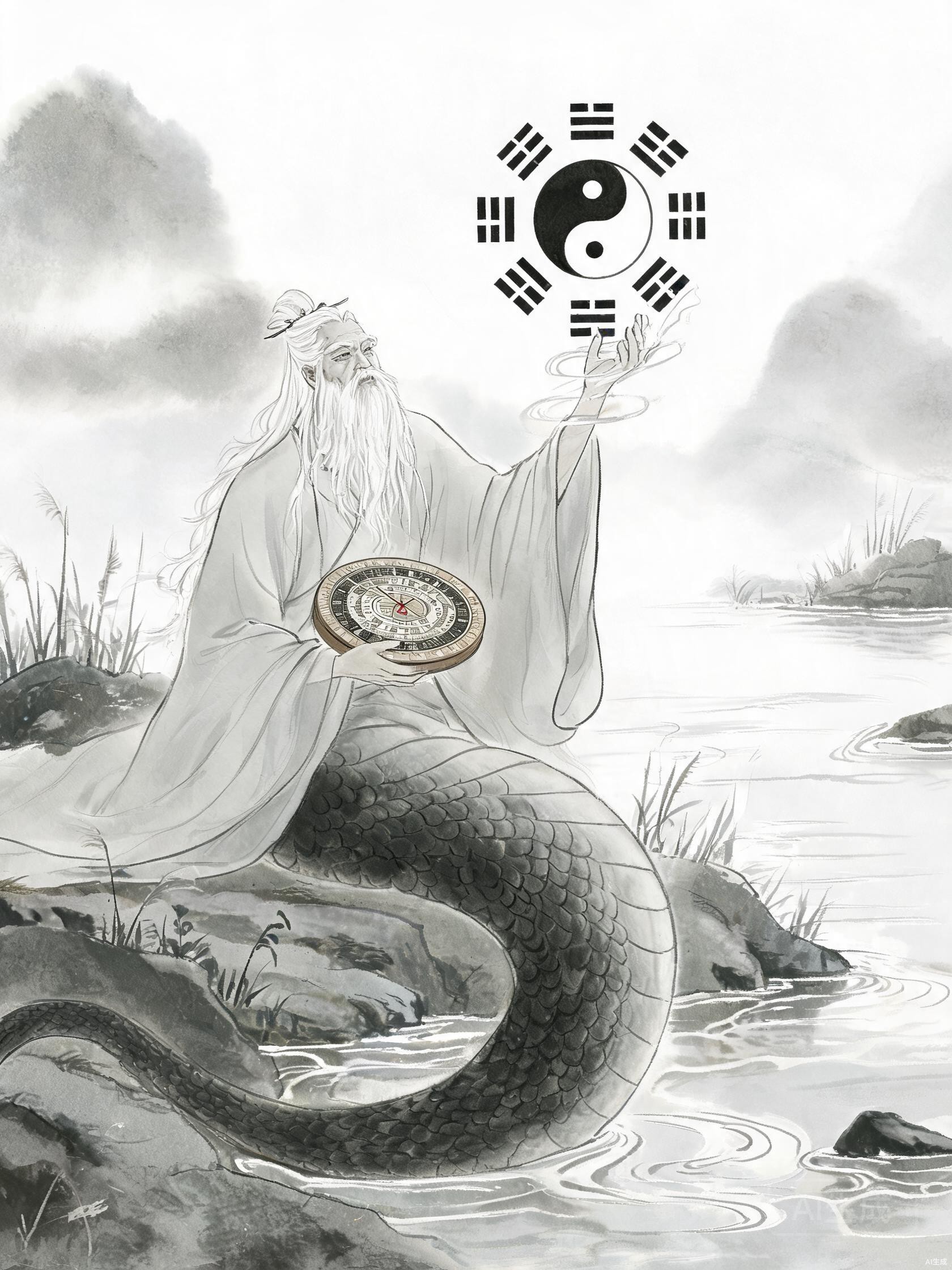
Fuxi
伏羲
The first of the Three Sovereigns, who revealed the Eight Trigrams to humanity.
Origin Story
Who Is Fuxi?
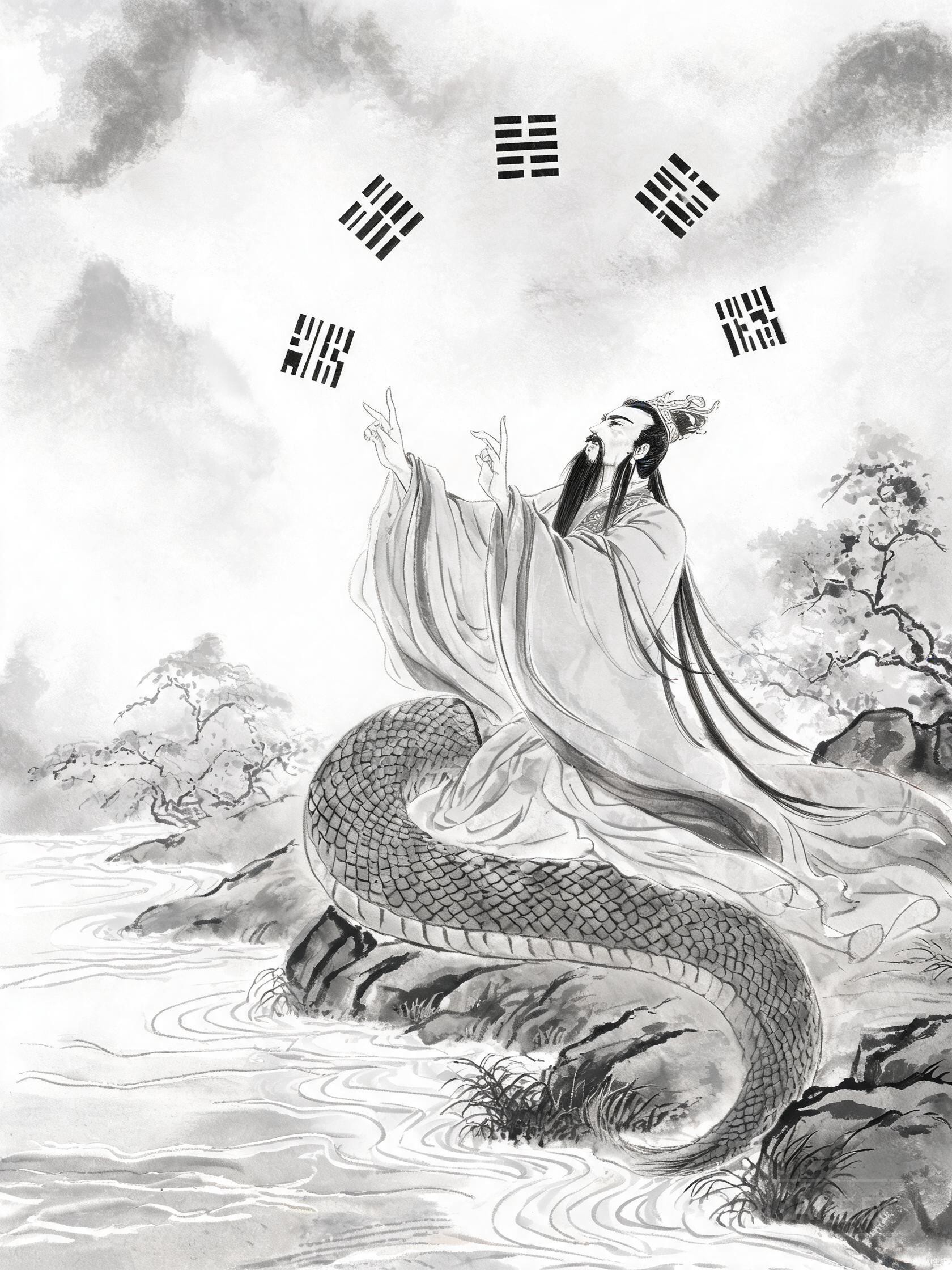
Fuxi is the first of the Three Sovereigns (Sanhuang), the legendary primordial rulers who founded Chinese civilization. Alongside his sister-wife Nuwa, he is depicted as a being with a human upper body and a serpent's tail, symbolizing the union of the human and natural worlds.
Where [Nuwa](/symbols/nuwa) is credited with creating humanity and repairing the sky, Fuxi is the god of culture and knowledge. He is the one who lifted humanity from savagery by teaching the arts of survival, social order, and divination. In the Chinese mythological timeline, he represents the dawn of civilization itself.
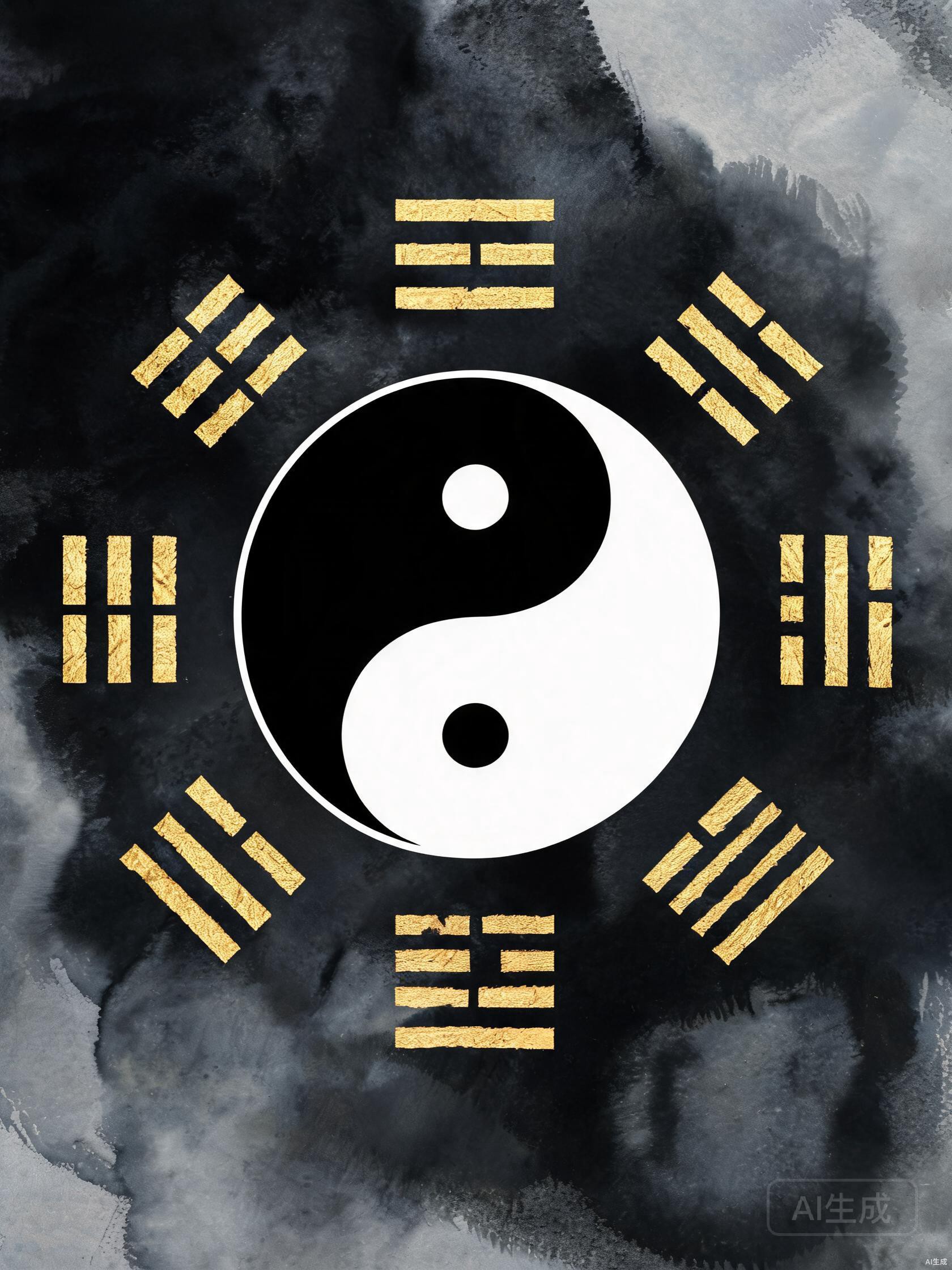
Fuxi's most enduring gift is the Bagua — the Eight Trigrams that form the foundation of the I Ching (Yijing, Book of Changes), the oldest of the Chinese classics. By observing the patterns of nature, he encoded the structure of the universe into a system of symbols that still influences Chinese thought today.
Fuxi is one of the Three Sovereigns, the primordial culture hero who created the Bagua (Eight Trigrams), instituted marriage, and taught humanity to fish and hunt. With his sister-wife Nuwa, he is the ancestor of Chinese civilization.
Powers & Symbols
Attributes & Artefacts
Click each card to reveal the details behind Fuxi's divine attributes.
Historical & Cultural Meaning
Beyond the Myth
Fuxi in Mythology
According to legend, Fuxi was born when his mother, Huaxu, stepped into the footprint of a giant god in a marsh called Leize. He emerged with extraordinary wisdom and, upon maturity, became the ruler of the world during an age when humans lived like animals — eating raw meat, sleeping in the open, without any social order.
Fuxi taught humanity to weave nets for fishing and hunting, to domesticate animals, to cook food with fire, and to perform sacrifices to heaven. He instituted the practice of marriage, requiring couples to exchange gifts and obtain permission, thus bringing order and ethics to human relationships where there had been only instinct.
His crowning achievement was the revelation of the Bagua. As he meditated along the Yellow River, a dragon-horse emerged from the water bearing a pattern of dots — the He Tu (River Map). From this pattern, Fuxi derived the eight trigrams: qian (heaven), kun (earth), zhen (thunder), xun (wind), kan (water), li (fire), gen (mountain), and dui (lake). These symbols encoded the fundamental forces of the cosmos and became the basis of all Chinese metaphysics, medicine, and divination.
Worship and Cultural Significance
Fuxi is worshipped as a sovereign sage, a culture hero who gave humanity the tools to rise above beastliness. His temple in Tianshui, Gansu province — traditionally identified as his birthplace — is a major pilgrimage site where descendants of the Huaxia people honor their ancestor with grand ceremonies.
The Bagua he revealed remains the foundation of the I Ching, one of the most influential books in world philosophy. The trigrams and their combinations form the basis of Taoist cosmology, [feng shui](/symbols/feng-shui), traditional Chinese medicine, and martial arts. To this day, the Bagua appears on the South Korean national flag — a testament to the reach of Fuxi's symbolic system far beyond China itself.
Fuxi and [Nuwa](/gods/nuwa) are often depicted together in ancient art, their serpent tails intertwined, holding the compass and the square — symbols of the measured, ordered cosmos they brought into being. This image is one of the most iconic in Chinese archaeological art, found in tomb paintings dating back to the Han Dynasty.
Fuxi in Popular Culture
[Fuxi](/gods/fuxi) appears in historical and mythological dramas, usually as a serene, ancient figure who guides early humanity. In xianxia web fiction and games, his [Bagua](/symbols/bagua-symbolism) and the He Tu are often invoked as cosmic artifacts of immense power, and Fuxi himself sometimes appears as a primordial god who sets the cosmic order in motion.
Sources & References
Primary classical texts: Shanhaijing (山海经, Classic of Mountains and Seas, c. 4th-2nd century BCE) · Fengshen Yanyi (封神演义, Investiture of the Gods, c. 16th century) · Journey to the West (西游记, Xiyouji, c. 16th century) · Records of the Grand Historian (史记, Shiji, by Sima Qian, c. 91 BCE) · Classic of Mountains and Seas commentary (郭璞注 Shanhaijing, c. 4th century) · Bamboo Annals (竹书纪年, c. 4th century BCE onwards)
Classical translations: Legge, James (trans.). The Sacred Books of the East (1879-1910, 50 volumes covering Chinese classics) · Girardot, Norman J. Myth and Meaning in Early Taoism (University of California Press, 1983) · Werner, E.T.C. A Dictionary of Chinese Mythology (Shanghai: Kelly & Walsh, 1932)
Modern academic references: Birrell, Anne. Chinese Mythology: An Introduction (Baltimore: Johns Hopkins University Press, 1993) · Yang, Lihui, and Deming An. Handbook of Chinese Mythology (New York: Oxford University Press, 2005) · Strassberg, Richard E. A Chinese Bestiary: Strange Creatures from the Guideways Through Mountains and Seas (Berkeley: University of California Press, 2002)
Digital encyclopedias and online resources: Wikipedia — Chinese mythology portal (continuously updated, citations to primary sources) · Encyclopedia Britannica — Mythology and Religion section
Mythology Network
Connections & Relationships
Fuxi is woven into a larger web of gods, creatures, and legends. Explore the connections below.
Fuxi
伏羲


Explore the Topic
Fuxi in the Mythology Network
Go deeper — read the topic guides that gather every deity like Fuxi.