Bagua (Eight Trigrams)
八卦
The eight trigrams that encode the fundamental patterns of reality — the universe in eight symbols.
Origin Story
What Is the Bagua?
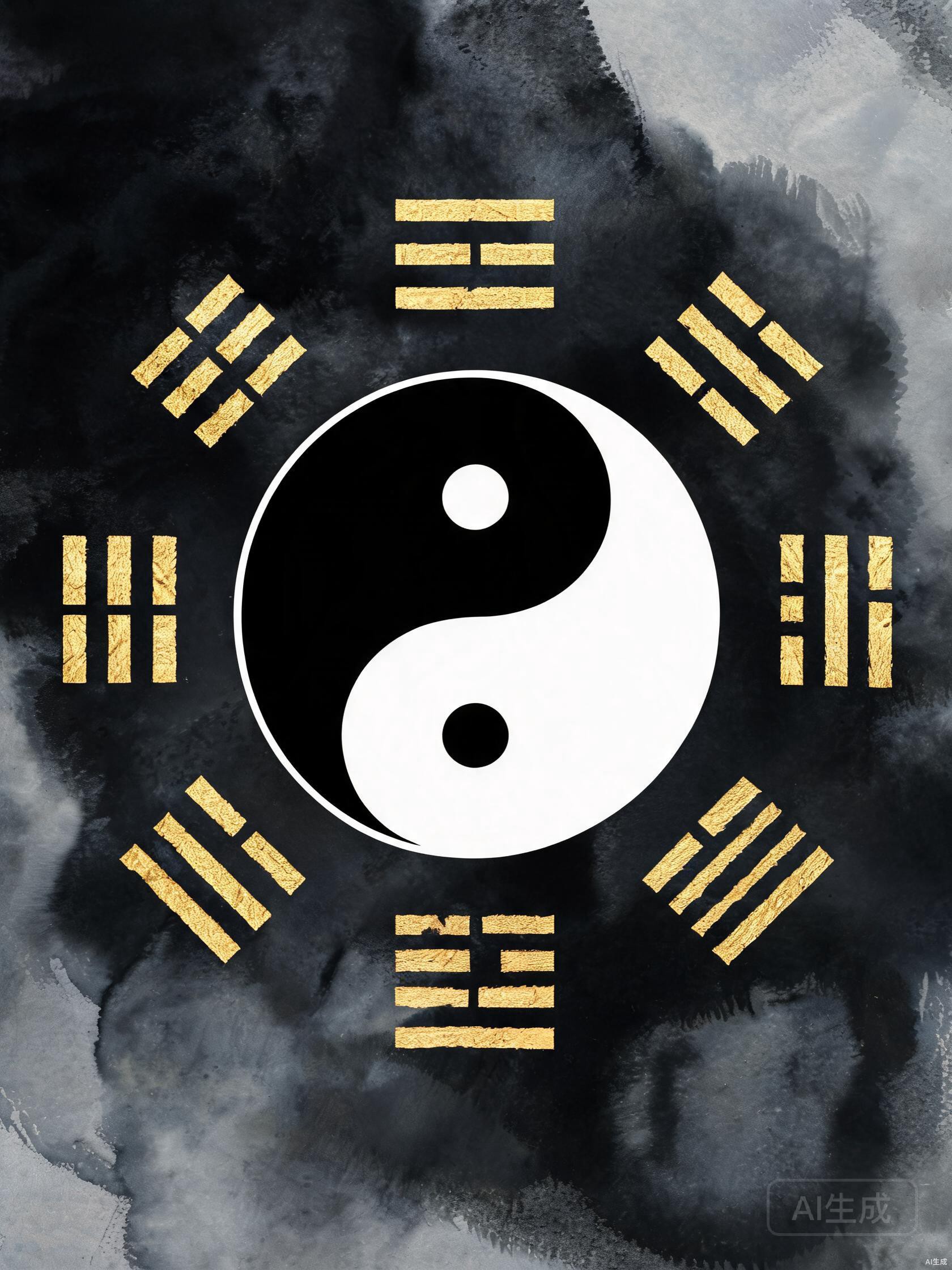
The Bagua (八卦, Eight Trigrams) is one of the most foundational concepts in Chinese philosophy. Each trigram is made of three horizontal lines stacked vertically — a solid line represents yang (active, bright, masculine energy) and a broken line, drawn as two segments, represents yin (receptive, dark, feminine energy). With three lines, each either solid or broken, there are exactly eight possible combinations (two to the power of three), giving us the eight trigrams.
The word bagua literally means 'eight symbols' or 'eight diagrams.' Each trigram corresponds to a natural force, a direction, a season, a family member, a body part, and an element. Together, the eight trigrams form a complete cosmological map — a way of understanding how the forces of nature interact and how human life fits within that pattern. The Bagua is not merely a symbol; it is a working framework that has been applied across Chinese culture for over three thousand years.
The Bagua is actively used for divination through the I Ching (Book of Changes), for spatial arrangement through Feng Shui, for self-defense through martial arts like Baguazhang (Eight Trigram Palm), and for diagnosis in traditional Chinese medicine. It is one of the most widely applied intellectual frameworks in all of Chinese civilization, bridging the philosophical, the practical, and the mystical in a single elegant system.
The Bagua — eight trigrams encoding all natural forces
The Bagua (Eight Trigrams) is a philosophical and divinatory system of eight symbols used in Taoist cosmology to represent the fundamental principles of reality. Each trigram is composed of three lines, either solid (yang) or broken (yin), forming eight combinations that map the forces of nature, directions, seasons, and human relationships.
Powers & Symbols
Attributes & Artefacts
Click each card to reveal the details behind Bagua (Eight Trigrams)'s divine attributes.
Historical & Cultural Meaning
Beyond the Myth
Historical Origins
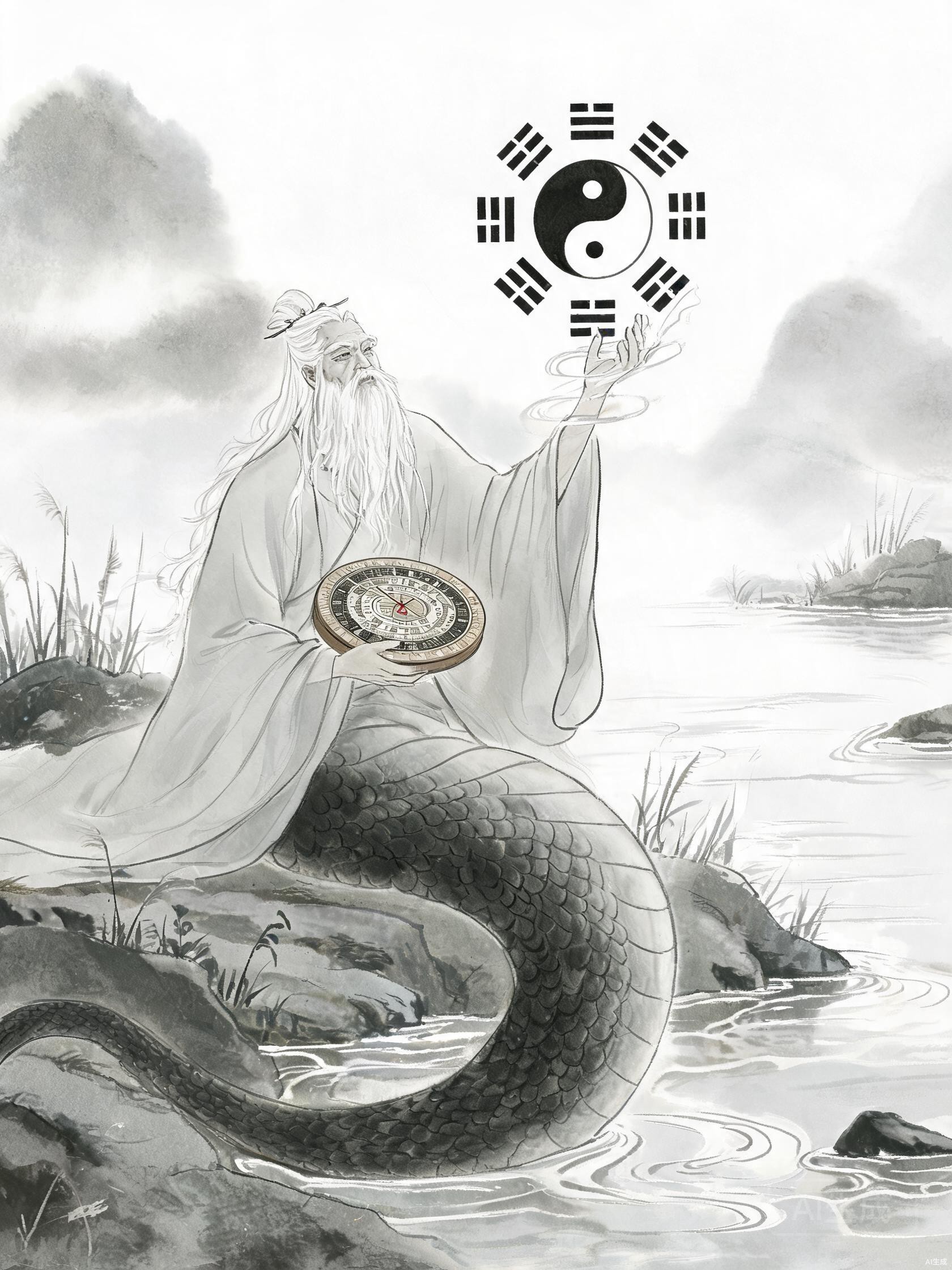
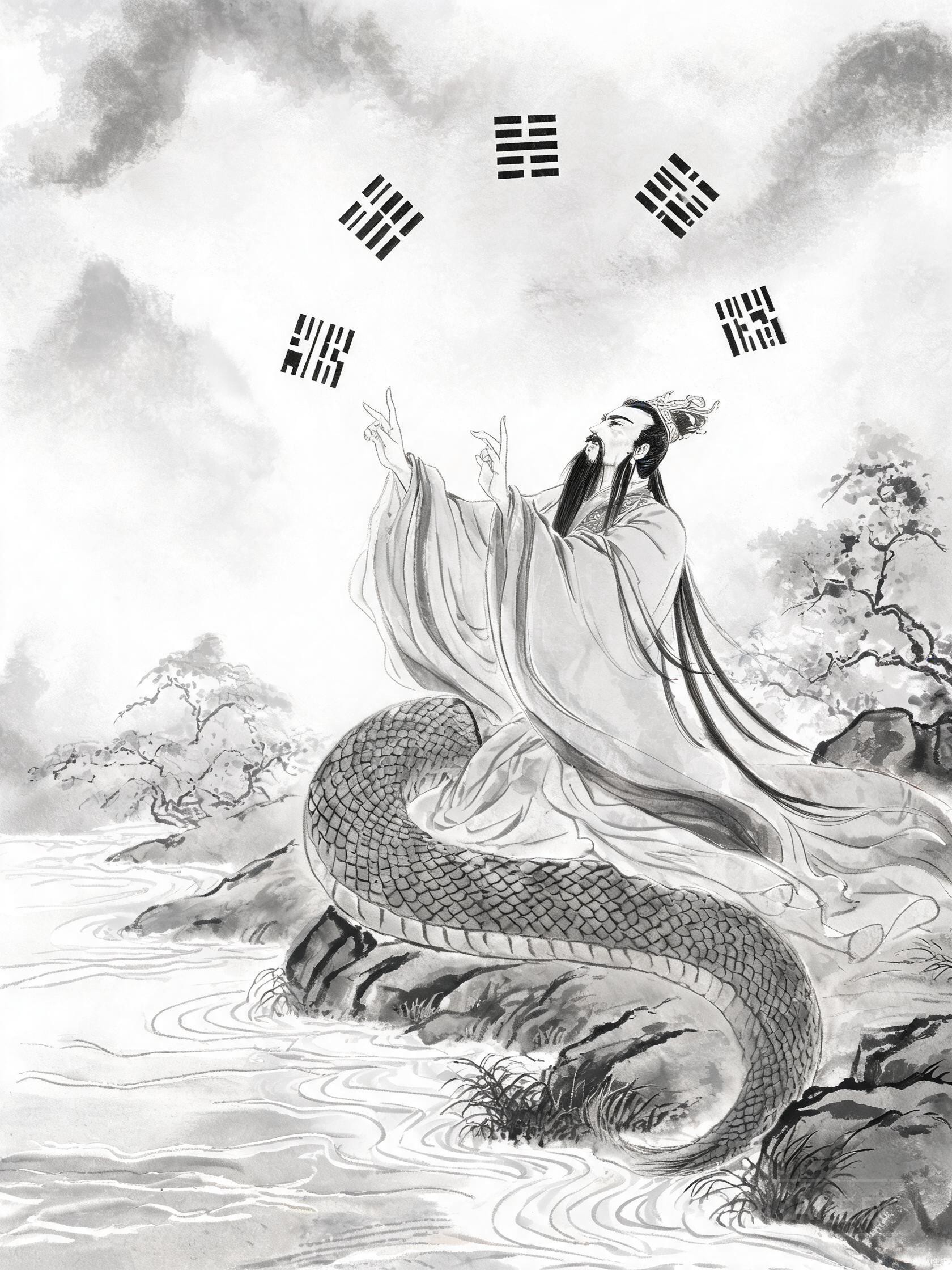
According to legend, the Bagua was created by [Fuxi](/symbols/fuxi), the mythical first emperor of China and a culture hero who is often depicted with the body of a snake and the head of a human. The story says that [Fuxi](/gods/fuxi) observed the patterns of heaven and earth — the movements of stars, the flow of rivers, the habits of animals — and distilled them into eight symbols that captured the fundamental patterns of reality. This happened in remote antiquity, perhaps as early as 2800 BCE by traditional reckoning, making the Bagua one of the oldest intellectual constructs in human history.
The Bagua was later incorporated into the I Ching (Yijing, Book of Changes), one of the oldest Chinese texts, dated to roughly 1000 BCE. The I Ching uses 64 hexagrams — each made by stacking two trigrams — to represent all possible states of change in the universe. King Wen of Zhou (11th century BCE) is traditionally credited with arranging the 64 hexagrams and writing commentary on them, a system known as the Later Heaven arrangement. His son, the Duke of Zhou, is said to have written the line statements for each hexagram.
There are two primary arrangements of the Bagua. The Earlier Heaven (Xiantian) arrangement, attributed to [Fuxi](/gods/fuxi), places the trigrams in a symmetrical pattern of opposites — heaven opposite earth, fire opposite water, thunder opposite wind, and mountain opposite lake. The Later Heaven (Houtian) arrangement, attributed to King Wen, places them in a seasonal cycle that reflects the flow of time and natural processes. Both arrangements are still used today in different applications of Feng Shui and divination, and the choice between them depends on whether the practitioner seeks to understand eternal principles or temporal change.
The Eight Trigrams and Their Meanings
Each of the eight trigrams represents a fundamental force of nature and carries a rich set of correspondences. Qian (乾, Heaven) is three solid lines — pure yang — representing the sky, the father, creativity, leadership, and the northwest direction. It is the most powerful and active of the trigrams, the generative force behind all creation. [Kun](/creatures/kunpeng) (坤, Earth) is three broken lines — pure yin — representing the earth, the mother, receptivity, nourishment, and the southwest. It is the most yielding and receptive, the field in which the seeds of creation grow.
Zhen (震, Thunder) is one solid line below two broken lines, representing thunder, the first son, arousal, springtime, and the east. It is the force that breaks open what is dormant. Xun (巽, Wind) is one broken line below two solid lines, representing wind and wood, the first daughter, gentleness, penetration, and the southeast. It is the force that enters subtly and pervasively. Kan (坎, Water) is a solid line between two broken lines, representing water and the moon, the second son, danger, depth, and the north. It flows through the lowest places and carries both peril and wisdom. Li (离, Fire) is a broken line between two solid lines, representing fire and the sun, the second daughter, clarity, attachment, and the south. It is the light that clings and illuminates.
Gen (艮, Mountain) is one solid line above two broken lines, representing the mountain, the third son, stillness, completion, and the northeast. It is the force that rests at the end of a cycle, gathering strength for the next. Dui (兑, Lake) is one broken line above two solid lines, representing the lake and marsh, the third daughter, joy, communication, and the west. It is the open, happy energy of surface water. Together these eight forces describe every dynamic in the natural world — from the creative power of heaven to the receptive stillness of the mountain, from the depth of water to the clarity of fire.
Bagua in Feng Shui, Martial Arts, and Medicine
In Feng Shui, the [Bagua](/symbols/bagua) map (also called the Bagua mirror or Bagua grid) is used to analyze the energy of a space. The Later Heaven arrangement is laid over a floor plan, dividing it into eight sectors, each governing an aspect of life: career, knowledge, family, [wealth](/gods/caishen), fame, relationships, creativity, and helpful people. By placing appropriate elements and colors in each sector, practitioners aim to harmonize the flow of qi (life energy) and improve the fortune of the home's inhabitants. The Bagua mirror, an octagonal frame surrounding a small mirror, is also hung outside homes to deflect negative energy and protect the household.
In martial arts, [Bagua](/symbols/bagua)zhang (八卦掌, Eight Trigram Palm) is one of the three major internal Chinese martial arts, alongside Tai Chi and Xingyi. Practitioners walk in a circle and use palm strikes, with the footwork and combat strategy based on the eight trigrams. The art emphasizes circular movement, evasion, and the ability to change direction fluidly — embodying the principle of constant change that the Bagua represents. It was popularized in the 19th century by Dong Haichuan and is now practiced worldwide for both self-defense and health.
In traditional Chinese medicine, the [Bagua](/symbols/bagua-symbolism) is used to map the organs and body systems to the trigrams, which helps practitioners understand the relationships between different parts of the body and the natural forces that govern them. The trigrams also underpin the I Ching's use in divination — a practice that continues today, where practitioners throw yarrow stalks or coins to generate a hexagram and interpret it as guidance for decisions ranging from business strategy to personal relationships. Whether applied to a room, a fight, a body, or a life decision, the [Bagua](/symbols/bagua) offers the same promise: that by understanding the patterns of change, one can act in harmony with the forces that shape reality.
Sources & References
Primary classical texts: Shanhaijing (山海经, Classic of Mountains and Seas, c. 4th-2nd century BCE) · Fengshen Yanyi (封神演义, Investiture of the Gods, c. 16th century) · Journey to the West (西游记, Xiyouji, c. 16th century) · Records of the Grand Historian (史记, Shiji, by Sima Qian, c. 91 BCE) · Classic of Mountains and Seas commentary (郭璞注 Shanhaijing, c. 4th century) · Bamboo Annals (竹书纪年, c. 4th century BCE onwards)
Classical translations: Legge, James (trans.). The Sacred Books of the East (1879-1910, 50 volumes covering Chinese classics) · Girardot, Norman J. Myth and Meaning in Early Taoism (University of California Press, 1983) · Werner, E.T.C. A Dictionary of Chinese Mythology (Shanghai: Kelly & Walsh, 1932)
Modern academic references: Birrell, Anne. Chinese Mythology: An Introduction (Baltimore: Johns Hopkins University Press, 1993) · Yang, Lihui, and Deming An. Handbook of Chinese Mythology (New York: Oxford University Press, 2005) · Strassberg, Richard E. A Chinese Bestiary: Strange Creatures from the Guideways Through Mountains and Seas (Berkeley: University of California Press, 2002)
Digital encyclopedias and online resources: Wikipedia — Chinese mythology portal (continuously updated, citations to primary sources) · Encyclopedia Britannica — Mythology and Religion section
Mythology Network
Connections & Relationships
Bagua (Eight Trigrams) is woven into a larger web of gods, creatures, and legends. Explore the connections below.
Bagua (Eight Trigrams)
八卦


Explore the Topic
Bagua (Eight Trigrams) in the Mythology Network
Go deeper — read the topic guides that gather every symbol like Bagua (Eight Trigrams).