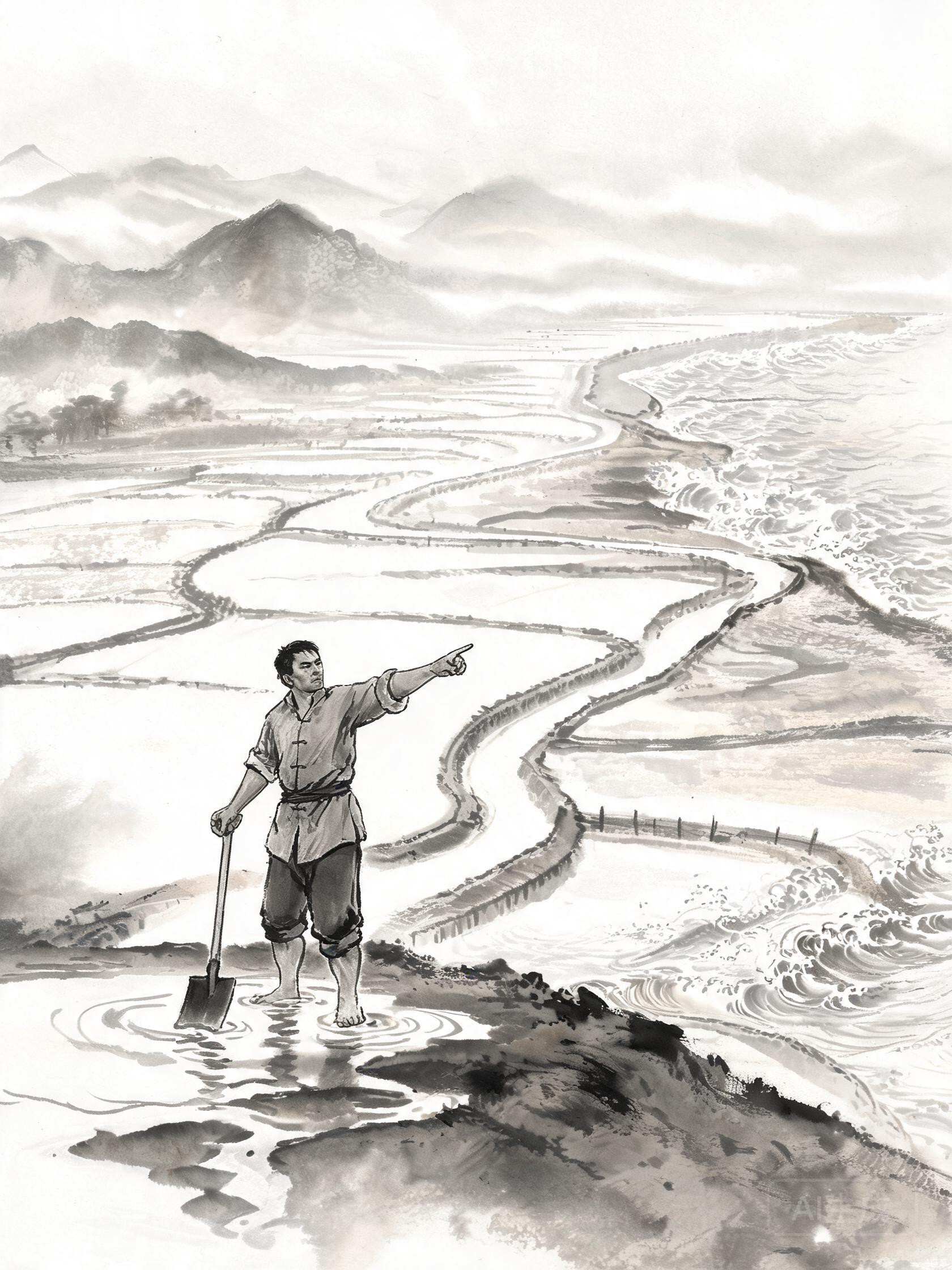
Yu the Great Tames the Flood
大禹治水
The hero who spent thirteen years taming a world-drowning flood — and passed his own door without entering.
Origin Story
A World Drowned
In the time of Emperor Yao, a great flood descended upon the land. The waters rose without mercy, swallowing hills, drowning fields, and forcing people to flee to the highest peaks. The civilization that had been built under Yao's reign was threatened with complete annihilation, and the people despaired.
A man named [Gun](/myths/gun), Yu's father, was appointed to control the flood. Gun tried to build dikes and dams to hold the water back, but after nine years of effort, he failed. The waters overwhelmed every barrier he constructed. For his failure, Gun was executed on Mount Yu, and the task of taming the flood fell to his son, Yu.
The legend of [Yu the Great](/myths/yu-the-great) tells how a mortal man conquered a catastrophic flood that devastated ancient China. Through wisdom and relentless labor, Yu dredged rivers and channeled waters into the sea, saving civilization and founding the Xia Dynasty.
Powers & Symbols
Attributes & Artefacts
Click each card to reveal the details behind Yu the Great Tames the Flood's divine attributes.
Historical & Cultural Meaning
Beyond the Myth
A Different Approach
Yu did not repeat his father's mistake. Where [Gun](/myths/gun-yu-tames-flood) had tried to block and contain the water, Yu understood that water could not be fought — it had to be guided. He resolved to dredge the rivers, clear the channels, and carve new waterways so that the floodwaters could flow naturally into the sea.
This was a task of staggering scale. Yu traveled across the entire land, surveying mountains, measuring rivers, and planning the network of channels that would drain the flood. He worked alongside the common laborers, his hands calloused and his body worn, never asking anyone to do what he would not do himself. According to legend, he was aided by a yellow dragon that used its tail to carve the channels, and by the spirit of the river who gave him a map of the waters.
Three Times Past His Own Door
Yu worked for thirteen years without rest. During those years, he married his wife, Lady Tushan, but he heard his newborn son cry for the first time only after months of absence. The most famous episode of the legend tells that Yu passed his own home three times during his labors — and each time, he did not enter.
He could hear his wife and child inside, but the flood was not yet tamed, and the people still suffered. He turned away each time and returned to the rivers and the mud. This detail — San Guo Jia Men Er Bu Ru (三过家门而不入), passing one's own door three times without entering — became one of the most celebrated acts of public duty in all of Chinese history, a standard against which every official and leader would be measured for millennia.
The Founding of the Xia Dynasty
After thirteen years, the flood was tamed. The waters receded, the rivers flowed in their channels, and the land became fertile again. The people returned to their homes and planted their crops. Emperor [Shun](/gods/shun), who had succeeded Yao, was so impressed by Yu's virtue and achievement that he named Yu as his successor.
Yu became the ruler of China and founded the Xia Dynasty — the first dynasty in Chinese history, traditionally dated to around 2070 BCE. He divided the land into Nine Provinces (Jiuzhou) and ordered the casting of Nine Cauldrons, symbols of sovereign authority. The legend of [Yu the Great](/myths/yu-tames-flood) blends myth and history: whether he was a real ruler or a mythic figure, his story established the ideal of the selfless public servant, a leader who serves the people before his own family. That ideal remains at the heart of Chinese political philosophy to this day.
Sources & References
Primary classical texts: Shanhaijing (山海经, Classic of Mountains and Seas, c. 4th-2nd century BCE) · Fengshen Yanyi (封神演义, Investiture of the Gods, c. 16th century) · Journey to the West (西游记, Xiyouji, c. 16th century) · Records of the Grand Historian (史记, Shiji, by Sima Qian, c. 91 BCE) · Classic of Mountains and Seas commentary (郭璞注 Shanhaijing, c. 4th century) · Bamboo Annals (竹书纪年, c. 4th century BCE onwards)
Classical translations: Legge, James (trans.). The Sacred Books of the East (1879-1910, 50 volumes covering Chinese classics) · Girardot, Norman J. Myth and Meaning in Early Taoism (University of California Press, 1983) · Werner, E.T.C. A Dictionary of Chinese Mythology (Shanghai: Kelly & Walsh, 1932)
Modern academic references: Birrell, Anne. Chinese Mythology: An Introduction (Baltimore: Johns Hopkins University Press, 1993) · Yang, Lihui, and Deming An. Handbook of Chinese Mythology (New York: Oxford University Press, 2005) · Strassberg, Richard E. A Chinese Bestiary: Strange Creatures from the Guideways Through Mountains and Seas (Berkeley: University of California Press, 2002)
Digital encyclopedias and online resources: Wikipedia — Chinese mythology portal (continuously updated, citations to primary sources) · Encyclopedia Britannica — Mythology and Religion section
Mythology Network
Connections & Relationships
Yu the Great Tames the Flood is woven into a larger web of gods, creatures, and legends. Explore the connections below.
Yu the Great Tames the Flood
大禹治水


Explore the Topic
Yu the Great Tames the Flood in the Mythology Network
Go deeper — read the topic guides that gather every legend like Yu the Great Tames the Flood.