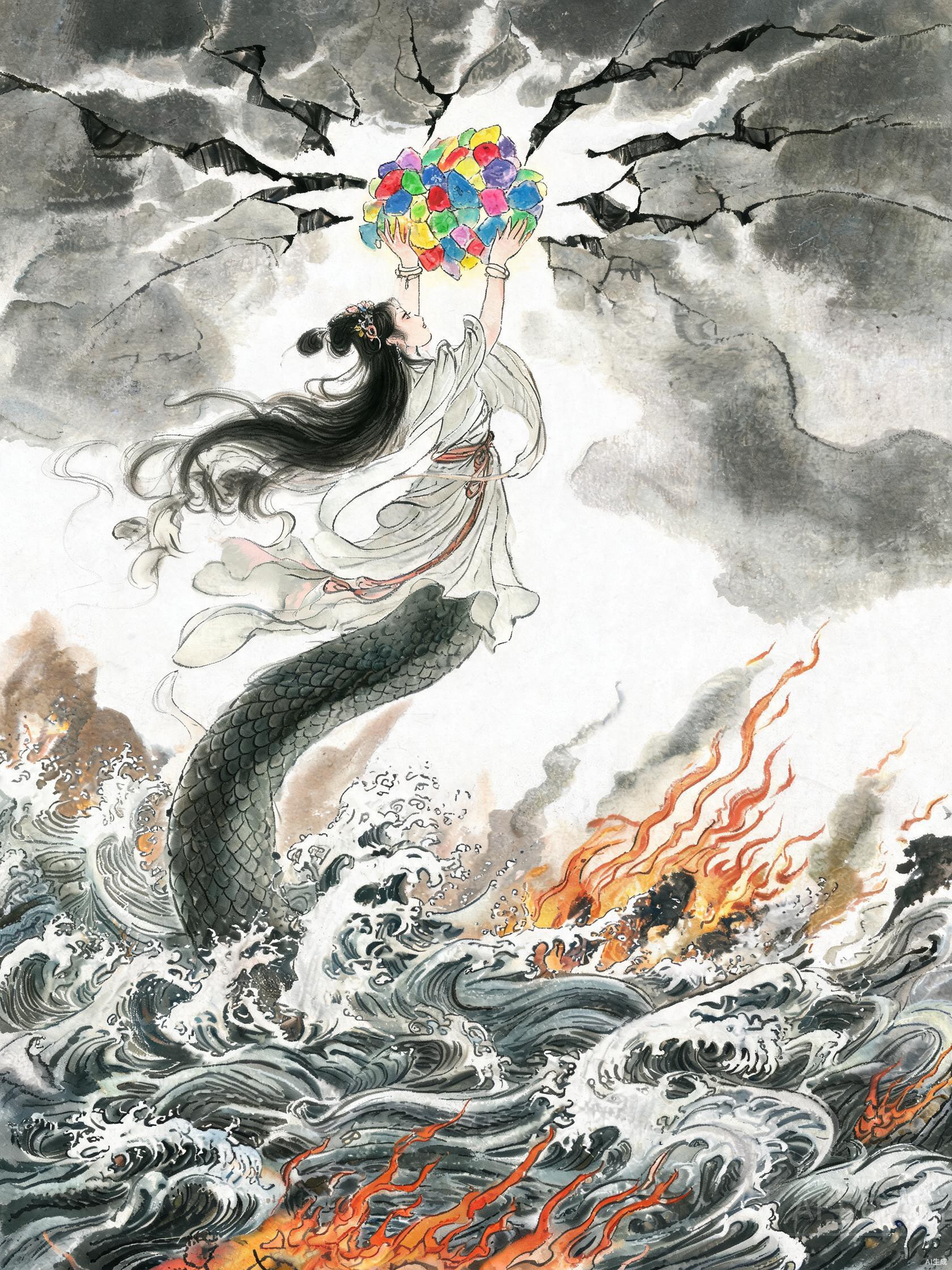
Nuwa Mends the Sky
女娲补天
The mother goddess who melted five-colored stones to patch a broken sky.
听故事 · Listen to the story
Origin Story
The Breaking of the World
In ancient times, a great cosmic catastrophe shattered the order of the world. The water god [Gonggong](/myths/gonggong), having lost a battle for supremacy, smashed his head in fury against Mount Buzhou — one of the pillars that held up the sky. The pillar collapsed, and the heavens tilted northwest while the earth tore southeast.
The sky tore open, and fires blazed across the land without ceasing. Floods poured from the broken heavens, drowning the people. Monsters and beasts crawled out of the chaos to devour the survivors. The world, which Nuwa had helped to create, was on the verge of complete destruction. The very fabric of the cosmos had been torn apart, and no force in heaven or earth could set it right — except Nuwa.
The myth of Nuwa Mending the Sky tells how the goddess Nuwa repaired the damaged heavens after a cosmic catastrophe. She melted five-colored stones to patch the sky and cut the legs off a giant turtle to prop up the world, saving all of creation from annihilation.
Powers & Symbols
Attributes & Artefacts
Click each card to reveal the details behind Nuwa Mends the Sky's divine attributes.
Historical & Cultural Meaning
Beyond the Myth
Five-Colored Stones
Nuwa, the goddess who had once sculpted humanity from yellow clay, could not bear to watch her creations perish. She gathered stones of five colors — corresponding to the five elements and the five directions of Chinese cosmology — and built a great furnace. With divine fire, she melted the stones into a luminous, molten patch.
She flew up to the broken sky and applied the molten stone to the gaping hole, sealing it as a potter patches a cracked vessel. The patch held. The fires died, the floods receded, and the heavens were whole again. But the sky had been tilted, and it would never be perfectly straight — which is why, the myth explains, the stars and planets drift to the northwest, and the rivers of China flow to the southeast.
Nuwa mending the sky with five-colored stones — a story of cosmic repair
The Turtle's Legs
The sky was mended, but it still needed support. Mount Buzhou, the broken pillar, could no longer hold up the heavens. Nuwa sought out a giant sea turtle — a creature of immense age and size — and cut off its four legs. She set each leg at a corner of the world, and they became the four pillars that hold up the sky to this day.
Some versions of the myth say the turtle willingly offered its legs to save the world, while others say Nuwa slew it. In either case, the turtle's sacrifice — like [Pangu](/gods/pangu)'s before it — became part of the structure of the cosmos. The four legs stand at the four compass points, and their presence keeps the sky from falling again.
Nuwa the Savior
The myth of Nuwa mending the sky completes her role as both creator and savior. She made humanity from clay, and when the world broke, she repaired it with stone. She is, in this sense, the complete mother of creation — not only does she bring life into being, but she protects and restores it when it is threatened.
The five-colored stones are deeply symbolic: they represent the [five elements](/symbols/five-elements) (metal, wood, water, fire, earth) that compose all of existence. By melting them together, [Nuwa](/gods/nuwa) unified the elements to restore cosmic harmony. The myth is recorded in the Huainanzi, a Han Dynasty text, and remains one of the most powerful images of divine female power in any mythology. In Chinese culture, [Nuwa](/symbols/nuwa) Mends the Sky (女娲补天) has become an idiom for a miraculous repair or salvation against impossible odds.
Sources & References
Primary classical texts: Shanhaijing (山海经, Classic of Mountains and Seas, c. 4th-2nd century BCE) · Fengshen Yanyi (封神演义, Investiture of the Gods, c. 16th century) · Journey to the West (西游记, Xiyouji, c. 16th century) · Records of the Grand Historian (史记, Shiji, by Sima Qian, c. 91 BCE) · Classic of Mountains and Seas commentary (郭璞注 Shanhaijing, c. 4th century) · Bamboo Annals (竹书纪年, c. 4th century BCE onwards)
Classical translations: Legge, James (trans.). The Sacred Books of the East (1879-1910, 50 volumes covering Chinese classics) · Girardot, Norman J. Myth and Meaning in Early Taoism (University of California Press, 1983) · Werner, E.T.C. A Dictionary of Chinese Mythology (Shanghai: Kelly & Walsh, 1932)
Modern academic references: Birrell, Anne. Chinese Mythology: An Introduction (Baltimore: Johns Hopkins University Press, 1993) · Yang, Lihui, and Deming An. Handbook of Chinese Mythology (New York: Oxford University Press, 2005) · Strassberg, Richard E. A Chinese Bestiary: Strange Creatures from the Guideways Through Mountains and Seas (Berkeley: University of California Press, 2002)
Digital encyclopedias and online resources: Wikipedia — Chinese mythology portal (continuously updated, citations to primary sources) · Encyclopedia Britannica — Mythology and Religion section
Mythology Network
Connections & Relationships
Nuwa Mends the Sky is woven into a larger web of gods, creatures, and legends. Explore the connections below.
Nuwa Mends the Sky
女娲补天


Explore the Topic
Nuwa Mends the Sky in the Mythology Network
Go deeper — read the topic guides that gather every legend like Nuwa Mends the Sky.