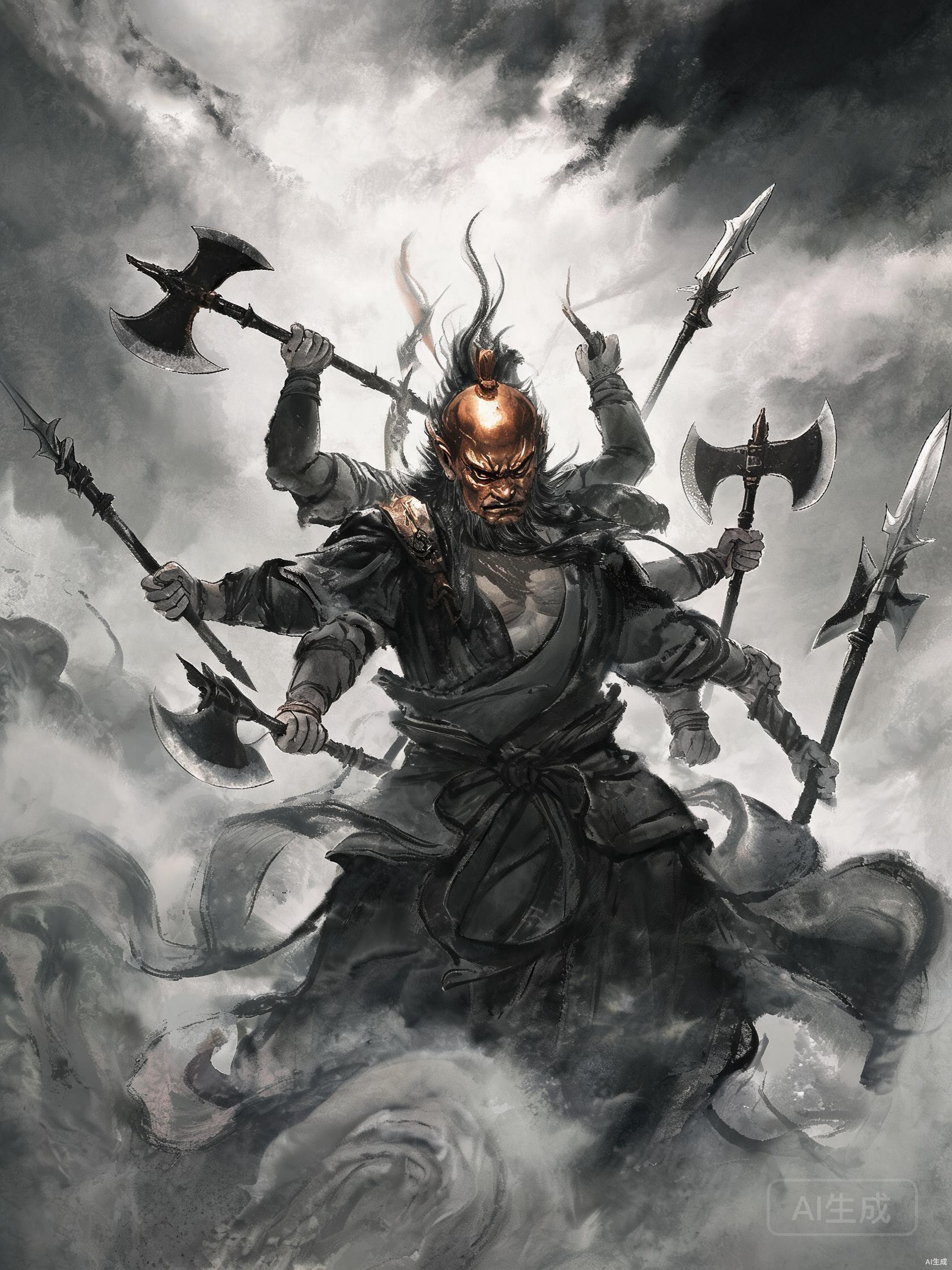
Chiyou
蚩尤
The god of war and metalwork, whose defeat at Zhuolu forged the Chinese nation.
Origin Story
Who Is Chiyou?
Chiyou is one of the most complex figures in Chinese mythology — simultaneously a villain, a war god, and an ancestor deity. He was the leader of the Nine Li (Jiuli) tribe, which rivaled the Yellow Emperor for dominance over the Yellow River valley. He is credited with being the first to forge metal weapons, making him the patron of metalworkers and weapon-smiths.
In mythological descriptions, Chiyou is a terrifying figure: a copper head and iron forehead that no blade could pierce, four eyes that could see in all directions, and six arms wielding weapons simultaneously. Some accounts describe him and his seventy-two brothers as having the heads of beasts and the bodies of men, capable of eating sand and rocks.
Despite being the antagonist in the founding myth of Chinese civilization, Chiyou was never fully demonized. After his defeat, the Yellow Emperor himself honored Chiyou's martial prowess, enshrining his image as the god of war. Soldiers prayed to him before battle, and his cult endured for centuries.
Chiyou is the fearsome war god of Chinese mythology, leader of the Nine Li tribe, and inventor of metal weapons. Though defeated by the Yellow Emperor at the Battle of Zhuolu, he remains a powerful deity of war, weather, and military prowess.
Powers & Symbols
Attributes & Artefacts
Click each card to reveal the details behind Chiyou's divine attributes.
Historical & Cultural Meaning
Beyond the Myth
Chiyou in Mythology
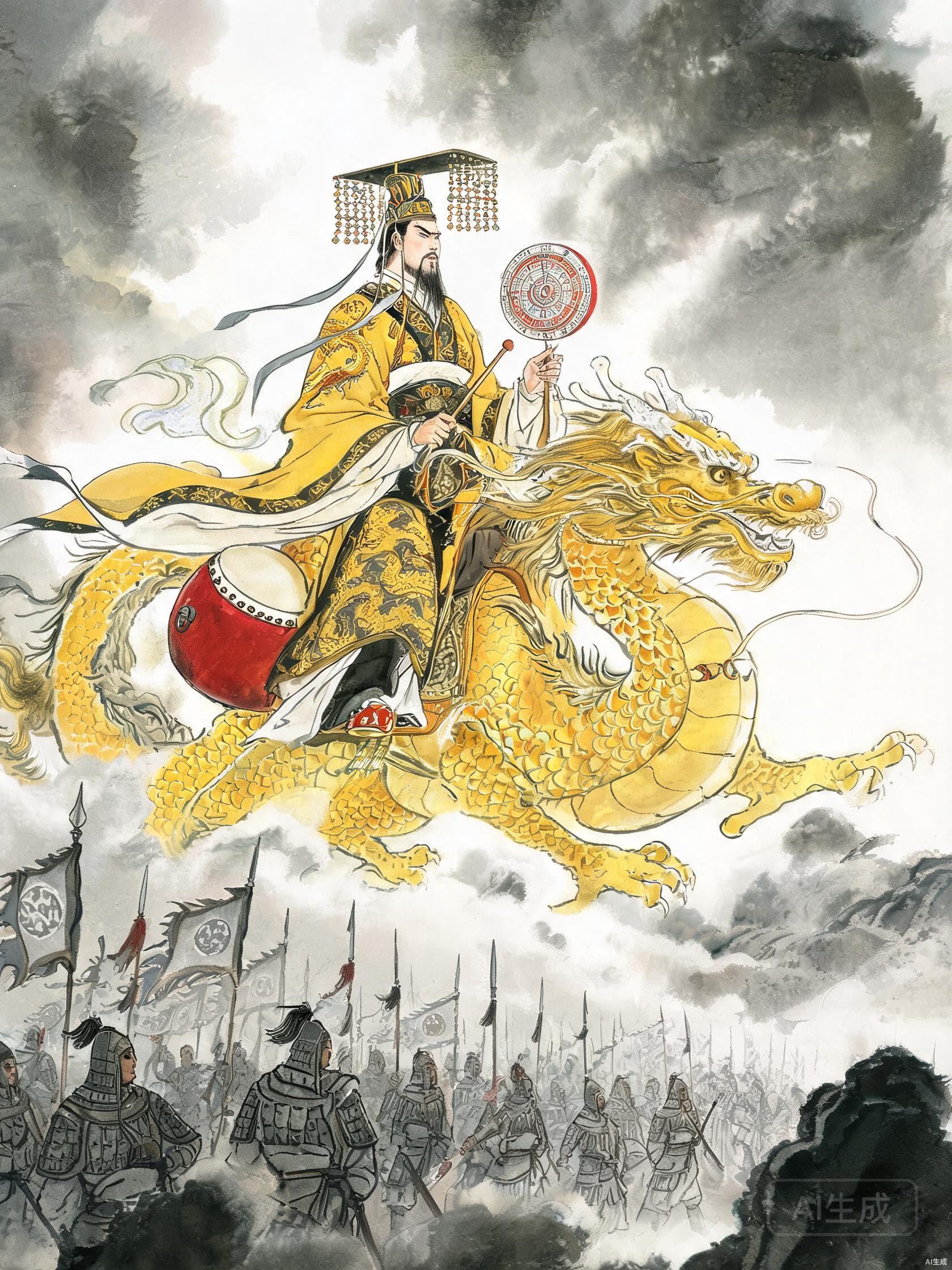
The Battle of Zhuolu is the central myth of Chiyou's story. Chiyou and his Nine Li tribe, masters of metalwork and warfare, clashed with the [Yellow Emperor](/gods/yellow-emperor)'s forces in the earliest great war of Chinese legend. The battle was no ordinary conflict — it was a cosmic struggle that involved gods, spirits, and supernatural weather.
Chiyou conjured a thick, blinding fog that trapped [Huangdi](/gods/huang-di)'s army, forcing the [Yellow Emperor](/gods/yellow-emperor) to invent the South-Pointing Chariot to navigate through the chaos. Chiyou then summoned the gods of wind and rain, unleashing a devastating storm. The [Yellow Emperor](/folklore/yellow-emperor) countered by calling upon the drought goddess Nuba, who dispersed the storm with scorching heat, turning the tide of battle.
Defeated and slain, Chiyou was decapitated. Legend says his head and body were buried in separate places to prevent his resurrection. Yet the [Yellow Emperor](/gods/yellow-emperor), recognizing his martial greatness, had his image painted on banners to inspire fear in enemies — effectively making Chiyou a posthumous god of war. In an alternate tradition, Chiyou's spirit became a red-shouldered celestial banner, a comet-like phenomenon in the night sky that foretold war and upheaval.
Worship and Cultural Significance
Chiyou is worshipped as a war god and as the ancestor of several non-Han peoples, particularly the Miao, who trace their lineage to the Nine Li tribe. In Miao tradition, Chiyou is not a villain but a heroic leader who fought against aggression and whose defeat forced his people into migration southward.
In Han Chinese tradition, Chiyou's cult persisted well into the imperial era. The first emperor of Han, Liu Bang, is said to have sacrificed to Chiyou before his final battle for the throne, invoking the war god's blessing. Throughout the dynasties, Chiyou remained a figure to be propitiated by armies and feared by enemies.
For metalworkers and weapon-smiths, Chiyou was the patron deity — the one who first taught humanity to forge bronze and iron into blades. His cult represents the Chinese acknowledgment that even in defeat, there is power worth honoring, and that martial excellence transcends political victory.
Chiyou in Popular Culture
In modern Chinese media, [Chiyou](/creatures/chiyou) is often depicted as a tragic antihero or a dark warlord, depending on the narrative perspective. He appears in historical fantasy novels, video games, and manhua (comics) that explore the mythological founding of China and the cosmic battle of Zhuolu.
Among the Miao and other minority peoples, [Chiyou](/gods/chiyou) has experienced a cultural revival as a symbol of ethnic identity and resistance, featured in festivals, songs, and art that reclaim his story from the marginal position it occupies in mainstream Han historiography.
Sources & References
Primary classical texts: Shanhaijing (山海经, Classic of Mountains and Seas, c. 4th-2nd century BCE) · Fengshen Yanyi (封神演义, Investiture of the Gods, c. 16th century) · Journey to the West (西游记, Xiyouji, c. 16th century) · Records of the Grand Historian (史记, Shiji, by Sima Qian, c. 91 BCE) · Classic of Mountains and Seas commentary (郭璞注 Shanhaijing, c. 4th century) · Bamboo Annals (竹书纪年, c. 4th century BCE onwards)
Classical translations: Legge, James (trans.). The Sacred Books of the East (1879-1910, 50 volumes covering Chinese classics) · Girardot, Norman J. Myth and Meaning in Early Taoism (University of California Press, 1983) · Werner, E.T.C. A Dictionary of Chinese Mythology (Shanghai: Kelly & Walsh, 1932)
Modern academic references: Birrell, Anne. Chinese Mythology: An Introduction (Baltimore: Johns Hopkins University Press, 1993) · Yang, Lihui, and Deming An. Handbook of Chinese Mythology (New York: Oxford University Press, 2005) · Strassberg, Richard E. A Chinese Bestiary: Strange Creatures from the Guideways Through Mountains and Seas (Berkeley: University of California Press, 2002)
Digital encyclopedias and online resources: Wikipedia — Chinese mythology portal (continuously updated, citations to primary sources) · Encyclopedia Britannica — Mythology and Religion section
Mythology Network
Connections & Relationships
Chiyou is woven into a larger web of gods, creatures, and legends. Explore the connections below.
Chiyou
蚩尤

Explore the Topic
Chiyou in the Mythology Network
Go deeper — read the topic guides that gather every deity like Chiyou.