
Gonggong Crashes the Pillar of Heaven
共工怒触不周山
The angry water god whose fall broke the sky — and set the stage for Núwa’s repair.
Origin Story
Who Was Gonggong?
Gonggong (literally ‘Shared Labor’) was a chieftain of water and a powerful minister in the era between the Flame Emperor and the Yellow Emperor. Unlike most cosmic beings of the early mythic age, Gonggong is described as human-shaped with a serpent’s body and a red head. He is associated with floods, storms, and the destructive face of water.
In the Huainanzi he is remembered less as a deity of the sea and more as a bringer of catastrophe — the god whose wrath can move mountains. Where the flood myths of Yú the Great honor human ingenuity against water, the Gonggong myths preserve an older theme of divine anger as the cause of cosmic disorder.
Gonggong was a lord of water and a divine rebel who, after losing a power struggle with Zhuanxu, smashed his head against the Pillar of Heaven (Buzhou Mountain). The pillar cracked, the sky tilted to the northwest, and the earth sank to the southeast — explaining why rivers in China flow east and the sun sets in the west. Núwa then descended to repair the heavens.
Powers & Symbols
Attributes & Artefacts
Click each card to reveal the details behind Gonggong Crashes the Pillar of Heaven's divine attributes.
Magical Artifacts & Weapons
Gonggong Crashes the Pillar of Heaven's Divine Arsenal
The legendary weapons and treasures wielded by Gonggong Crashes the Pillar of Heaven — each with its own origin story, powers, and mythological significance.
Historical & Cultural Meaning
Beyond the Myth
The War with Zhuanxu
According to multiple early sources, Gonggong sought to seize the throne from Zhuanxu (a culture-hero emperor between the Flame Emperor and the Yellow Emperor). He united allies including Xiangliu, a nine-headed poisonous snake minister, and waged a long war. Defeated at every turn, he fled in humiliation.
At the edge of the world, in a place the texts only call ‘the southwest,’ Gonggong struck his head against Buzhou Mountain, the great cosmic pillar that holds up the northern sky. The blow was so forceful that the pillar snapped, the heavens cracked, and the world tilted.
Why Rivers Flow East and the Sun Sets West
This is the ancient Chinese explanation of a basic geographic fact: the upper Yellow River and Yangzi flow from west to east, and the sun sets in the western sky. The classical texts explain it as follows — because the pillar cracked and leaned, the celestial dome tilted toward the northwest (so the sun, moon, and stars slide toward it and set in the west) while the earth below sank toward the southeast (so rivers and rain drain toward the eastern seas).
It is a profoundly elegant myth: a single divine tantrum becomes the geometric reason for the shape of the world. Every garden with a stream, every sunset over the Pacific, is a quiet echo of Gonggong’s final desperate blow.
Núwa’s Repair
After the crash, the world burned and flooded. Núwa descended, smelted five-colored stones to patch the broken sky, used the legs of a divine turtle to prop the four corners of the sky aloft, and finally tamed the wild waters by killing the black dragon. Her work — the repair of heaven — is the only story in the Chinese canon where a goddess alone saves the cosmos.
Gonggong himself is sometimes remembered as the original “angry god,” a cautionary figure whose pride broke the world, and whose catastrophe made possible the great cultural task of Núwa’s repair.
Mythology Network
Connections & Relationships
Gonggong Crashes the Pillar of Heaven is woven into a larger web of gods, creatures, and legends. Explore the connections below.
Gonggong Crashes the Pillar of Heaven
共工怒触不周山
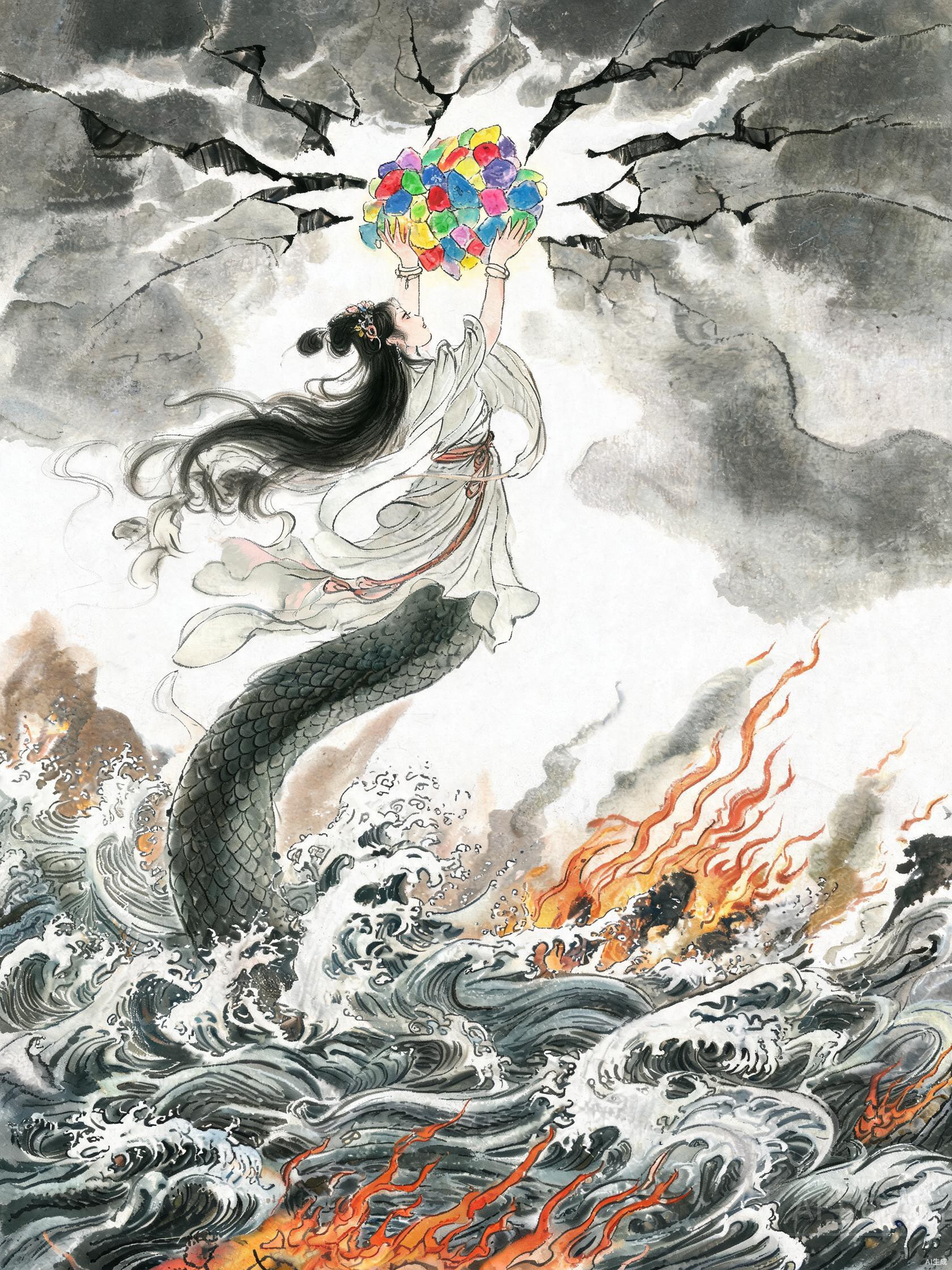
Nuwa Mends the Sky
The mother goddess who melted five-colored stones to patch a broken sky.

Nuwa Creates Humanity
How the mother goddess sculpted the first humans from yellow clay.

Xiangliu the Nine-Headed Serpent
The nine-headed minister of Gonggong, whose blood poisons whole countrysides.