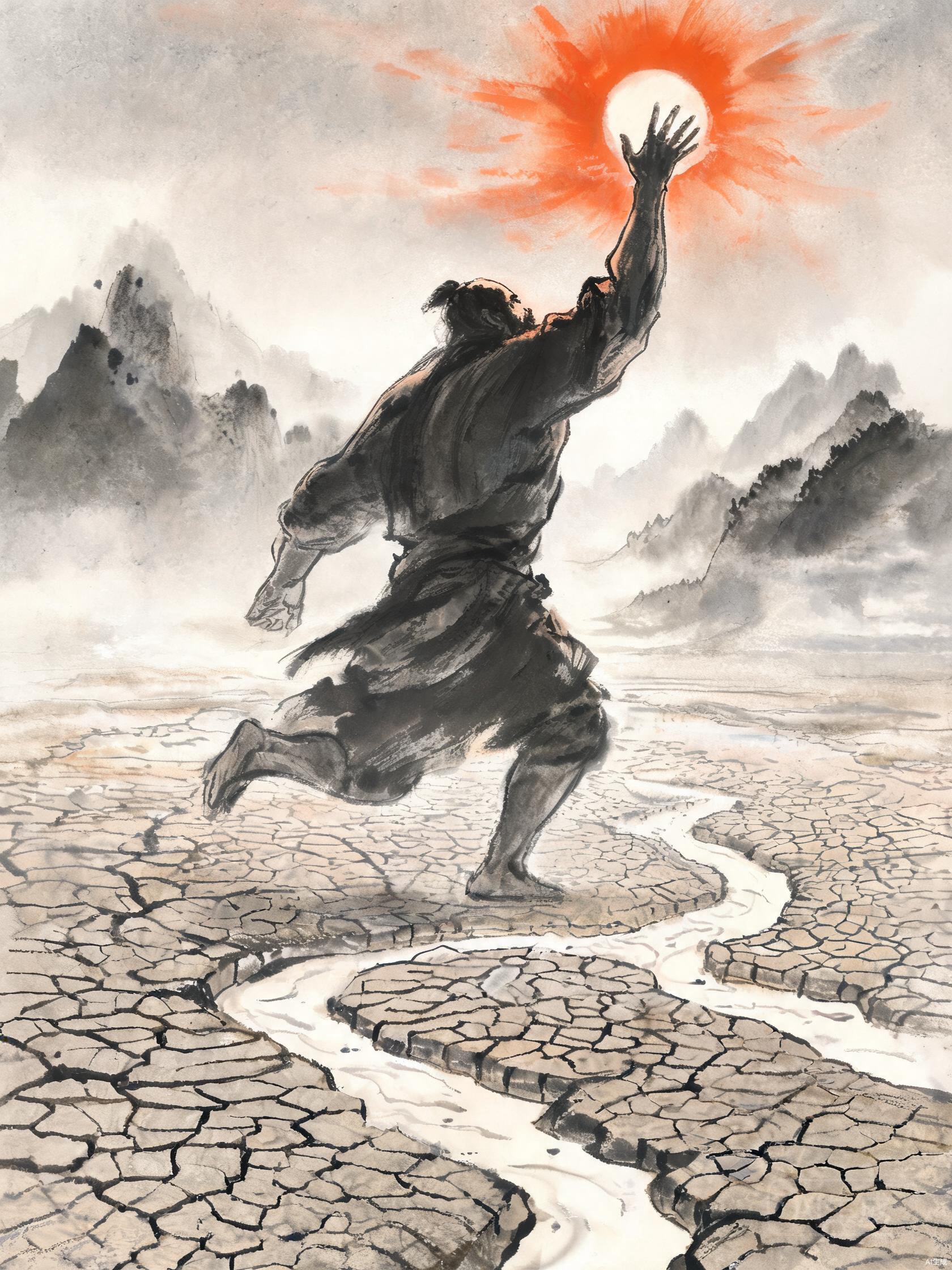
Xing Tian Wu Gan Qi
刑天舞干戚
The headless giant who fights on — using his eyes as nipples and his mouth as navel, wielding axe and shield.
Origin Story
The Warrior Who Lost His Head
Xing Tian (刑天, whose name means 'Punished Heaven' or 'Severed Body') was a giant, a warrior of tremendous power who served under the Yan Emperor (炎帝). When the Yan Emperor was defeated by the Yellow Emperor (黄帝) in the great war for supremacy over the Central Plains, Xing Tian refused to accept the outcome. While other warriors submitted or fled, Xing Tian seized his battle axe and shield and marched alone to the Yellow Emperor's celestial palace at the summit of Changyang Mountain.
The battle between Xing Tian and the Yellow Emperor was titanic — axe against sword, giant against god, will against authority. They fought across the mountain and into the heavens, each blow shaking the earth and splitting the sky. But the Yellow Emperor was the supreme deity of the Central Plains, and his power was ultimate. With a single stroke, he severed Xing Tian's head. The head rolled down the mountain and was buried at Changyang, swallowed by the earth.
Any other warrior would have died. But Xing Tian's will was so fierce that it kept his body alive. Denied a head, his body refused to fall. Instead, in one of the most extraordinary transformations in world mythology, his nipples became eyes — twin burning orbs that glared from his chest — and his navel became a mouth, gaping and roaring with battle fury. Headless but unbroken, Xing Tian raised his axe and shield once more and began to dance — the warrior's dance, the dance of defiance, the dance of the spirit that will not yield.
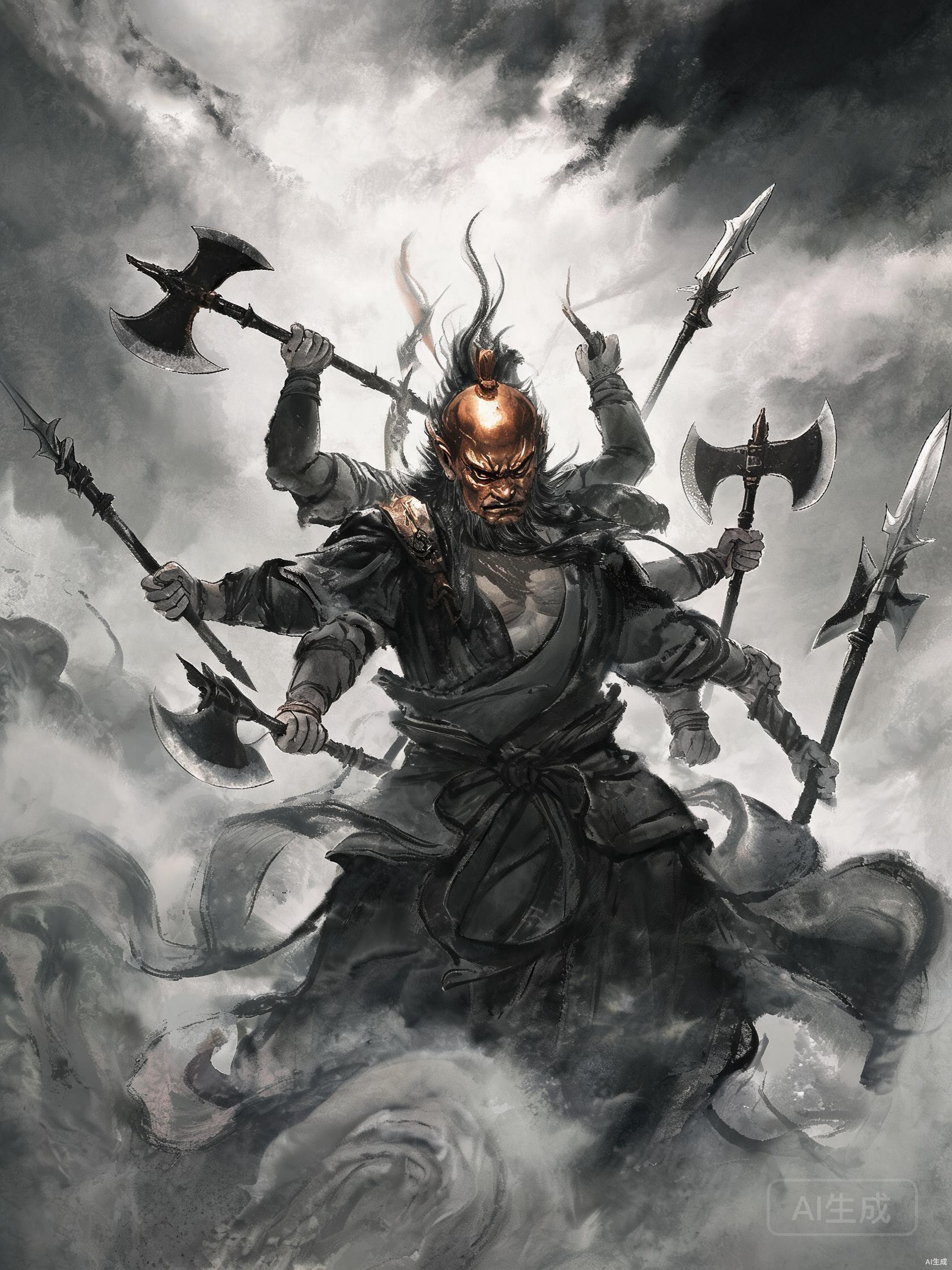
Chiyou and Xing Tian — both warriors who defied the Yellow Emperor
Xing Tian (刑天) is a giant warrior in Chinese mythology who was beheaded by the Yellow Emperor in their battle for supremacy. Denied death, Xing Tian's headless body continued to fight, his nipples becoming eyes and his navel becoming a mouth. Wielding his battle axe (干, gān) and shield (戚, qī), he dances an eternal warrior's dance, refusing to accept defeat even after losing his head. The story, recorded in the Classic of Mountains and Seas, is the ultimate symbol of indomitable will in Chinese culture.
Powers & Symbols
Attributes & Artefacts
Click each card to reveal the details behind Xing Tian Wu Gan Qi's divine attributes.
Magical Artifacts & Weapons
Xing Tian Wu Gan Qi's Divine Arsenal
The legendary weapons and treasures wielded by Xing Tian Wu Gan Qi — each with its own origin story, powers, and mythological significance.
Historical & Cultural Meaning
Beyond the Myth
The Eternal Dance of Defiance
The image of the headless Xing Tian dancing with axe and shield is one of the most powerful and surreal in all of Chinese mythology. The Classic of Mountains and Seas describes it in stark, unforgettable terms: 'Xing Tian and the Yellow Emperor fought at Changyang. The Yellow Emperor struck off Xing Tian's head and buried it at Changyang. Xing Tian's body, using its nipples as eyes and its navel as mouth, wields its axe and dances.' The text is brief, but the image it conjures is searing — a body that has lost its most essential part, continuing to fight with the only weapons it has left.
The dance is not merely physical; it is symbolic. In Chinese martial tradition, the dance with axe and shield (干戚之舞, gān qī zhī wǔ) is the oldest form of military display — a ritual performed before battle to demonstrate prowess and intimidate the enemy. Xing Tian's dance is this ritual pushed to its absolute extreme: the warrior who has lost everything except the will to fight, performing the battle dance that says 'I am still here, I am still dangerous, I have not surrendered.'
The location of the dance is also significant. Changyang (常羊), where Xing Tian's head is buried, is described as a mountain in the mythological geography of the Shanhaijing. Some scholars identify it with a real mountain in Gansu Province, but in the mythic landscape, it represents the boundary between the world of the living and the world of the dead. Xing Tian dances at this threshold — not quite alive, not quite dead, existing in the space between, where the body that should have perished refuses to acknowledge its own end.
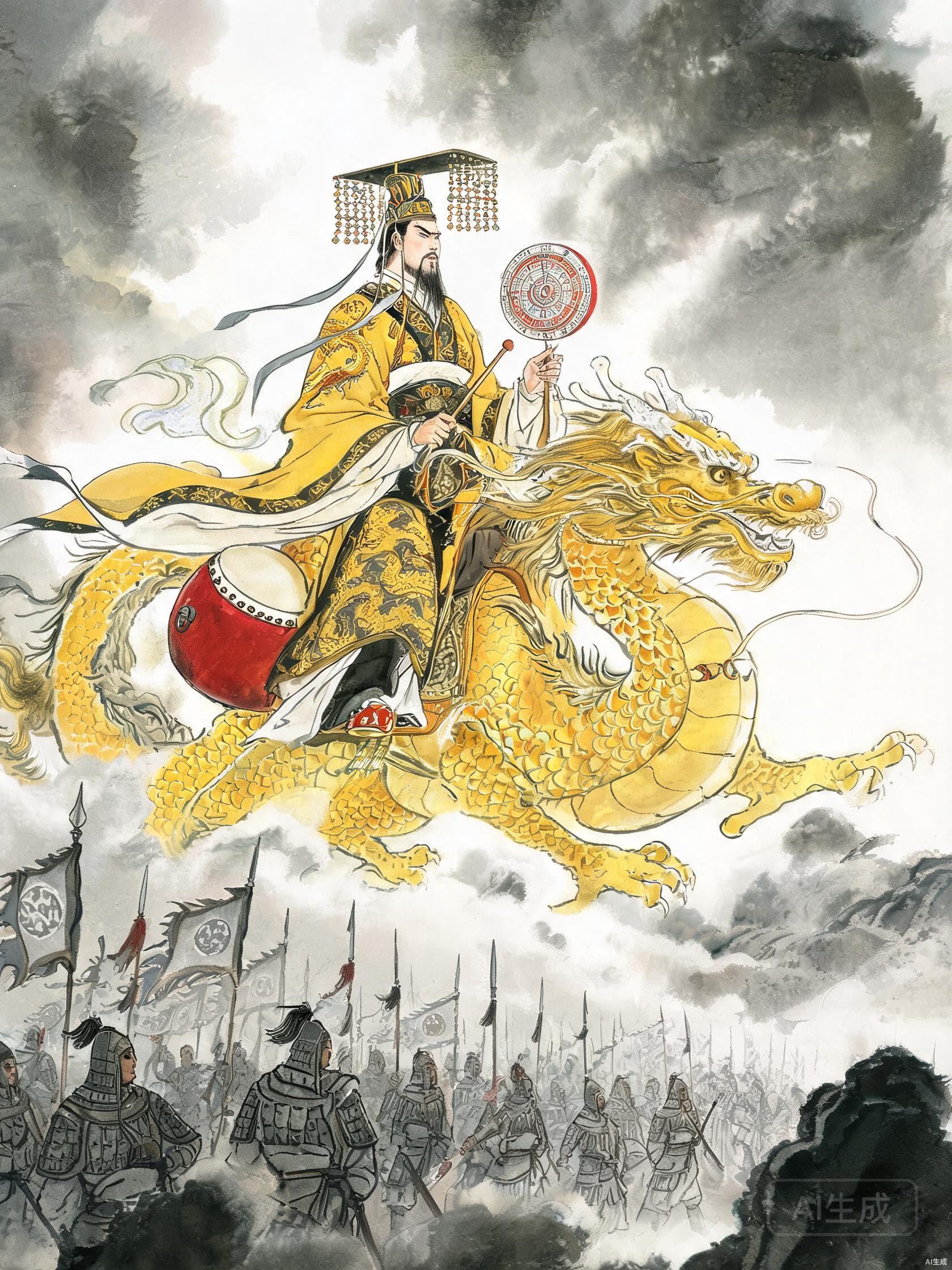
The Yellow Emperor — the supreme authority that Xing Tian defied
Xing Tian in Chinese Culture
The story of Xing Tian has resonated through Chinese culture for over two thousand years. The Jin Dynasty poet Tao Yuanming (陶渊明) immortalized Xing Tian in one of the most famous lines in Chinese poetry: '刑天舞干戚, 猛志固常在' — 'Xing Tian dances with axe and shield, his fierce will surely endures forever.' This line, written in the 5th century CE, cemented Xing Tian as the supreme symbol of unconquerable spirit — the warrior whose determination outlasts even the loss of his head.
Tao Yuanming's use of Xing Tian is itself remarkable. Tao was a poet of retirement and contemplation, a man who left government service to farm and write. His invocation of Xing Tian — the most violent, most defiant figure in Chinese mythology — in a poem about reading the Classics suggests that the poet saw in the headless warrior not merely martial valor but a deeper spiritual truth: that the true self, the will, the spirit, does not reside in the head (the seat of reason, of hierarchy, of submission to authority) but in the body (the seat of instinct, of force, of the drive to continue). The head can be cut off, but the will that lives in the body endures.
In modern Chinese, the phrase '刑天精神' (Xing Tian spirit) describes the refusal to surrender in the face of impossible odds — the determination that persists even after everything has been lost. Xing Tian has been adopted as a symbol by political movements, martial artists, and anyone who faces an opponent so powerful that defeat seems certain. His image — headless, with eyes burning from his chest and a mouth roaring from his belly, dancing with his axe — is one of the most recognizable figures from the Shanhaijing, a reminder that the body can be broken but the will, if it is fierce enough, can dance on without a head.
Mythology Network
Connections & Relationships
Xing Tian Wu Gan Qi is woven into a larger web of gods, creatures, and legends. Explore the connections below.
Xing Tian Wu Gan Qi
刑天舞干戚