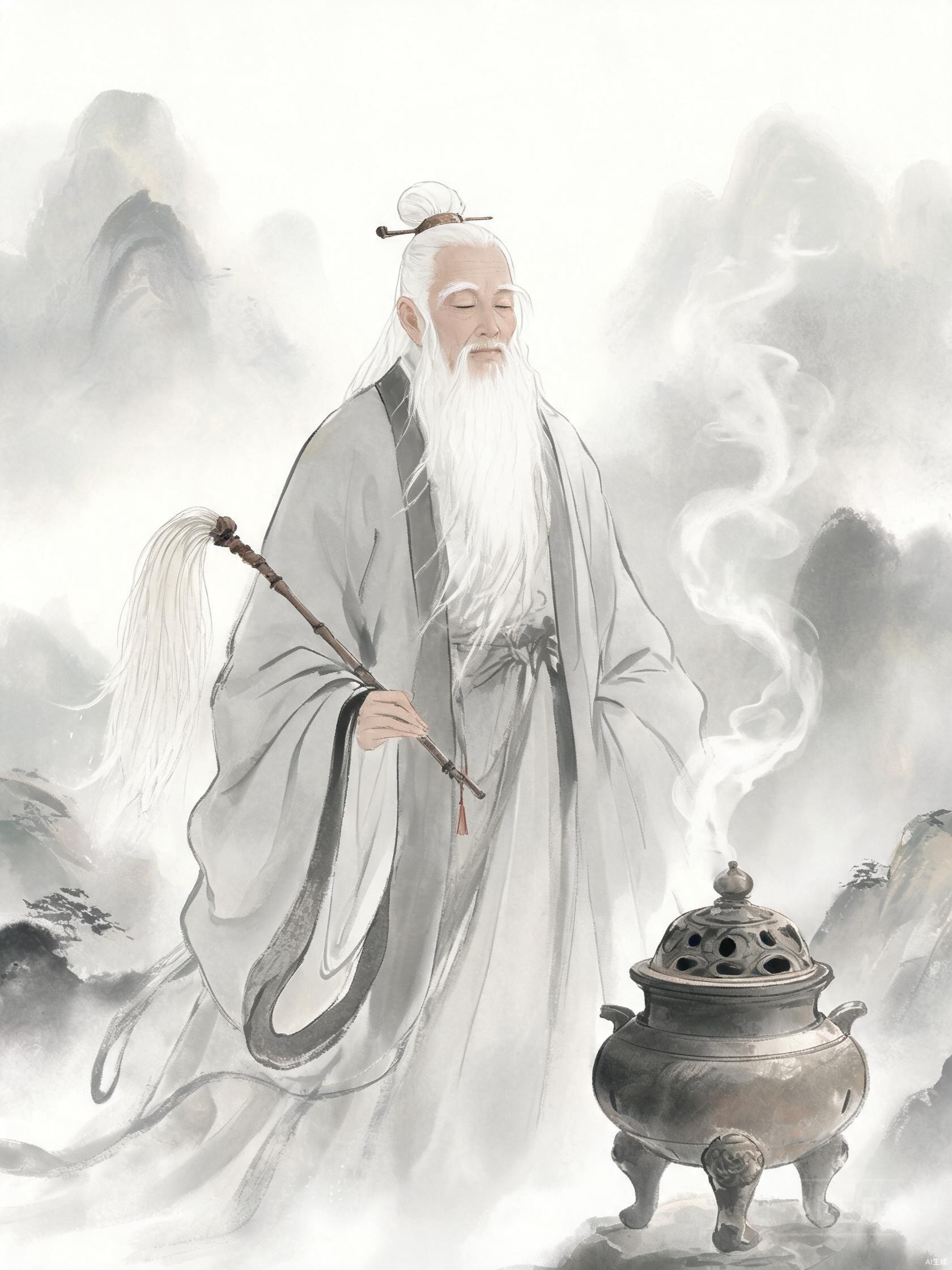
Cao Guojiu
曹国舅
The imperial brother-in-law who renounced wealth and power for the path of immortality.
Origin Story
Who Is Cao Guojiu?
Cao Guojiu (曹国舅, 'Imperial Brother-in-Law Cao') is the most recent of the Eight Immortals in terms of the era he is associated with. He is said to have lived during the Song Dynasty, and his title 'Guojiu' (国舅) — literally 'uncle of the state' — refers to his position as the brother of Empress Cao (曹皇后), the wife of Emperor Renzong of Song. By birth, Cao was one of the most powerful men in the empire — connected to the throne by blood, surrounded by wealth, and accustomed to privilege from birth.
The crisis that transformed Cao Guojiu's life came from his own family. His younger brother, also a member of the imperial clan by marriage, was a tyrant who abused his power, oppressed the people, and committed crimes so brazen that they threatened the reputation of the entire Cao family. Cao Guojiu tried to restrain his brother, argued with him, and begged him to reform. But the brother would not listen. When the brother's crimes finally came to the attention of the imperial court and he was punished, Cao Guojiu was overwhelmed with shame — not for his own actions, but for the family name that had been stained.
Rather than defend his family's honor or use his connections to protect his brother, Cao Guojiu made a decision that astonished the court: he gave away his fortune, distributed his wealth to the poor, left his estates, and retreated to the mountains as a hermit. He dressed in rough clothes, ate simple food, and devoted himself to Taoist cultivation. The man who had been born with everything chose to have nothing — and in having nothing, he found what wealth and power could never give.

Cao Guojiu — the imperial nobleman who traded the earthly court for the celestial one
Cao Guojiu, the Imperial Brother-in-Law Cao, is the most aristocratic of the Eight Immortals. A Song Dynasty nobleman whose sister was the empress, he was so ashamed of his brother's crimes that he gave away his fortune, became a hermit, and sought the Tao. He carries a pair of jade castanets (or a jade tablet) and is the patron of actors, performers, and those who seek virtue after a life of privilege.
Powers & Symbols
Attributes & Artefacts
Click each card to reveal the details behind Cao Guojiu's divine attributes.
Historical & Cultural Meaning
Beyond the Myth
The Jade Castanets
Cao Guojiu's emblem is a pair of jade castanets (玉板, yùbǎn) — flat pieces of jade held in each hand and struck together to produce a sharp, rhythmic sound. In some traditions, these are interpreted as a jade tablet (笏板, hùbǎn) — the ceremonial tablet that officials held before the emperor when presenting memorials. Both interpretations carry rich meaning: the castanets connect Cao to the performing arts, while the tablet connects him to his origins in the imperial court.
As castanets, the jade tablets are a musical instrument, and Cao Guojiu is the patron of actors and performers. This patronage is itself remarkable: the nephew of an empress, a man born to the highest nobility, chose to be associated with actors — who in traditional Chinese society were considered among the lowest social classes. By carrying the castanets, Cao Guojiu declared that the stage and the court are not so different: both are performances, both require masks, and the only real difference is whether the actor knows that he is playing a part.
The jade material of the castanets is also significant. Jade (玉, yù) in Chinese culture represents the highest virtue — it is hard but not brittle, warm but not hot, beautiful but not gaudy. Confucius said that jade embodies eleven virtues, including benevolence, wisdom, righteousness, sincerity, and loyalty. By holding jade, Cao Guojiu carries the virtues he renounced privilege to pursue. The sound of jade striking jade — clear, sharp, and brief — is the sound of truth cutting through illusion, a reminder that the noblest birth is not of blood but of character.

Cao Guojiu and Guan Yu — both noblemen who chose virtue over power
The Meeting with the Immortals
In the most famous version of his legend, Cao Guojiu was tested by either Lü Dongbin or Zhongli Quan. The immortal appeared to him in the mountains and asked him what he was seeking. Cao Guojiu replied that he was seeking the Tao. The immortal then asked: 'The Tao is formless and nameless. What are you seeking it with?' Cao Guojiu raised his jade castanets and said: 'With these.' The immortal asked what the castanets were made of. 'Jade,' replied Cao. 'And where does jade come from?' 'From the mountain.' 'And the mountain?' 'From the earth.' 'And the earth?' 'From the Tao.'
In this dialogue, Cao Guojiu demonstrated that he understood the chain of existence — that all things trace back to the Tao, and that the jade in his hands was, at its deepest root, a manifestation of the same principle that animates the cosmos. Pleased with his understanding, the immortal accepted him as a disciple and taught him the secrets of immortality. Cao Guojiu joined the Eight Immortals as their most recent member, the one who had farthest to travel — from the heights of privilege to the depths of renunciation — and who made the journey without hesitation.
In folk worship, Cao Guojiu is invoked by those who seek to make amends for past privilege, by those born into wealth who wish to use it wisely, and by performers of all kinds. His story is a reminder that nobility is not inherited but earned, and that the path to the Tao is open even to those who have everything — perhaps especially to them, for they have the most to give up.
Mythology Network
Connections & Relationships
Cao Guojiu is woven into a larger web of gods, creatures, and legends. Explore the connections below.
Cao Guojiu
曹国舅