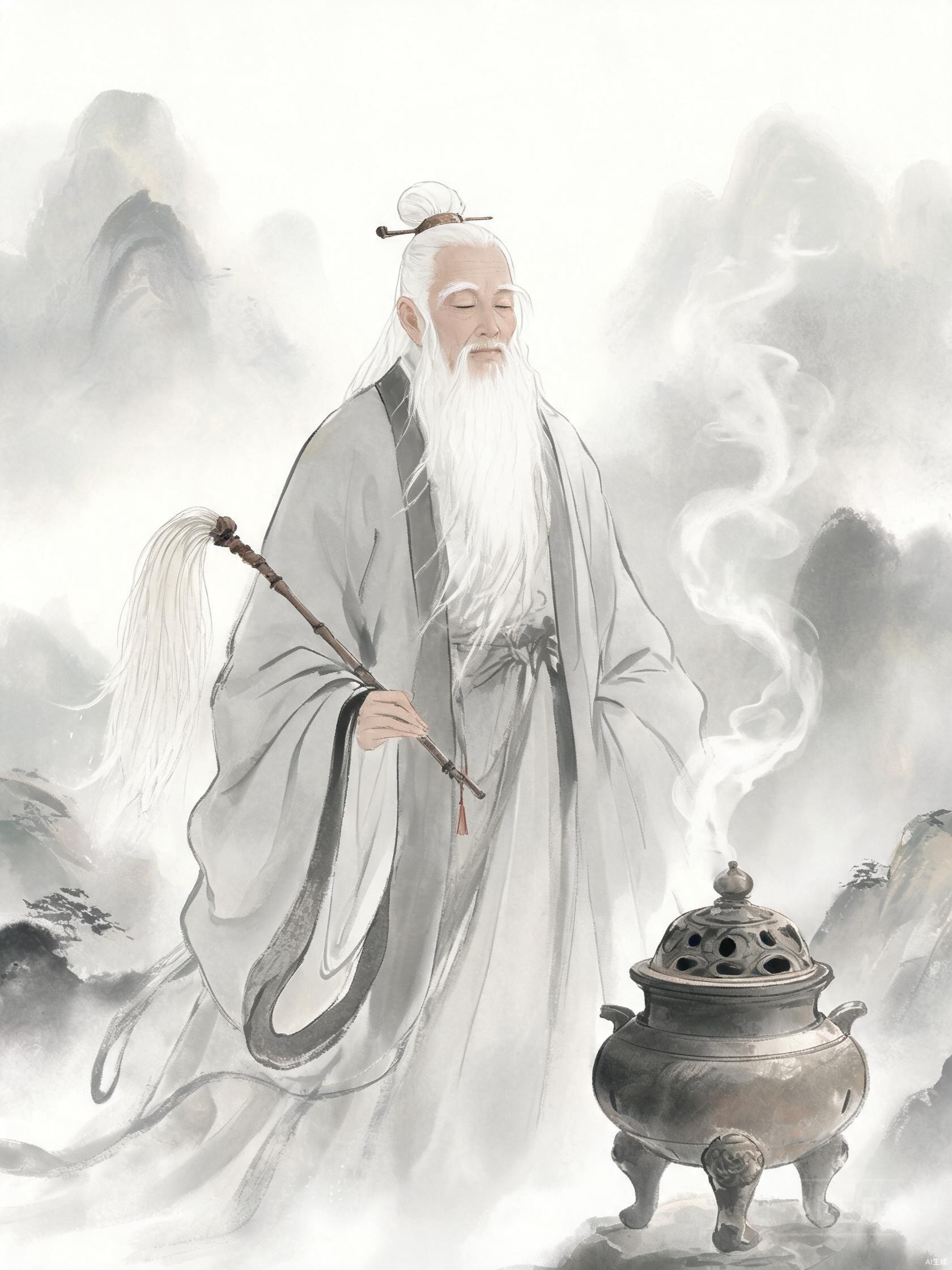
He Xiangu
何仙姑
The only woman among the Eight Immortals, a maiden who ate mica and the peach of immortality.
Origin Story
Who Is He Xiangu?
He Xiangu, whose personal name was He Qiong (何琼), was born in Zengcheng (增城), in present-day Guangdong Province, during the Tang Dynasty. From childhood, she was known for her extraordinary beauty, her quiet intelligence, and her devotion to purity. While other girls dreamed of marriage and household, He Qiong spent her time in the mountains, gathering herbs and observing the rhythms of nature. She was, by all accounts, a child who belonged more to the wild than to the world of human convention.
When she was thirteen or fourteen years old, she encountered a strange old man on the mountain path. In some versions, this was Lü Dongbin in disguise; in others, it was an unnamed immortal. The old man gave her powdered mica (云母, yúnmǔ) — a shimmering mineral that Taoist alchemists believed could refine the body into a lighter, more spiritual substance. He instructed her to eat a small amount each day. He Qiong followed his instructions faithfully, and gradually her body became lighter, her senses sharper, and her dreams clearer. She could walk without tiring, see things at great distances, and predict fortune and misfortune with uncanny accuracy.
In another version of the story, she was given a peach of immortality by an immortal who appeared in her dream. She ate the peach and awoke transformed — free from hunger, free from fatigue, free from the decay that touches all mortal flesh. She vowed never to marry, dedicating her life to the Tao and to helping those in need. Her family and the villagers were astonished, but they recognized that she had become something more than human. She eventually ascended to immortality, carried upward on a crane or a cloud, leaving behind only her lotus.

He Xiangu — like Guanyin, a female figure of compassion and purity
He Xiangu is the sole female member of the Eight Immortals. A Tang Dynasty maiden from Zengcheng in Guangdong, she attained immortality by eating powdered mica and a celestial peach. She carries a lotus flower as her emblem and is the patron of women, domestic harmony, and the art of healing with herbs. Her story represents the Taoist ideal that spiritual liberation is available to all, regardless of gender.
Powers & Symbols
Attributes & Artefacts
Click each card to reveal the details behind He Xiangu's divine attributes.
Historical & Cultural Meaning
Beyond the Myth
The Lotus and Its Meaning
He Xiangu's emblem is the lotus flower (莲花, liánhuā), one of the most richly symbolic objects in Chinese culture. The lotus grows in mud but blooms in pristine beauty — its roots in the dark earth, its flower turned toward the light. This makes it the perfect symbol of the Taoist (and Buddhist) ideal: to live in the world without being stained by it. He Xiangu, a woman who moved through the world of markets and villages, who interacted with ordinary people, yet remained unstained by worldly attachment, is the living embodiment of the lotus.
The lotus also carries specifically feminine symbolism in Chinese culture. Its delicate petals, its association with summer, and its connection to purity and grace made it the emblem of the ideal woman — not in the sense of submission, but in the sense of inner strength. The lotus stem is hollow, allowing the flower to sway with wind and water without breaking. He Xiangu, as the only woman among the Eight Immortals, embodies this quality: flexible, resilient, and rooted in a strength that is not visible from the outside.
In iconography, He Xiangu is depicted as a beautiful young woman holding a lotus flower or a fly-whisk, often with a serene, slightly otherworldly expression. She is sometimes shown riding a fenghuang (phoenix), the feminine counterpart to the dragon, reinforcing her association with feminine cosmic energy. Her relationship with Lü Dongbin is one of the most discussed aspects of Eight Immortals lore — in some tales she resists his advances, in others they share a spiritual bond that transcends romance, and in still others she is his disciple or his equal.

The fenghuang — emblem of feminine grace, paired with He Xiangu's lotus
He Xiangu in Culture
As the only woman among the Eight Immortals, He Xiangu holds a special place in Chinese religious life. She is the patron of women — especially those who seek spiritual growth outside the traditional roles of wife and mother. In a culture where women's lives were often defined by marriage and family, He Xiangu's vow of celibacy and her pursuit of immortality represented a radical alternative. She showed that a woman could choose a different path, one that led not to the household but to the heavens.
She is also invoked by those seeking domestic harmony, by herbalists and healers, and by anyone who values purity of intention over outward success. Temples to the Eight Immortals throughout China include her shrine, and she is particularly venerated in southern China, where her legend originated. Her image — a beautiful woman with a lotus — provides a counterpoint to the male-dominated imagery of much of Chinese religious art, reminding worshippers that the Tao is beyond gender, and that spiritual liberation is the birthright of all beings.
Mythology Network
Connections & Relationships
He Xiangu is woven into a larger web of gods, creatures, and legends. Explore the connections below.
He Xiangu
何仙姑