Lan Caihe
蓝采和
The androgynous, barefoot beggar who sang in the streets and rode clouds to heaven.
Origin Story
Who Is Lan Caihe?
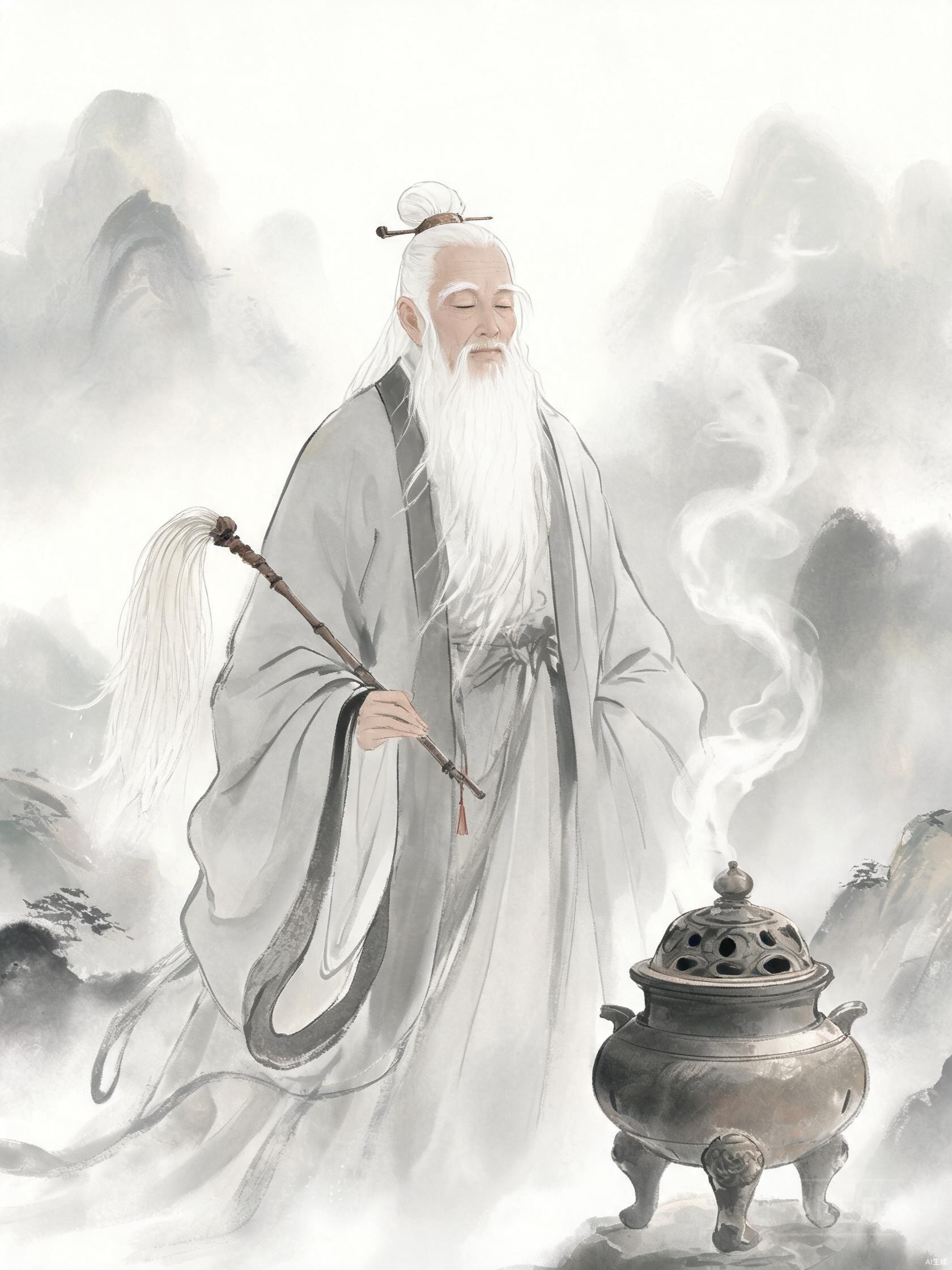
Lan Caihe is the most enigmatic of the Eight Immortals, a figure who defies categorization at every turn. The name 'Lan Caihe' is itself a puzzle — 'Lan' (蓝) means blue, the color of the tattered robe Lan wears; 'Caihe' (采和) can be read as 'gathering harmony' or as a personal name. In some texts, Lan is referred to as male; in others, as female; in still others, the question is deliberately left unanswered. The Tang Dynasty text mentions that Lan was sometimes male and sometimes female — changing appearance at will, or simply existing beyond the binary that structures mortal identity.
In appearance, Lan Caihe is unmistakable. Lan wears a tattered blue robe, fastened with a belt of black wood. One foot wears a shoe; the other is bare. In one hand, Lan carries a basket of flowers — peonies, chrysanthemums, lotus, and others, gathered from mountain meadows and field edges. In the other hand, Lan holds a wooden clapper, used to beat rhythm while singing. Lan's face is often described as flushed — whether from wine, from the sun, or from the sheer joy of existence is never specified.
Lan Caihe wanders the streets of towns and cities, singing songs that sound like nonsense to most listeners. But those with wisdom recognize that the songs contain prophecies, warnings, and fragments of Taoist philosophy. When people offer Lan money, Lan strings the coins on a cord and lets them drag on the ground. When the cord is full, Lan gives the coins to the poor — or simply walks away, leaving them scattered in the street. Lan has no home, no family, no possessions beyond the robe, the basket, and the clapper. And yet, Lan is richer than any emperor.
Lan Caihe — the street singer whose songs carried the wisdom of the Tao
Lan Caihe is the most eccentric and ambiguous of the Eight Immortals — a figure whose gender is unclear, whose appearance is ragged, and whose behavior defies every social convention. Wearing a tattered blue robe, one shoe on and one foot bare, Lan wanders the streets singing cryptic songs and begging for coins. When drunk, Lan rises into the air and flies away on clouds, leaving behind a basket of flowers that bring good fortune to the kind.
Powers & Symbols
Attributes & Artefacts
Click each card to reveal the details behind Lan Caihe's divine attributes.
Historical & Cultural Meaning
Beyond the Myth
The Drunkard Who Flies
Lan Caihe's most distinctive trait is the habit of getting drunk and flying. When Lan has had enough wine — and Lan always has enough wine, for strangers press cups upon the strange street singer — Lan begins to sway, to laugh, and then to rise. Slowly, impossibly, Lan's bare feet leave the ground. Higher and higher, until Lan is walking on air, on cloud, on nothing at all. The basket of flowers swings from Lan's arm, petals falling to the streets below. Those who catch the petals find that they never wilt — a gift of eternal spring from the immortal who has no use for permanence.
This image — the drunk beggar ascending to heaven — is one of the most powerful in Chinese folk religion. It inverts every hierarchy: the beggar is richer than the king, the drunkard is wiser than the sage, the ragged wanderer can fly while the emperor is bound to his throne. Lan Caihe represents the Taoist principle of wuwei (无为, non-action): the idea that the highest wisdom looks like foolishness, that the greatest freedom comes from having nothing to lose, and that the sage is precisely the one who has stopped trying to be wise.
Lan's gender ambiguity carries its own philosophical weight. In Taoist cosmology, the separation of yin and yang is the first step in the creation of the world, and the return to the undivided state — before yin and yang, before male and female, before self and other — is the goal of cultivation. Lan Caihe, who is neither clearly male nor clearly female, who wears both a shoe and barefoot, who is both beggar and immortal, embodies this return to the undivided. Lan is not confused; Lan is complete.
The lantern's glow — like Lan Caihe's madness, a light that comes from outside the ordinary
Lan Caihe in Culture
In Chinese folk worship, Lan Caihe is the patron of the poor, the eccentric, the outcast, and the artist. Those who do not fit — who refuse to conform, who choose a different path, who are called mad by the world — pray to Lan Caihe, the immortal who proved that madness can be wisdom and that the raggedest beggar may be the freest being in the heavens. Lan's image in temples shows a figure in blue, with a flower basket, either androgynous or shifting between presentations, a reminder that the Tao does not recognize the categories that humans build.
Lan Caihe also represents the ancient Chinese tradition of the 'mad sage' (狂士, kuángshì) — the wise person who hides their wisdom behind eccentric behavior. From the Daoist philosopher Zhuangzi to the Tang poet Li Bai to the Ming painter Xu Wei, Chinese culture has always held a special reverence for those who seem mad but are actually free. Lan Caihe is the immortal patron of this tradition — the one who took the madness all the way to heaven, proving that the door of immortality opens not for the respectable but for the authentic, not for those who fit the mold but for those who break it entirely.
Mythology Network
Connections & Relationships
Lan Caihe is woven into a larger web of gods, creatures, and legends. Explore the connections below.
Lan Caihe
蓝采和