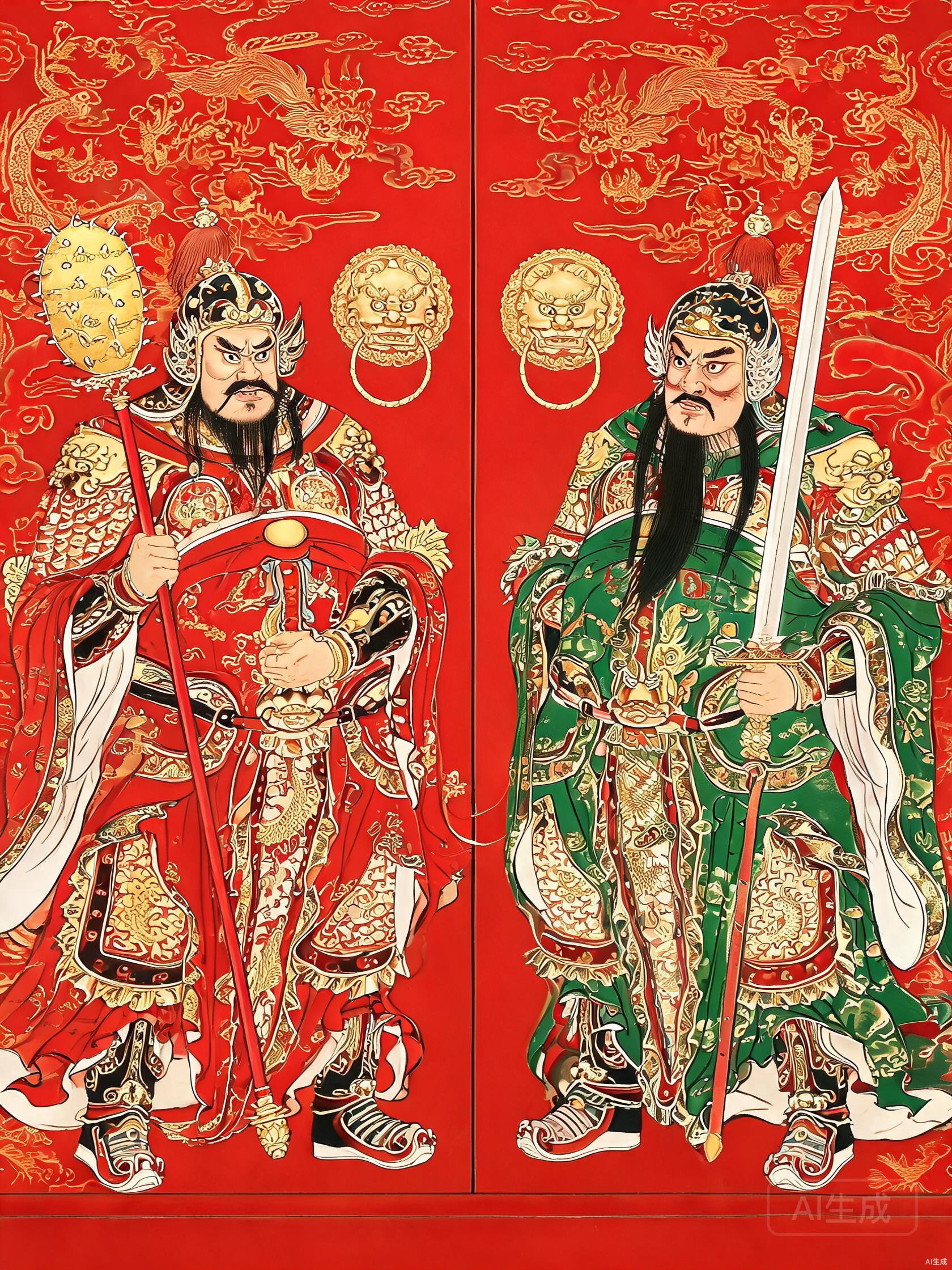
Door Gods (Menshen)
门神
The divine guardians pasted on doorways to protect the household from evil.
Origin Story
The Emperor's Sleepless Nights
The most popular origin story of the Door Gods involves Emperor Taizong of the Tang Dynasty. According to legend, the emperor was tormented by the ghost of a dragon king whose execution he had ordered. The ghost haunted the palace every night, causing the emperor terrible nightmares and preventing him from sleeping.
Two of his most trusted generals, Qin Shubao (also known as Qin Qiong) and Yuchi Gong (Yuchi Jingde), volunteered to stand guard outside the emperor's bedroom door all night. Their martial aura was so powerful that the ghost dared not approach, and the emperor slept peacefully. Night after night, the generals stood guard, until the emperor, moved by their loyalty, commissioned portraits of the two warriors to be pasted on the door — and the ghosts stayed away just as effectively.
This tale spread throughout the empire, and soon every household wanted the same protection. Qin Shubao and Yuchi Gong became the most popular Door Gods, their images pasted on doors across China. Over the centuries, other warrior figures were also adopted as Door Gods in different regions, but the Tang generals remain the most widely recognized.
Door Gods ([Menshen](/folklore/menshen)) are divine protectors whose images are pasted on the doors of Chinese homes, especially during the [Spring Festival](/symbols/spring-festival). Believed to be the first line of defense against evil spirits, these fearsome warriors have guarded Chinese doorways for over a thousand years, blending folk religion, military valor, and the art of woodblock printing.
Powers & Symbols
Attributes & Artefacts
Click each card to reveal the details behind Door Gods (Menshen)'s divine attributes.
Historical & Cultural Meaning
Beyond the Myth
Other Door Gods
While Qin Shubao and Yuchi Gong are the most common, many other figures serve as Door Gods in different regions and traditions. The mythological pair Shen Tu and Yu Lei, who in ancient legend guarded the gates of heaven and caught demons, are among the oldest Door Gods, predating the Tang Dynasty story.
In some regions, historical generals known for their bravery and righteousness — [Guan Yu](/folklore/guan-yu), Zhao Yun, Ma Chao — are used as Door Gods. The choice of Door God often reflects local traditions and family preferences. Some households pasted different Door Gods on different doors: warrior gods on the main entrance, literary gods on interior doors.
The images themselves are works of folk art. Traditionally produced by woodblock printing on red or pink paper, Door God images depict the warriors in full armor, with fierce expressions, brandishing weapons — swords, halberds, or maces. Some hold symbolic objects: a mirror to reflect evil, a peach branch for longevity, or a scroll bearing auspicious characters.
The Threshold as Sacred Space
The practice of pasting Door Gods reflects the Chinese understanding of the doorway as a liminal space — the threshold between the safe interior of the home and the dangerous exterior world. The door is where the family's protection begins, and the Door God is the guardian of this boundary.
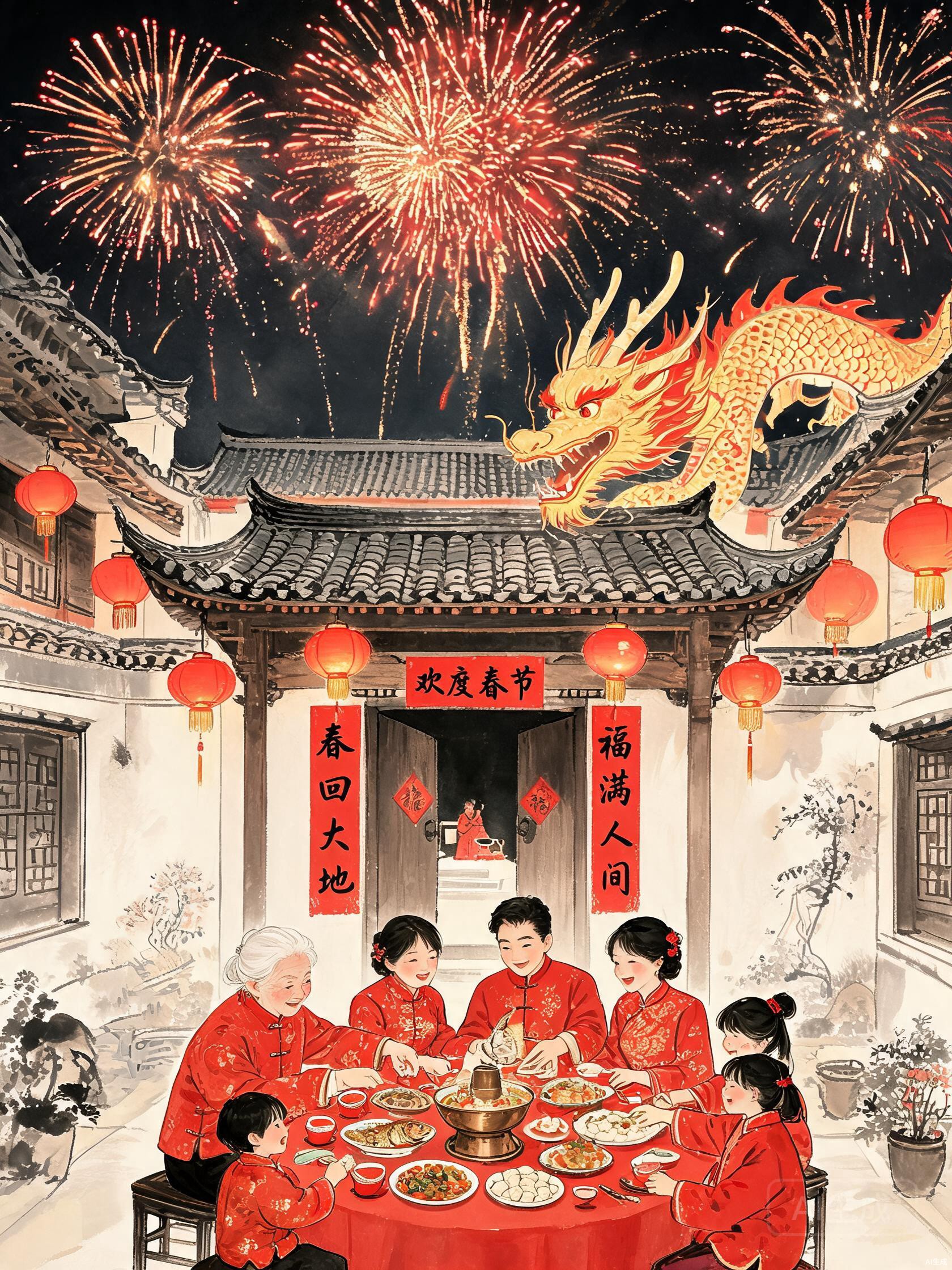
During the [Spring Festival](/folklore/spring-festival), old Door God images are removed and new ones pasted up, symbolizing renewal and the reaffirmation of the household's protective barriers. This ritual is part of the broader New Year custom of 'changing the peach charms' — an ancient practice of renewing protective talismans at the start of the year.
Today, while the religious significance has faded in urban areas, the cultural tradition persists. [Door God](/folklore/door-gods-custom) images remain popular in rural China and among overseas Chinese communities, and contemporary artists have reimagined them in modern styles. The Door God endures as a symbol of the Chinese desire to protect the home and family — a piece of ancient magic that still hangs on doorways in the twenty-first century.
Sources & References
Primary classical texts: Shanhaijing (山海经, Classic of Mountains and Seas, c. 4th-2nd century BCE) · Fengshen Yanyi (封神演义, Investiture of the Gods, c. 16th century) · Journey to the West (西游记, Xiyouji, c. 16th century) · Records of the Grand Historian (史记, Shiji, by Sima Qian, c. 91 BCE) · Classic of Mountains and Seas commentary (郭璞注 Shanhaijing, c. 4th century) · Bamboo Annals (竹书纪年, c. 4th century BCE onwards)
Classical translations: Legge, James (trans.). The Sacred Books of the East (1879-1910, 50 volumes covering Chinese classics) · Girardot, Norman J. Myth and Meaning in Early Taoism (University of California Press, 1983) · Werner, E.T.C. A Dictionary of Chinese Mythology (Shanghai: Kelly & Walsh, 1932)
Modern academic references: Birrell, Anne. Chinese Mythology: An Introduction (Baltimore: Johns Hopkins University Press, 1993) · Yang, Lihui, and Deming An. Handbook of Chinese Mythology (New York: Oxford University Press, 2005) · Strassberg, Richard E. A Chinese Bestiary: Strange Creatures from the Guideways Through Mountains and Seas (Berkeley: University of California Press, 2002)
Digital encyclopedias and online resources: Wikipedia — Chinese mythology portal (continuously updated, citations to primary sources) · Encyclopedia Britannica — Mythology and Religion section
Mythology Network
Connections & Relationships
Door Gods (Menshen) is woven into a larger web of gods, creatures, and legends. Explore the connections below.
Door Gods (Menshen)
门神

Explore the Topic
Door Gods (Menshen) in the Mythology Network
Go deeper — read the topic guides that gather every folk tradition like Door Gods (Menshen).