Double Ninth Festival
重阳节
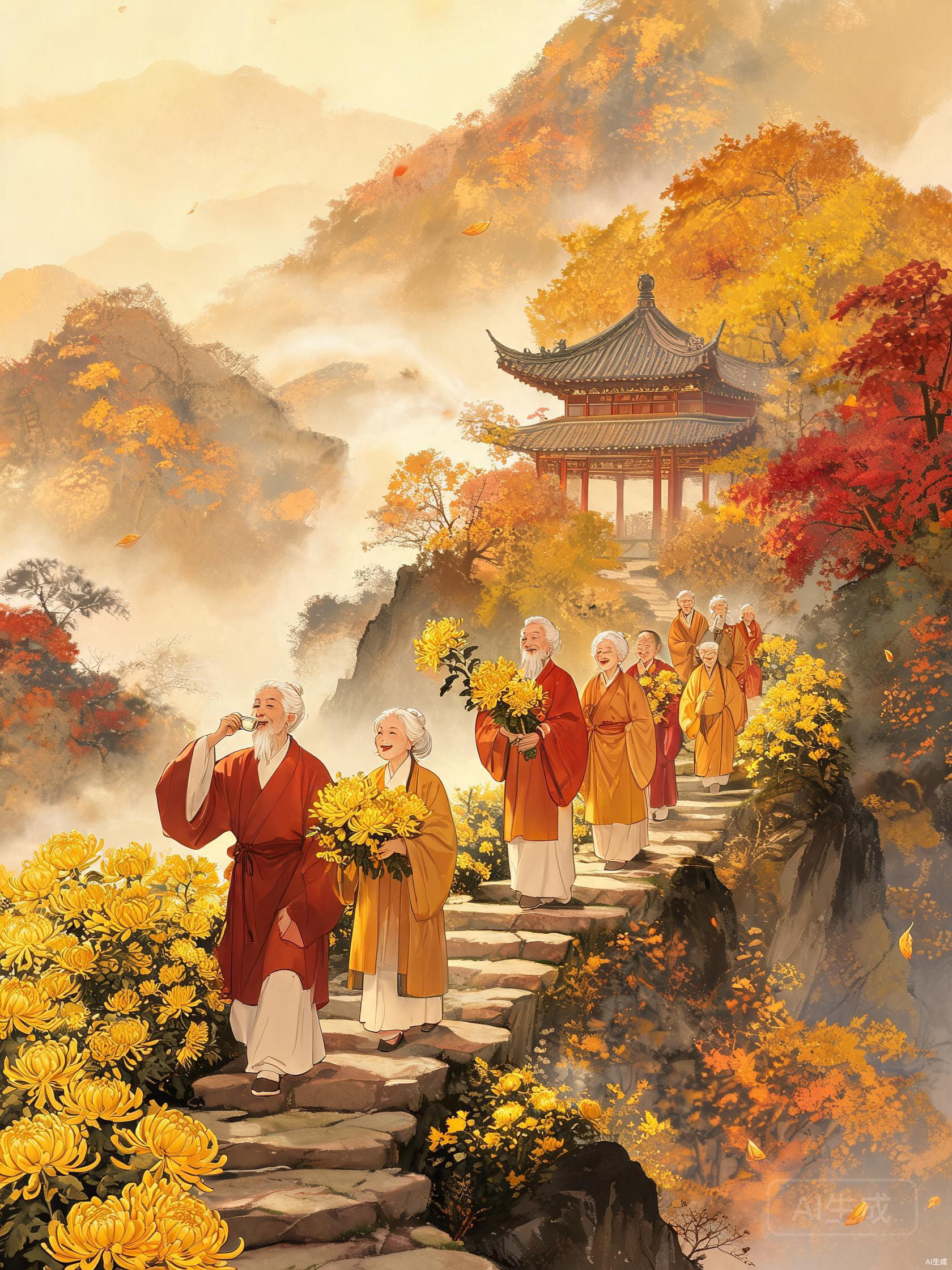
A festival of climbing high, drinking chrysanthemum wine, and honoring elders.
Origin Story
The Festival of Double Yang
In Chinese numerology, nine is the highest [yang](/symbols/yin-yang) (active, masculine) number. The 9th day of the 9th month represents a doubling of yang energy — hence the name '[Chongyang](/folklore/chongyang),' meaning 'double yang.' This excess of yang was considered potentially dangerous, and the festival's customs originated as protective measures.
According to a Han Dynasty text, a man named Huan Jing was warned by a Taoist that a disaster would strike his home on the 9th day of the 9th month. He was told to take his family to a high place, wear dogwood (zhuyu) leaves, and drink [chrysanthemum](/symbols/chrysanthemum) wine. He did so, and when they returned home, they found all their livestock dead — the disaster had claimed them instead of the family.
From this origin story came the traditions of climbing to high places (deng gao) and wearing dogwood on the Double Ninth Festival. The [moun](/symbols/wine)tain climbing also had a practical purpose — it was a way to enjoy the crisp autumn weather and spectacular foliage before the onset of winter.
The Double Ninth Festival, celebrated on the 9th day of the 9th lunar month, is a traditional autumn festival associated with climbing [mountain](/symbols/three-peaks)s, admiring chrysanthemums, and wearing dogwood. In modern times, it has been designated as Senior Citizens' Day, honoring the elderly.
Powers & Symbols
Attributes & Artefacts
Click each card to reveal the details behind Double Ninth Festival's divine attributes.
Historical & Cultural Meaning
Beyond the Myth
Chrysanthemums and Autumn
The chrysanthemum is the flower of the Double Ninth Festival. Unlike the peony (flower of spring and [wealth](/gods/caishen)) or the lotus (flower of summer and purity), the chrysanthemum blooms in autumn when other flowers have faded. It symbolizes resilience, longevity, and the ability to endure hardship.
Drinking chrysanthemum wine on this day is believed to promote health and long life. The wine is brewed in the previous year specifically for the festival — fresh chrysanthemums are steeped in rice wine and aged. The practice combines the flower's medicinal properties with ritual significance.
The great Tang Dynasty poet Wang Wei [immortal](/gods/buddha-shakyamuni)ized the festival in his famous poem 'Double Ninth, Remembering My Shandong Brothers': 'Alone, a stranger in a strange land, / I doubly miss my kinsfolk on this festival day. / I know my brothers climb the [moun](/symbols/nine)tain with dogwood, / But one is missing from their company.' The poem captures both the festival's joy and its melancholy of separation.
Honoring Elders
In 1989, the Chinese government designated the [Double Ninth](/folklore/double-ninth-festival) Festival as Senior Citizens' Day (Lao Ren Jie), giving new meaning to this ancient festival. The number nine (jiu) is a homophone for 'long-lasting' (jiu) in Chinese, making it an auspicious symbol of longevity.
On this day, families visit [elderly](/gods/shou-xing) relatives, give them gifts, and spend time together. Communities organize activities for seniors, and temples hold prayers for the health and longevity of the elderly. This modern adaptation demonstrates how traditional festivals can evolve while maintaining their cultural core.
The festival also carries associations with autumn harvest and the approach of winter. In agricultural communities, it was a time to take stock of the year's harvest, prepare for the cold months ahead, and give thanks for the bounty of the land.
Sources & References
Primary classical texts: Shanhaijing (山海经, Classic of Mountains and Seas, c. 4th-2nd century BCE) · Fengshen Yanyi (封神演义, Investiture of the Gods, c. 16th century) · Journey to the West (西游记, Xiyouji, c. 16th century) · Records of the Grand Historian (史记, Shiji, by Sima Qian, c. 91 BCE) · Classic of Mountains and Seas commentary (郭璞注 Shanhaijing, c. 4th century) · Bamboo Annals (竹书纪年, c. 4th century BCE onwards)
Classical translations: Legge, James (trans.). The Sacred Books of the East (1879-1910, 50 volumes covering Chinese classics) · Girardot, Norman J. Myth and Meaning in Early Taoism (University of California Press, 1983) · Werner, E.T.C. A Dictionary of Chinese Mythology (Shanghai: Kelly & Walsh, 1932)
Modern academic references: Birrell, Anne. Chinese Mythology: An Introduction (Baltimore: Johns Hopkins University Press, 1993) · Yang, Lihui, and Deming An. Handbook of Chinese Mythology (New York: Oxford University Press, 2005) · Strassberg, Richard E. A Chinese Bestiary: Strange Creatures from the Guideways Through Mountains and Seas (Berkeley: University of California Press, 2002)
Digital encyclopedias and online resources: Wikipedia — Chinese mythology portal (continuously updated, citations to primary sources) · Encyclopedia Britannica — Mythology and Religion section
Mythology Network
Connections & Relationships
Double Ninth Festival is woven into a larger web of gods, creatures, and legends. Explore the connections below.
Double Ninth Festival
重阳节
Explore the Topic
Double Ninth Festival in the Mythology Network
Go deeper — read the topic guides that gather every folk tradition like Double Ninth Festival.