Spirit Money (Joss Paper)
纸钱
The burning of spirit money that sends wealth and goods to the afterlife.
Origin Story
Sending Wealth to the Dead
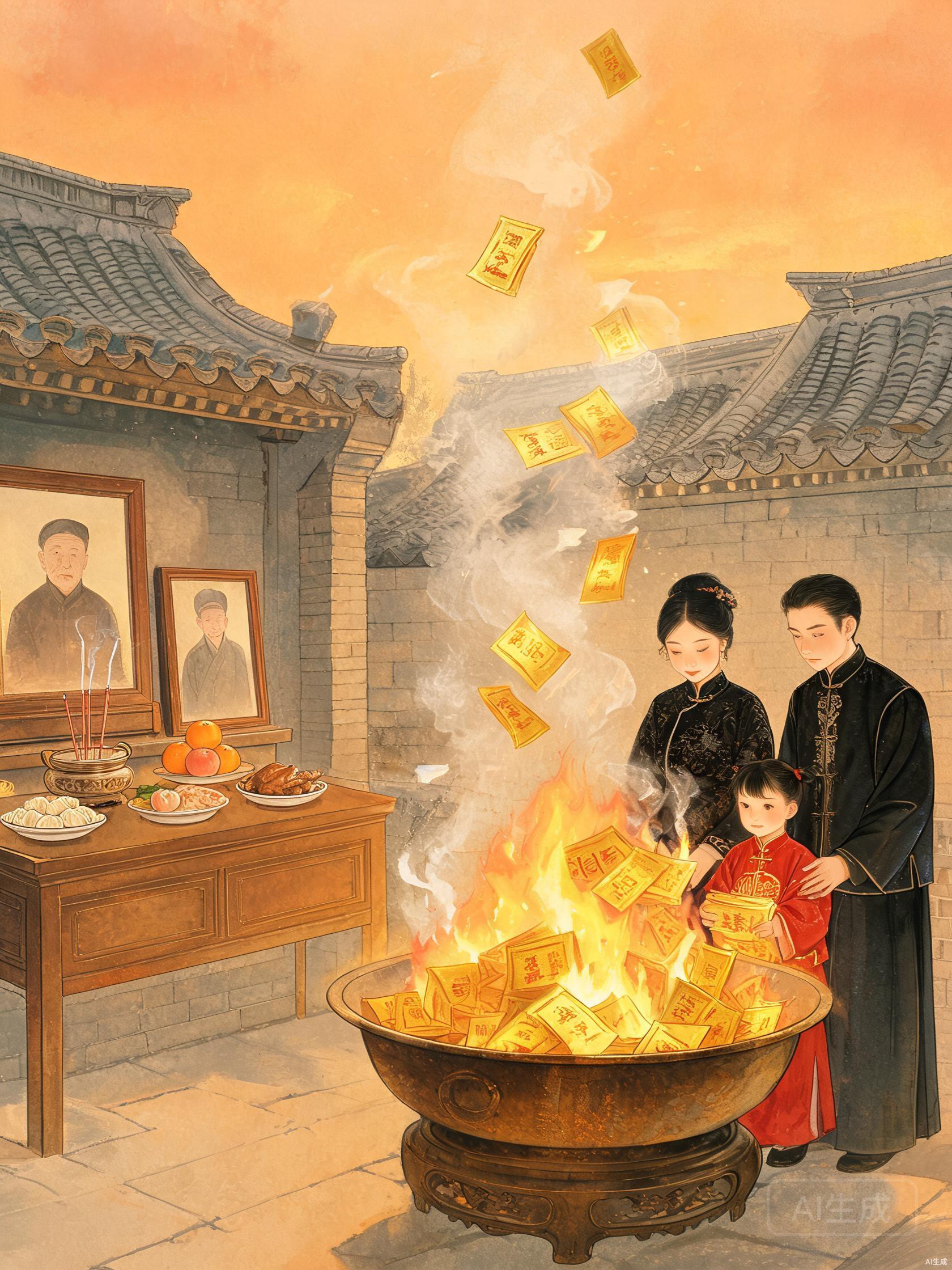
The practice of [burning](/folklore/qingming) spirit money rests on a fundamental Chinese belief: the afterlife is a mirror of the living world, and the dead have the same needs as the living — money, clothing, housing, and transportation. By burning paper representations of these goods, the living send them to the spirit world, where they become real and usable for the deceased.
The transformation occurs through fire. In Chinese cosmology, fire is the bridge between the material and spirit worlds — it consumes the physical form and releases the essence. What is [burne](/folklore/hungry-ghosts)d in the world of the living materializes in the world of the dead. This principle applies not only to money but to all paper offerings: paper houses become mansions, paper cars become real vehicles, paper clothing becomes wearable garments.
Different types of spirit money serve different purposes. [Gold](/gods/caishen) foil paper is burned for deities and gods. Silver foil paper is for [ancestor](/folklore/qingming)s and recently deceased family members. 'Hell money' — printed to resemble banknotes with enormous denominations (billions or trillions of dollars) — is burned for general spirits during the [Ghost Festival](/folklore/ghost-festival). The denomination reflects the belief that inflation exists in the afterlife just as it does on earth.
Spirit money (zhiqian), also known as joss paper or ghost money, is paper currency [burn](/folklore/qingming)ed as an offering to deceased ancestors and spirits. The Chinese believe that burning transforms the paper into spirit currency that the dead can use in the afterlife. This practice, spanning thousands of years, is one of the most enduring and widespread customs in Chinese folk religion.
Powers & Symbols
Attributes & Artefacts
Click each card to reveal the details behind Spirit Money (Joss Paper)'s divine attributes.
Historical & Cultural Meaning
Beyond the Myth
From Ancient Coins to Modern Goods
The tradition dates back over a thousand years. Originally, real coins and precious objects were buried with the dead — a practice dating to the Shang Dynasty (1600-1046 BCE). Over time, this evolved into burying clay replicas and then, by the [Tang Dynasty](/gods/tang-emperor), into burning paper substitutes — a more economical and accessible way to provide for the dead.
Today, the variety of paper offerings is staggering. Traditional paper money remains the most common, but specialized shops sell elaborate paper replicas of everything a modern person might need in the afterlife: paper iPhones, paper laptops, paper Mercedes-Benzes, paper mansions with working paper lights, paper designer handbags, and even paper credit cards.
During funerals, families may [burn an ](/folklore/qingming)entire paper house — sometimes life-sized — filled with paper furniture, appliances, and clothing, so the deceased will have a comfortable home in the afterlife. The more elaborate the offering, the greater the display of filial piety and the family's wish to provide for their loved one beyond the grave.
Ritual and Meaning
The act of burning spirit money is a ritual of connection. Families gather around the fire — whether at a graveside, a temple brazier, or a sidewalk offering — and feed the flames with paper while speaking to the deceased. They might say, 'Grandfather, here is some money for you. Buy yourself something nice.' The fire becomes a channel of communication, the smoke a messenger carrying words and gifts to the other side.
This practice is one of the most deeply felt expressions of Chinese filial piety. It affirms that the relationship between the living and the dead does not end with death — it continues through ritual, memory, and material care. The dead are not gone; they are simply in another place, and the living have the duty and privilege of providing for them.
In recent years, environmental concerns have led to some [change](/zodiac/change)s. Urban areas have restricted open burning, and some temples now offer electronic burning systems — digital flames that simulate the ritual without smoke. But the practice endures in modified forms because it addresses a human need that transcends practicality: the need to maintain a bond with those who have gone before.
Sources & References
Primary classical texts: Shanhaijing (山海经, Classic of Mountains and Seas, c. 4th-2nd century BCE) · Fengshen Yanyi (封神演义, Investiture of the Gods, c. 16th century) · Journey to the West (西游记, Xiyouji, c. 16th century) · Records of the Grand Historian (史记, Shiji, by Sima Qian, c. 91 BCE) · Classic of Mountains and Seas commentary (郭璞注 Shanhaijing, c. 4th century) · Bamboo Annals (竹书纪年, c. 4th century BCE onwards)
Classical translations: Legge, James (trans.). The Sacred Books of the East (1879-1910, 50 volumes covering Chinese classics) · Girardot, Norman J. Myth and Meaning in Early Taoism (University of California Press, 1983) · Werner, E.T.C. A Dictionary of Chinese Mythology (Shanghai: Kelly & Walsh, 1932)
Modern academic references: Birrell, Anne. Chinese Mythology: An Introduction (Baltimore: Johns Hopkins University Press, 1993) · Yang, Lihui, and Deming An. Handbook of Chinese Mythology (New York: Oxford University Press, 2005) · Strassberg, Richard E. A Chinese Bestiary: Strange Creatures from the Guideways Through Mountains and Seas (Berkeley: University of California Press, 2002)
Digital encyclopedias and online resources: Wikipedia — Chinese mythology portal (continuously updated, citations to primary sources) · Encyclopedia Britannica — Mythology and Religion section
Mythology Network
Connections & Relationships
Spirit Money (Joss Paper) is woven into a larger web of gods, creatures, and legends. Explore the connections below.
Spirit Money (Joss Paper)
纸钱
Explore the Topic
Spirit Money (Joss Paper) in the Mythology Network
Go deeper — read the topic guides that gather every folk tradition like Spirit Money (Joss Paper).