Qingming Festival (Tomb Sweeping Day)
清明节
The day when Chinese families honor their ancestors by tending to their graves.
Origin Story
Honoring the Ancestors
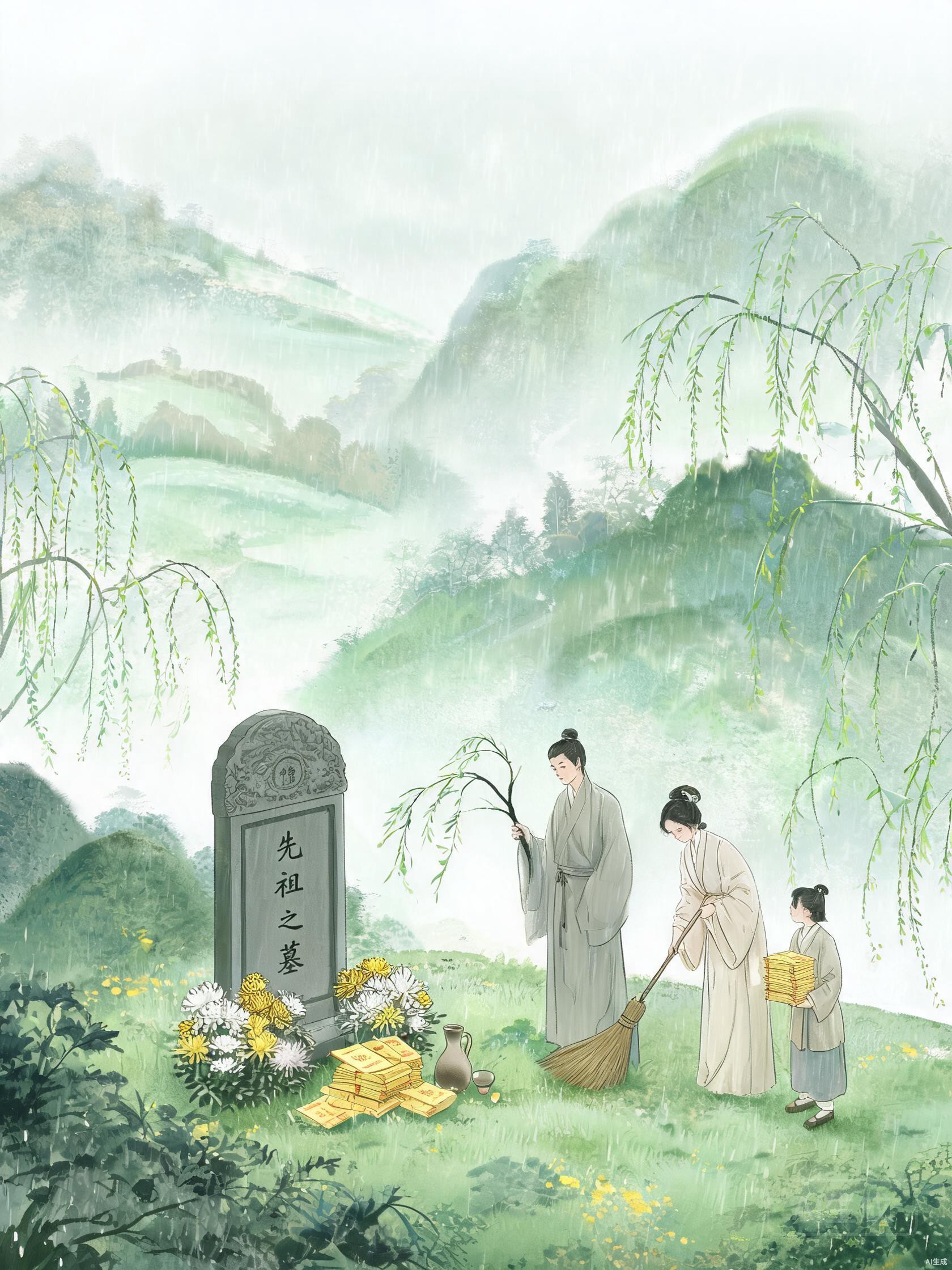
Qingming, meaning 'clear and bright,' is one of the 24 solar terms in the traditional Chinese calendar. It falls in early April, when spring is in full bloom. The festival is both a solemn duty and a celebration of life — families clean ancestral graves, offer food and wine, burn spirit money for the deceased to use in the afterlife, and bow in respect.
The practice of tomb sweeping embodies the Confucian virtue of filial piety (xiao), which extends beyond death. By tending to ancestors' graves, the living demonstrate that their love and respect continue even after death. The offerings of food — typically the deceased's favorite dishes — symbolize the ongoing relationship between the living and the dead.
Families also burn paper money (jisi zhi) and paper replicas of modern goods — houses, cars, phones — believing these will reach their ancestors in the spirit world and improve their afterlife. This practice reflects the Chinese view that death is not an end but a transition to another form of existence.
The Qingming Festival, or [Tomb Sweeping](/folklore/tomb-sweeping) Day, is a solemn occasion when Chinese families visit the graves of their ancestors to clean the tombstones, offer food and incense, and burn spirit money. It is a profound expression of filial piety that bridges the living and the dead.
Powers & Symbols
Attributes & Artefacts
Click each card to reveal the details behind Qingming Festival (Tomb Sweeping Day)'s divine attributes.
Historical & Cultural Meaning
Beyond the Myth
The Legend of Jie Zitui
The Qingming Festival is historically linked to the story of [Jie Zitui](/folklore/jie-zitui), a loyal minister of Duke Wen of Jin during the Spring and Autumn Period. When the duke was in exile, Jie once cut flesh from his own thigh to feed his starving lord. Years later, when the duke regained power and rewarded his followers, Jie refused all honors and retreated to Mount Mian with his mother.
The duke, wanting to force Jie out, ordered the mountain set ablaze. But Jie refused to emerge and perished in the fire with his mother. Overcome with remorse, the duke established the [Hanshi](/folklore/hanshi-festival) (Cold Food) Festival — a day when no fires were allowed — to commemorate Jie's sacrifice. The following day became Qingming, when fires were relit and life resumed.
The tale of [Jie Zitui](/folklore/jie-zitui) exemplifies the Chinese cultural values of loyalty, integrity, and the refusal to seek reward for righteous deeds. Though the [Cold Food](/folklore/cold-food-festival) Festival has largely faded, its spirit lives on in the solemnity of Qingming.
Spring Outings and Qingtuan
Beyond tomb sweeping, Qingming is also a time for spring outings (taqing — 'treading the green'). As the weather warms and flowers bloom, families take to the countryside to fly kites, plant trees, and enjoy the return of spring. This duality of mourning and celebration reflects the Chinese philosophical balance of yin and yang.
The festival's signature food is qingtuan — bright green glutinous rice balls colored with mugwort or barley grass juice and filled with sweet red bean paste. The green color represents the vitality of spring, and the round shape symbolizes family unity. Qingtuan is especially popular in the Jiangnan region.
Kite flying during [Qingming](/folklore/qingming-festival) has special significance: people write their troubles on kites and then cut the string, letting the kite carry away bad luck and misfortune. It is a ritual of cleansing and renewal, matching the spirit of the season.
Sources & References
Primary classical texts: Shanhaijing (山海经, Classic of Mountains and Seas, c. 4th-2nd century BCE) · Fengshen Yanyi (封神演义, Investiture of the Gods, c. 16th century) · Journey to the West (西游记, Xiyouji, c. 16th century) · Records of the Grand Historian (史记, Shiji, by Sima Qian, c. 91 BCE) · Classic of Mountains and Seas commentary (郭璞注 Shanhaijing, c. 4th century) · Bamboo Annals (竹书纪年, c. 4th century BCE onwards)
Classical translations: Legge, James (trans.). The Sacred Books of the East (1879-1910, 50 volumes covering Chinese classics) · Girardot, Norman J. Myth and Meaning in Early Taoism (University of California Press, 1983) · Werner, E.T.C. A Dictionary of Chinese Mythology (Shanghai: Kelly & Walsh, 1932)
Modern academic references: Birrell, Anne. Chinese Mythology: An Introduction (Baltimore: Johns Hopkins University Press, 1993) · Yang, Lihui, and Deming An. Handbook of Chinese Mythology (New York: Oxford University Press, 2005) · Strassberg, Richard E. A Chinese Bestiary: Strange Creatures from the Guideways Through Mountains and Seas (Berkeley: University of California Press, 2002)
Digital encyclopedias and online resources: Wikipedia — Chinese mythology portal (continuously updated, citations to primary sources) · Encyclopedia Britannica — Mythology and Religion section
Mythology Network
Connections & Relationships
Qingming Festival (Tomb Sweeping Day) is woven into a larger web of gods, creatures, and legends. Explore the connections below.
Qingming Festival (Tomb Sweeping Day)
清明节
Explore the Topic
Qingming Festival (Tomb Sweeping Day) in the Mythology Network
Go deeper — read the topic guides that gather every folk tradition like Qingming Festival (Tomb Sweeping Day).