Hungry Ghosts
饿鬼
Restless spirits cursed with insatiable hunger and impossible thirst.
Origin Story
The Anatomy of a Hungry Ghost
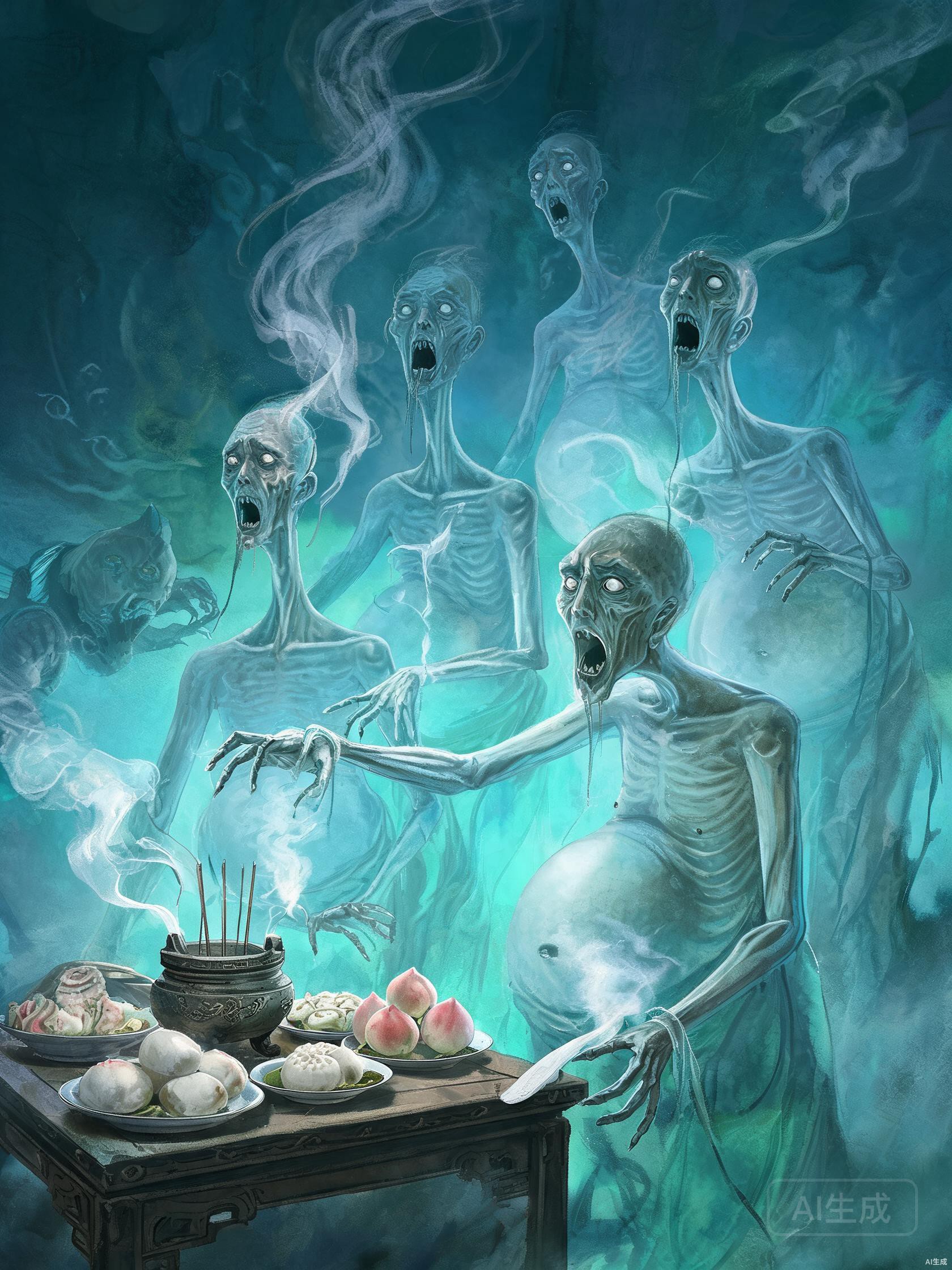
In Buddhist cosmology, which deeply influenced Chinese folk belief, [hungry](/folklore/meng-po) ghosts (preta) inhabit one of the Six Realms of Rebirth. Their appearance is a visceral metaphor for their condition: they have massive, swollen bellies that cry out for sustenance, but only pinhole-sized mouths and threadlike necks through which almost nothing can pass.
Some [hungry gh](/gods/guanyin)osts can eat, but the food bursts into flames the moment it touches their lips. Others can consume food, but it turns to ash or excrement in their mouths. Some can smell food but never reach it. The specific torment varies, but the essence is always the same: eternal desire without satisfaction.
These grotesque forms are not arbitrary punishments but karmic consequences. A person who hoarded [wealth](/gods/caishen) and refused to share in life may be reborn as a [hungry g](/folklore/qingming)host, experiencing firsthand the torment of never having enough. The hungry ghost is thus a moral warning — a mirror reflecting the consequences of greed and attachment.
Hungry ghosts (egui) are among the most pitiable beings in Chinese folklore — spirits who, due to their karma in life, are cursed with enormous bellies they can never fill and tiny mouths they can barely feed through. They represent the fate of those consumed by greed, desire, or who died without proper rites.
Powers & Symbols
Attributes & Artefacts
Click each card to reveal the details behind Hungry Ghosts's divine attributes.
Historical & Cultural Meaning
Beyond the Myth
Ghosts Without Descendants
In Chinese folk religion, the most common category of [hungry gh](/folklore/paper-money-offerings)osts is 'wild ghosts' (ye gui) — spirits who have no living descendants to perform ancestral rites for them. In a culture where ongoing remembrance is essential for a soul's peace, having no one to burn incense or offer food is a terrible fate.
These include those who died without children, those whose family lines died out, those who died far from home and were never properly buried, and those who died violently or unjustly. Without proper funeral rites and ongoing veneration, they cannot rest and become restless, potentially dangerous spirits.
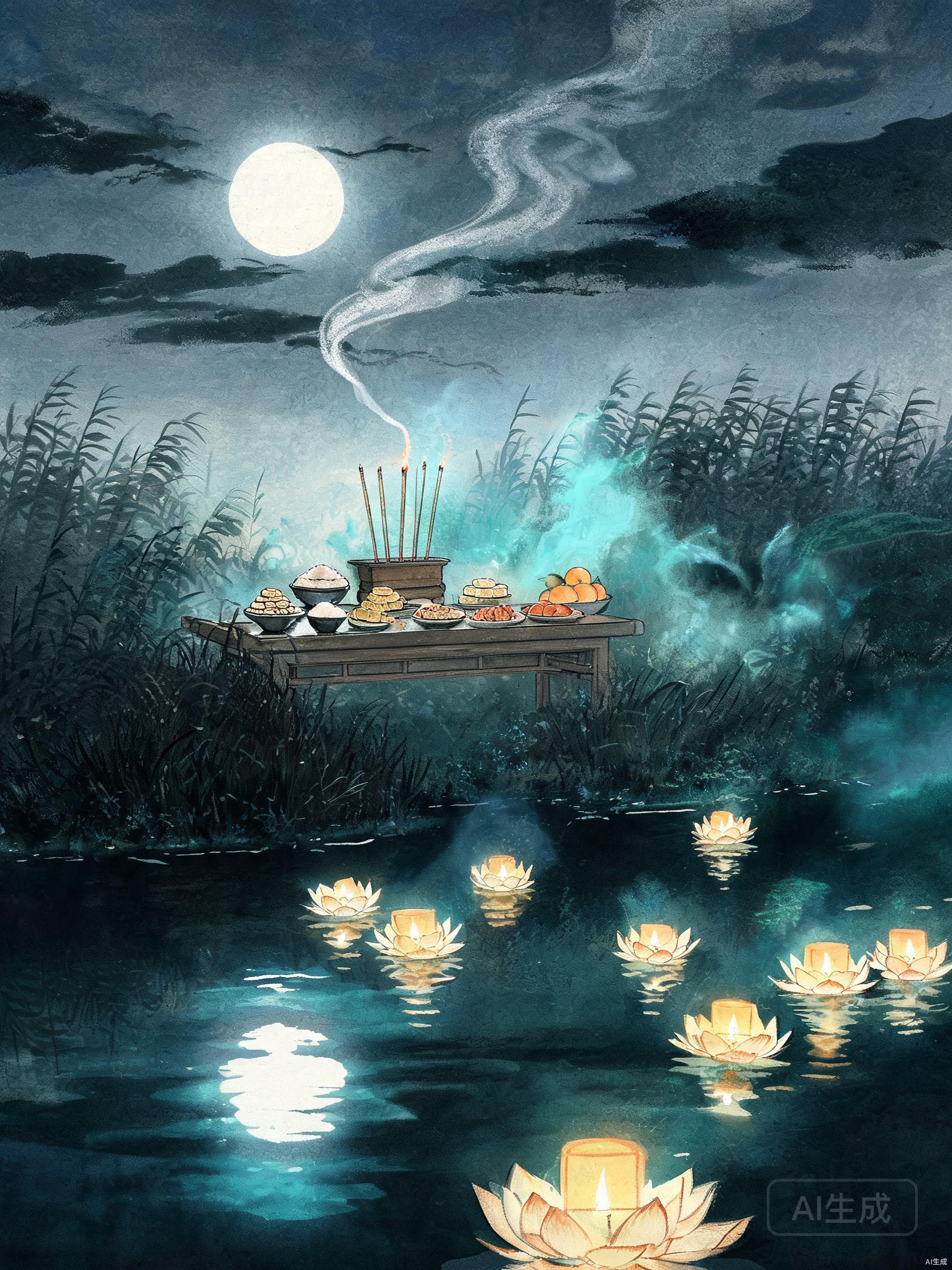
This belief drives the practice of offering food and burning paper money during the [Ghost Festival](/folklore/ghost-festival) not just for one's own ancestors, but for all hungry ghosts. It is an act of compassion that extends filial piety beyond bloodlines — caring even for those who have no one to care for them.
Placating the Restless
Hungry ghosts are not inherently malevolent, but their suffering can make them dangerous. A hungry ghost that feels neglected may cause illness, bad luck, or mischief in a household. To prevent this, families set out small offerings of food at the doorstep or roadside — typically plain rice, water, or simple dishes — during Ghost Month.
Taoist and Buddhist temples hold elaborate ceremonies during the seventh lunar month to feed hungry ghosts and guide them toward better rebirths. Monks and priests chant sutras, offer food on special altars, and perform the 'releasing of flaming mouths' (fang yankou) ritual, which is specifically designed to relieve the suffering of hungry ghosts.
These rituals reflect a deeply compassionate dimension of Chinese folk religion. The hungry ghost is not a monster to be feared and destroyed, but a suffering being to be pitied and helped. Even the lowest, most wretched spirit deserves compassion — a principle that echoes the Confucian ideal of benevolence extended even to the dead.
Sources & References
Primary classical texts: Shanhaijing (山海经, Classic of Mountains and Seas, c. 4th-2nd century BCE) · Fengshen Yanyi (封神演义, Investiture of the Gods, c. 16th century) · Journey to the West (西游记, Xiyouji, c. 16th century) · Records of the Grand Historian (史记, Shiji, by Sima Qian, c. 91 BCE) · Classic of Mountains and Seas commentary (郭璞注 Shanhaijing, c. 4th century) · Bamboo Annals (竹书纪年, c. 4th century BCE onwards)
Classical translations: Legge, James (trans.). The Sacred Books of the East (1879-1910, 50 volumes covering Chinese classics) · Girardot, Norman J. Myth and Meaning in Early Taoism (University of California Press, 1983) · Werner, E.T.C. A Dictionary of Chinese Mythology (Shanghai: Kelly & Walsh, 1932)
Modern academic references: Birrell, Anne. Chinese Mythology: An Introduction (Baltimore: Johns Hopkins University Press, 1993) · Yang, Lihui, and Deming An. Handbook of Chinese Mythology (New York: Oxford University Press, 2005) · Strassberg, Richard E. A Chinese Bestiary: Strange Creatures from the Guideways Through Mountains and Seas (Berkeley: University of California Press, 2002)
Digital encyclopedias and online resources: Wikipedia — Chinese mythology portal (continuously updated, citations to primary sources) · Encyclopedia Britannica — Mythology and Religion section
Mythology Network
Connections & Relationships
Hungry Ghosts is woven into a larger web of gods, creatures, and legends. Explore the connections below.
Hungry Ghosts
饿鬼
Explore the Topic
Hungry Ghosts in the Mythology Network
Go deeper — read the topic guides that gather every folk tradition like Hungry Ghosts.